Department of Chemistry, Indiana University, 800 East Kirkwood Avenue, Bloomington, IN, 47405, USA.
Angew Chem Int Ed Engl. 2019 Aug 19;58(34):11704-11708. doi: 10.1002/anie.201905247. Epub 2019 Jul 11.
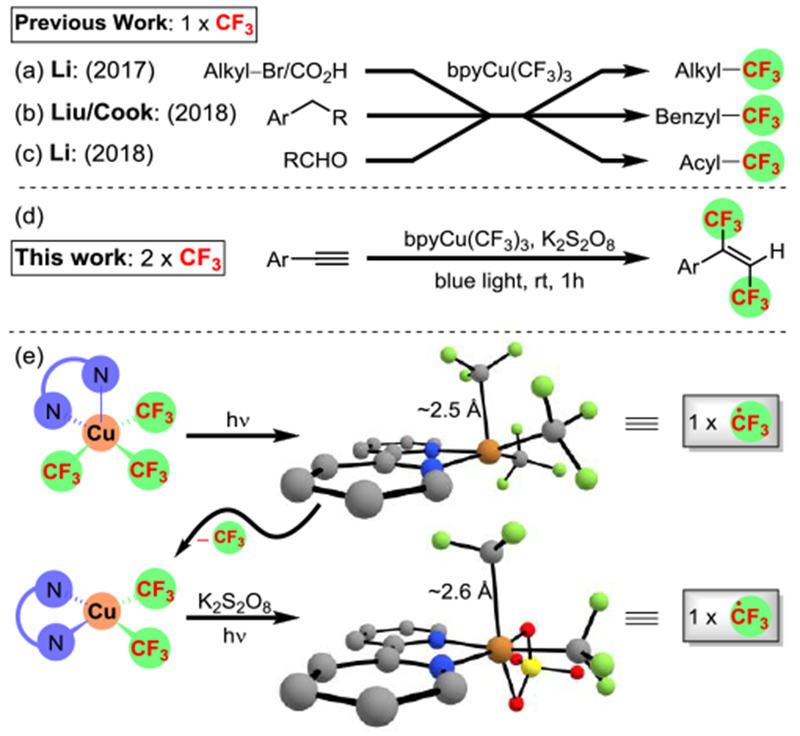
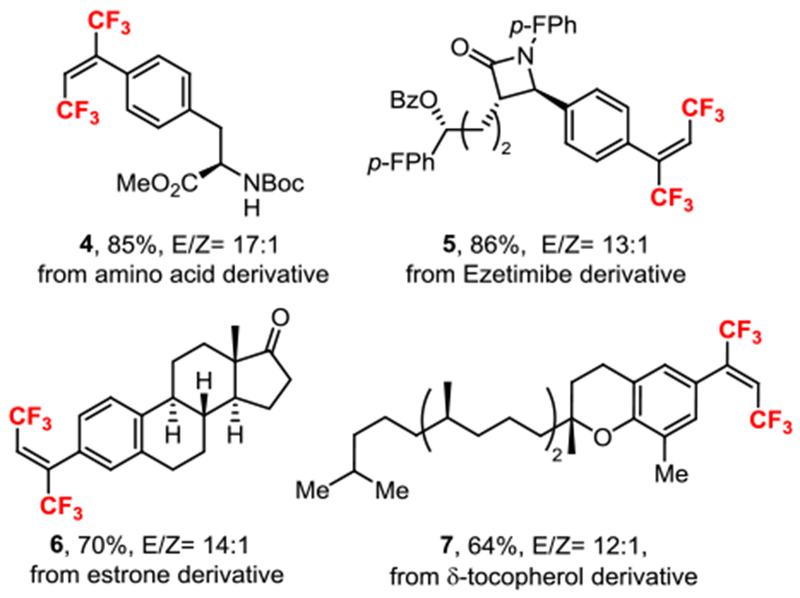
Modifying the electronic properties of olefins is the quintessential approach to tuning alkene reactivity. In this context, the exploration of trifluoromethyl groups as divergent electronic modifiers has not been considered. In this work, we describe a copper-mediated 1,2-(bis)trifluoromethylation of acetylenes to create E-hexafluorobutenes (E-HFBs) under blue light in a single step. The reaction proceeds with high yield and E/Z selectivity. Since the alkyne captures two trifluoromethyl groups from each molecule of bpyCu(CF ) , mechanistic studies were conducted to illuminate the role of the reactants. Interestingly, E-HFBs exhibit remarkable stability to standard olefin functionalization reactions in spite of the pendant trifluoromethyl groups. This finding has significant implications for medicine, agroscience, and materials.
修饰烯烃的电子性质是调节烯烃反应性的关键方法。在这种情况下,尚未考虑将三氟甲基基团作为不同的电子修饰剂进行探索。在这项工作中,我们描述了铜介导的炔烃的 1,2-(双)三氟甲基化,在蓝光下一步即可生成 E-六氟丁烯(E-HFBs)。该反应具有高产率和 E/Z 选择性。由于炔烃从每个 bpyCu(CF ) 分子中捕获两个三氟甲基基团,因此进行了机理研究以阐明反应物的作用。有趣的是,尽管存在侧挂的三氟甲基基团,E-HFBs 对标准烯烃官能化反应表现出显著的稳定性。这一发现对医学、农业科学和材料科学具有重要意义。