Department of Preventive Medicine, University of Southern California, Keck School of Medicine, 2001 N. Soto Street, Room 302B, Los Angeles, CA, USA.
Department of Preventive Medicine, University of Southern California, Keck School of Medicine, 2001 N. Soto Street, Room 302B, Los Angeles, CA, USA.
Drug Alcohol Depend. 2019 Aug 1;201:109-114. doi: 10.1016/j.drugalcdep.2019.04.018. Epub 2019 Jun 8.
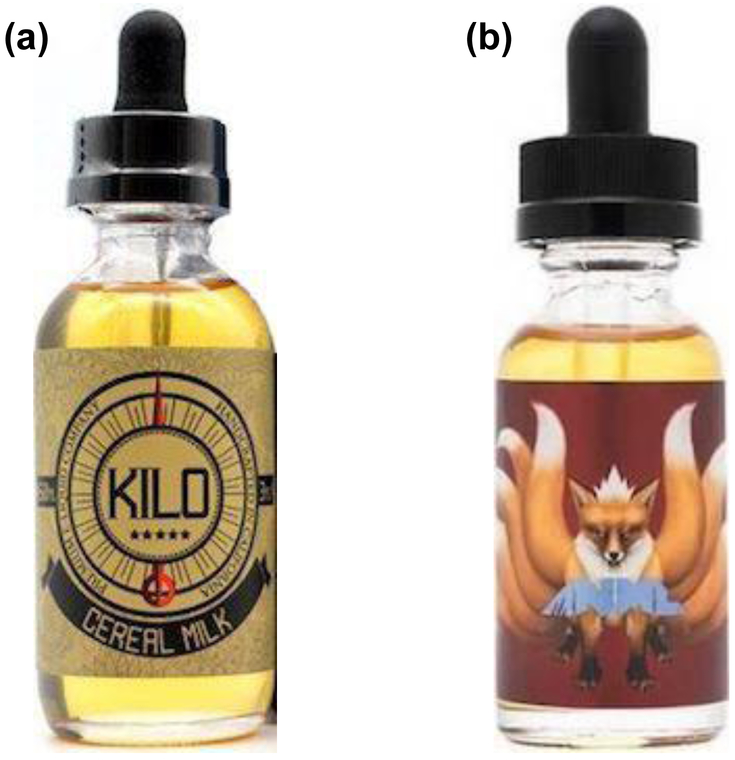
Manufacturers of e-cigarette-related products are using cartoons as a marketing strategy, despite restrictions on cartoon marketing for combustible cigarettes. Here, we examined associations between exposure to e-liquid packaging with cartoons (operationally defined as recognition of actual marketing images) and e-cigarette use, susceptibility to use, and expectations of benefits and risks of use.
U.S. adults completed online surveys assessing e-cigarette use. In Study 1, participants (N = 778; Mean age = 23.5 years; 62% women) completed a questionnaire assessing expectations about benefits and risks of use. Then they were presented with 22 e-liquid package images (with and without cartoons) and were asked to endorse whether they recognized the products. In Study 2, participants (N = 522; Mean age = 30.4; 55% women) were presented with 24 e-liquid images (with and without cartoons) and asked to rate product appeal.
For Study 1, among never users, cartoon recognition was associated with greater likelihood of being susceptible to use e-cigarettes, and with expectations of taste enjoyment and social facilitation. For Study 2, there was no significant difference between cartoon and non-cartoon images on appeal ratings.
Cartoon-based marketing exposure - as measured by recognition of e-liquid package images - was associated with susceptibility to use e-cigarettes, which is consistent with previous research on the use of cartoons to promote combustible cigarettes. These data suggest that restrictions on the use of cartoon-based marketing strategies for e-cigarettes should be similar to those for cigarettes, to reduce susceptibility and perceived benefits among non-users.
电子烟相关产品制造商正在使用卡通形象作为营销策略,尽管对可燃香烟的卡通营销有限制。在这里,我们研究了暴露于带有卡通形象的电子烟烟油包装(操作上定义为识别实际营销图像)与电子烟使用、使用易感性以及对使用益处和风险的期望之间的关联。
美国成年人完成了在线调查,评估电子烟的使用情况。在研究 1 中,参与者(N=778;平均年龄 23.5 岁;62%为女性)完成了一份评估使用益处和风险期望的问卷。然后,他们被展示了 22 个电子烟烟油包装图像(有卡通和无卡通),并被要求认可他们是否识别出这些产品。在研究 2 中,参与者(N=522;平均年龄 30.4;55%为女性)被展示了 24 个电子烟烟油图像(有卡通和无卡通),并被要求对产品吸引力进行评分。
对于研究 1,在从未使用者中,对卡通形象的识别与更有可能对使用电子烟产生易感性有关,并且与对口感享受和社交促进的期望有关。对于研究 2,在吸引力评分方面,卡通和非卡通图像之间没有显著差异。
通过对电子烟烟油包装图像的识别来衡量的基于卡通形象的营销暴露与使用电子烟的易感性有关,这与之前关于使用卡通形象来推广可燃香烟的研究一致。这些数据表明,对电子烟使用卡通化营销策略的限制应与对香烟的限制类似,以减少非使用者的易感性和感知益处。