
虾青素复合物可减轻体内股动脉缺血再灌注后肌肉损伤。
Astaxanthin Complexes to Attenuate Muscle Damage after In Vivo Femoral Ischemia-Reperfusion.
机构信息
INSERM U1148, Laboratory for Vascular Translational Science, Cardiovascular Bioengineering, Université Paris 13, Av. Jean-Baptiste Clément 93430 Villetaneuse France/ CHU X. Bichat, 46 rue H. Huchard, 75018 Paris, France.
Pathology Department, Bichat Hospital, AP-HP, 46 rue H. Huchard, 75018 Paris, France.
出版信息
Mar Drugs. 2019 Jun 14;17(6):354. doi: 10.3390/md17060354.
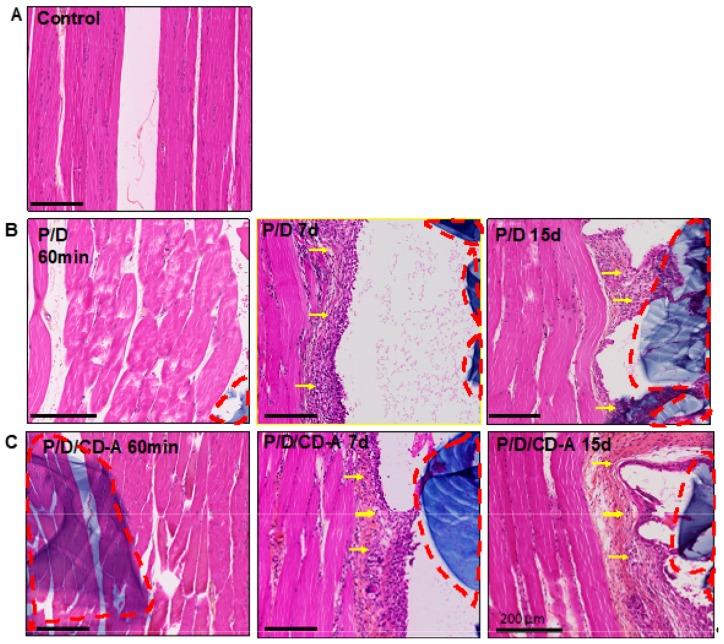
(1) Background: Reperfusion injury refers to the cell and tissue damage induced, when blood flow is restored after an ischemic period. While reperfusion reestablishes oxygen supply, it generates a high concentration of radicals, resulting in tissue dysfunction and damage. Here, we aimed to challenge and achieve the potential of a delivery system based on astaxanthin, a natural antioxidant, in attenuating the muscle damage in an animal model of femoral hind-limb ischemia and reperfusion. (2) Methods: The antioxidant capacity and non-toxicity of astaxanthin was validated before and after loading into a polysaccharide scaffold. The capacity of astaxanthin to compensate stress damages was also studied after ischemia induced by femoral artery clamping and followed by varied periods of reperfusion. (3) Results: Histological evaluation showed a positive labeling for CD68 and CD163 macrophage markers, indicating a remodeling process. In addition, higher levels of Nrf2 and NQO1 expression in the sham group compared to the antioxidant group could reflect a reduction of the oxidative damage after 15 days of reperfusion. Furthermore, non-significant differences were observed in non-heme iron deposition in both groups, reflecting a cell population susceptible to free radical damage. (4) Conclusions: Our results suggest that the in situ release of an antioxidant molecule could be effective in improving the antioxidant defenses of ischemia/reperfusion (I/R)-damaged muscles.
(1) 背景:再灌注损伤是指在缺血期后血流恢复时引起的细胞和组织损伤。虽然再灌注恢复了氧的供应,但它会产生高浓度的自由基,导致组织功能障碍和损伤。在这里,我们旨在挑战并实现基于虾青素的递送系统的潜力,虾青素是一种天然抗氧化剂,可减轻动物股后肢缺血再灌注模型中的肌肉损伤。
(2) 方法:在将虾青素加载到多糖支架之前和之后,验证了虾青素的抗氧化能力和非毒性。还研究了虾青素在股动脉夹闭诱导缺血后,经过不同时间的再灌注后,补偿应激损伤的能力。
(3) 结果:组织学评估显示 CD68 和 CD163 巨噬细胞标记物的阳性标记,表明存在重塑过程。此外,与抗氧化剂组相比,假手术组中 Nrf2 和 NQO1 表达水平更高,这可能反映了再灌注 15 天后氧化损伤的减少。此外,两组中非血红素铁沉积无显著差异,反映了易受自由基损伤的细胞群体。
(4) 结论:我们的结果表明,抗氧化分子的原位释放可能有效改善缺血/再灌注(I/R)损伤肌肉的抗氧化防御能力。



 Zotero 插件