
通过沉默内源性 TCR 靶向黑色素瘤相关抗原-A4 的 T 细胞受体基因治疗抑制小鼠和人体内的肿瘤生长。
T-cell receptor gene therapy targeting melanoma-associated antigen-A4 by silencing of endogenous TCR inhibits tumor growth in mice and human.
机构信息
Department of Immunology, Key Laboratory of Cancer Immunology and Biotherapy, Key Laboratory of Cancer Prevention and Therapy, Tianjin's Clinical Research Center for Cancer, Tianjin Medical University Cancer Institute and Hospital, Tianjin, China.
Department of Radiology, Key Laboratory of Cancer Prevention and Therapy, Tianjin's Clinical Research Center for Cancer, Tianjin Medical University Cancer Institute and Hospital, Tianjin, China.
出版信息
Cell Death Dis. 2019 Jun 17;10(7):475. doi: 10.1038/s41419-019-1717-8.
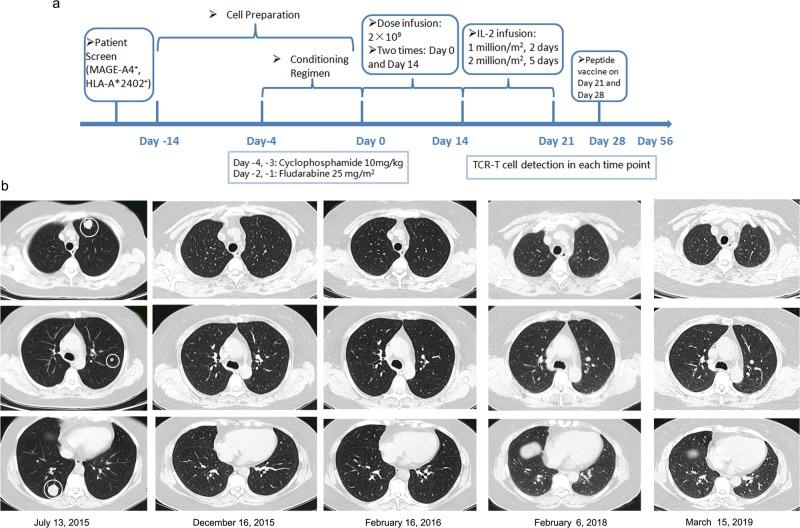
Genetically engineered T cells expressing a T-cell receptor (TCR) are powerful tools for cancer treatment and have shown significant clinical effects in sarcoma patients. However, mismatch of the introduced TCR α/β chains with endogenous TCR may impair the expression of transduced TCR, resulting in an insufficient antitumor capacity of modified T cells. Here, we report the development of immunotherapy using human lymphocytes transduced with a codon-optimized melanoma-associated antigen (MAGE)-A4 and HLA-A2402-restricted TCR, which specifically downregulate endogenous TCR by small interfering RNA (si-TCR). We evaluated the efficacy of this immunotherapy in both NOD-SCID mice and uterine leiomyosarcoma patients. Our results revealed that transduced human lymphocytes exhibited high surface expression of the introduced tumor-specific TCR, enhanced cytotoxic activity against antigen-expressing tumor cells, and increased interferon-γ production by specific MAGE-A4 peptide stimulation. Retarded tumor growth was also observed in NOD-SCID mice inoculated with human tumor cell lines expressing both MAGE-A4 and HLA-A2402. Furthermore, we report the successful management of a case of uterine leiomyosarcoma treated with MAGE-A4 si-TCR/HLA-A*2402 gene-modified T cells. Our results indicate that the TCR-modified T cell therapy is a promising novel strategy for cancer treatment.
表达 T 细胞受体(TCR)的基因工程 T 细胞是癌症治疗的有力工具,在肉瘤患者中显示出显著的临床效果。然而,引入的 TCRα/β 链与内源性 TCR 的不匹配可能会损害转导 TCR 的表达,从而导致修饰 T 细胞的抗肿瘤能力不足。在这里,我们报告了使用转导了密码子优化的黑色素瘤相关抗原(MAGE)-A4 和 HLA-A2402 限制性 TCR 的人淋巴细胞进行免疫治疗的开发,该 TCR 通过小干扰 RNA(si-TCR)特异性地下调内源性 TCR。我们在 NOD-SCID 小鼠和子宫平滑肌肉瘤患者中评估了这种免疫疗法的疗效。我们的结果表明,转导的人淋巴细胞表现出高水平的表面表达引入的肿瘤特异性 TCR,增强了对表达抗原的肿瘤细胞的细胞毒性活性,并增加了特异性 MAGE-A4 肽刺激产生的干扰素-γ。在接种表达 MAGE-A4 和 HLA-A2402 的人肿瘤细胞系的 NOD-SCID 小鼠中也观察到肿瘤生长减缓。此外,我们报告了成功管理一例用 MAGE-A4 si-TCR/HLA-A*2402 基因修饰 T 细胞治疗的子宫平滑肌肉瘤病例。我们的结果表明,TCR 修饰的 T 细胞疗法是一种有前途的癌症治疗新策略。


 Zotero 插件