Zhang Wenyu, Feng Yanling, Guo Qiqiang, Guo Wendong, Xu Hongde, Li Xiaoman, Yi Fei, Guan Yi, Geng Nanxi, Wang Pingyuan, Cao Longyue, O'Rourke Brian P, Jo Juhyeon, Kwon Jiyun, Wang Ruihong, Song Xiaoyu, Lee In Hye, Cao Liu
Institute of Translational Medicine, Key Laboratory of Cell Biology of Ministry of Public Health, and Key Laboratory of Medical Cell Biology of Ministry of Education, Liaoning Province Collaborative Innovation Center of Aging Related Disease Diagnosis and Treatment and Prevention, China Medical University, No. 77, Puhe Road, Shenyang North New Area, Shenyang, 110122, Liaoning, China.
Department of Cell Biology, Key Laboratory of Cell Biology of Ministry of Public Health, and Key Laboratory of Medical Cell Biology of Ministry of Education, China Medical University, No. 77, Puhe Road, Shenyang North New Area, Shenyang, 110122, Liaoning, China.
Cell Death Differ. 2020 Feb;27(2):482-496. doi: 10.1038/s41418-019-0369-7. Epub 2019 Jun 17.
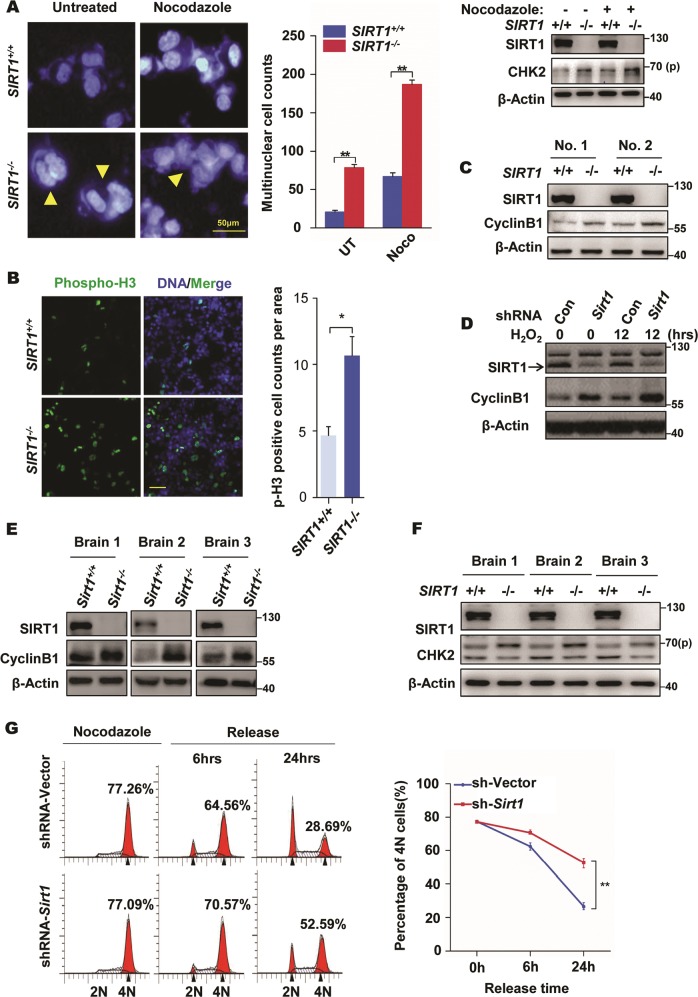
Both the stress-response protein, SIRT1, and the cell cycle checkpoint kinase, CHK2, play critical roles in aging and cancer via the modulation of cellular homeostasis and the maintenance of genomic integrity. However, the underlying mechanism linking the two pathways remains elusive. Here, we show that SIRT1 functions as a modifier of CHK2 in cell cycle control. Specifically, SIRT1 interacts with CHK2 and deacetylates it at lysine 520 residue, which suppresses CHK2 phosphorylation, dimerization, and thus activation. SIRT1 depletion induces CHK2 hyperactivation-mediated cell cycle arrest and subsequent cell death. In vivo, genetic deletion of Chk2 rescues the neonatal lethality of Sirt1 mice, consistent with the role of SIRT1 in preventing CHK2 hyperactivation. Together, these results suggest that CHK2 mediates the function of SIRT1 in cell cycle progression, and may provide new insights into modulating cellular homeostasis and maintaining genomic integrity in the prevention of aging and cancer.
应激反应蛋白SIRT1和细胞周期检查点激酶CHK2都通过调节细胞内稳态和维持基因组完整性在衰老和癌症中发挥关键作用。然而,连接这两条途径的潜在机制仍然不清楚。在这里,我们表明SIRT1在细胞周期控制中作为CHK2的修饰因子发挥作用。具体而言,SIRT1与CHK2相互作用并使其赖氨酸520残基去乙酰化,从而抑制CHK2的磷酸化、二聚化以及激活。SIRT1缺失诱导CHK2过度激活介导的细胞周期停滞和随后的细胞死亡。在体内,Chk2的基因缺失挽救了Sirt1小鼠的新生致死性,这与SIRT1在预防CHK2过度激活中的作用一致。总之,这些结果表明CHK2介导SIRT1在细胞周期进程中的功能,并可能为调节细胞内稳态和维持基因组完整性以预防衰老和癌症提供新的见解。