Key Laboratory for the Genetics of Developmental and Neuropsychiatric Disorders (Ministry of Education), Bio-X Institutes, School of Medicine, Shanghai Jiao Tong University, Shanghai 200240, China.
Key Laboratory of Fertility Preservation and Maintenance of Ministry of Education, Ningxia Medical University, Yinchuan 750004, China.
Cells. 2019 Jun 18;8(6):606. doi: 10.3390/cells8060606.
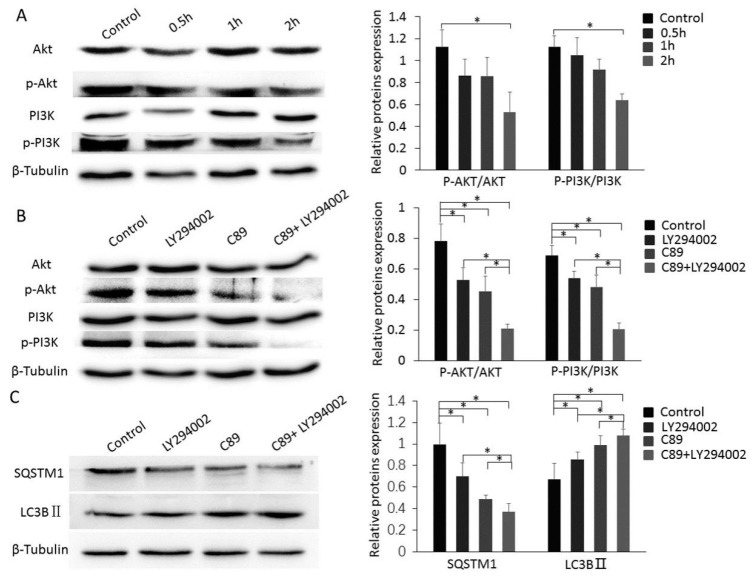
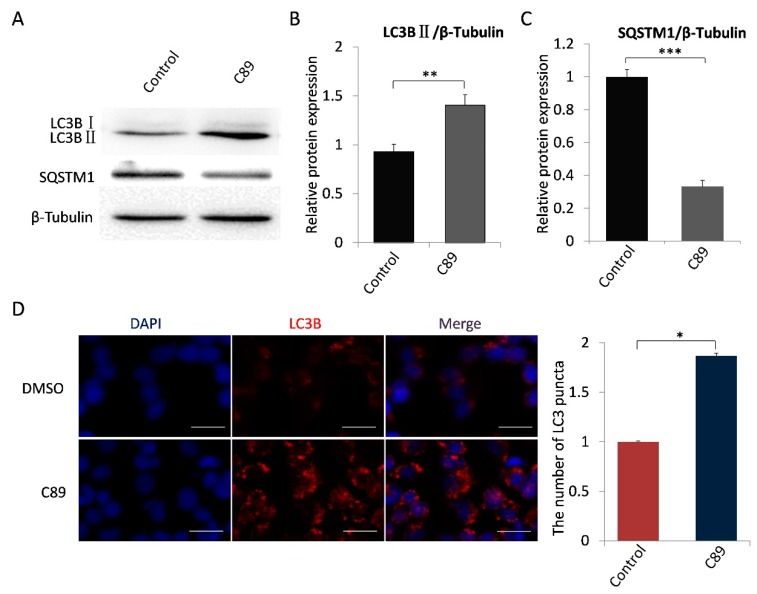
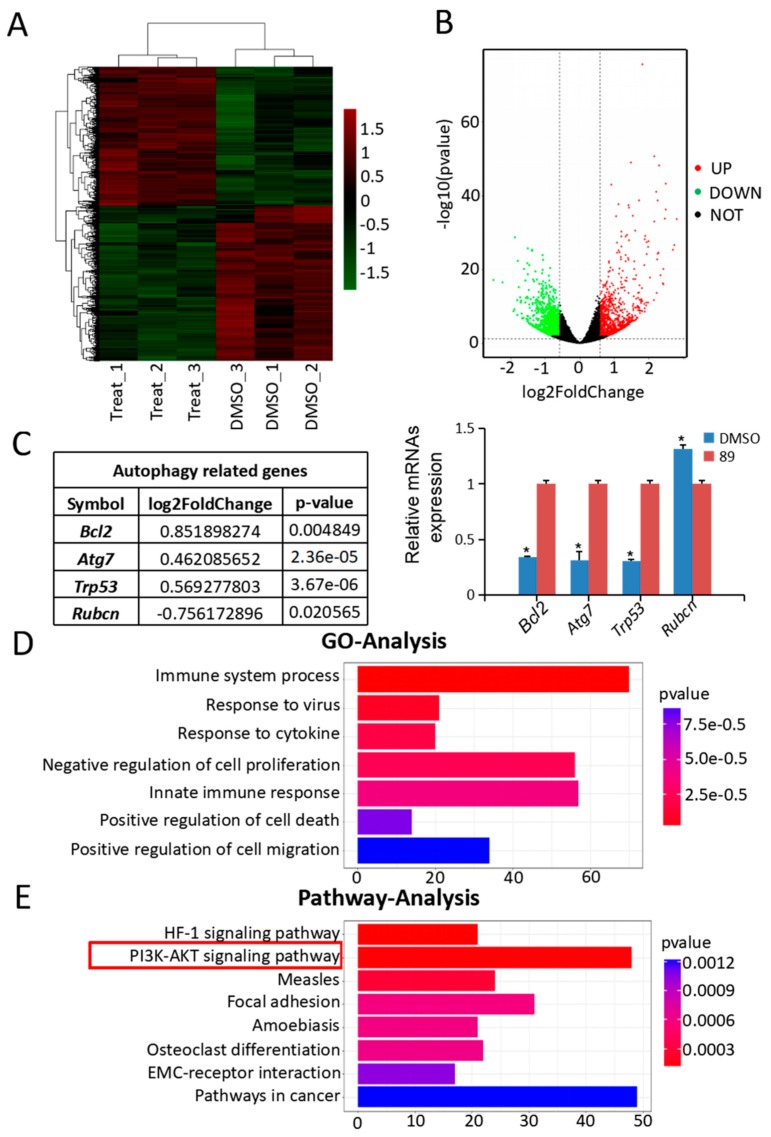
Postnatal female germline stem cells (FGSCs) are a type of germline stem cell with self-renewal ability and the capacity of differentiation toward oocyte. The proliferation, differentiation, and apoptosis of FGSCs have been researched in recent years, but autophagy in FGSCs has not been explored. This study investigated the effects of the small-molecule compound 89 (C89) on FGSCs and the underlying molecular mechanism in vitro. Cytometry, Cell Counting Kit-8 (CCK8), and 5-ethynyl-2'-deoxyuridine (EdU) assay showed that the number, viability, and proliferation of FGSCs were significantly reduced in C89-treated groups (0.5, 1, and 2 µM) compared with controls. C89 had no impact on FGSC apoptosis or differentiation. However, C89 treatment induced the expression of light chain 3 beta II (LC3BII) and reduced the expression of sequestosome-1 (SQSTM1) in FGSCs, indicating that C89 induced FGSC autophagy. To investigate the mechanism of C89-induced FGSC autophagy, RNA-seq technology was used to compare the transcriptome differences between C89-treated FGSCs and controls. Bioinformatics analysis of the sequencing data indicated a potential involvement of the phosphatidylinositol 3 kinase and kinase Akt (PI3K-Akt) pathway in the effects of C89's induction of autophagy in FGSCs. Western blot confirmed that levels of p-PI3K and p-Akt were significantly reduced in the C89- or LY294002 (PI3K inhibitor)-treated groups compared with controls. Moreover, we found cooperative functions of C89 and LY294002 in inducing FGSC autophagy through suppressing the PI3K-Akt pathway. Taken together, this research demonstrates that C89 can reduce the number, viability, and proliferation of FGSCs by inducing autophagy. Furthermore, C89 induced FGSC autophagy by inhibiting the activity of PI3K and Akt. The PI3K-Akt pathway may be a target to regulate FGSC proliferation and death.
产后雌性生殖干细胞 (FGSCs) 是一种具有自我更新能力和向卵母细胞分化能力的生殖干细胞。近年来,人们对 FGSCs 的增殖、分化和凋亡进行了研究,但 FGSCs 中的自噬作用尚未得到探索。本研究在体外探讨了小分子化合物 89 (C89) 对 FGSCs 的影响及其潜在的分子机制。流式细胞术、细胞计数试剂盒-8 (CCK8) 和 5-乙炔基-2'-脱氧尿苷 (EdU) 检测显示,与对照组相比,C89 处理组 (0.5、1 和 2 μM) FGSCs 的数量、活力和增殖明显减少。C89 对 FGSC 凋亡或分化没有影响。然而,C89 处理诱导 FGSC 中轻链 3 beta II (LC3BII) 的表达,并降低自噬体相关蛋白 1 (SQSTM1) 的表达,表明 C89 诱导 FGSC 自噬。为了研究 C89 诱导 FGSC 自噬的机制,我们使用 RNA-seq 技术比较了 C89 处理的 FGSCs 与对照组之间的转录组差异。测序数据分析的生物信息学分析表明,PI3K-Akt 途径可能参与了 C89 诱导的 FGSC 自噬作用。Western blot 验证了 C89 或 LY294002 (PI3K 抑制剂) 处理组中 p-PI3K 和 p-Akt 的水平明显低于对照组。此外,我们发现 C89 和 LY294002 可以通过抑制 PI3K-Akt 通路协同诱导 FGSC 自噬。综上所述,本研究表明 C89 通过诱导自噬来减少 FGSCs 的数量、活力和增殖。此外,C89 通过抑制 PI3K 和 Akt 的活性诱导 FGSC 自噬。PI3K-Akt 通路可能是调节 FGSC 增殖和死亡的靶点。