Behavioral Neuropharmacology and Neuroimaging Laboratory on Addictions, Clinical Research Institute on Addictions, Department of Pharmacology and Toxicology, Jacobs School of Medicine and Biosciences, State University of New York at Buffalo, Buffalo, NY, United States of America.
Department of Psychology, State University of New York at Buffalo, Buffalo, NY, United States of America.
PLoS One. 2019 Jun 20;14(6):e0218680. doi: 10.1371/journal.pone.0218680. eCollection 2019.
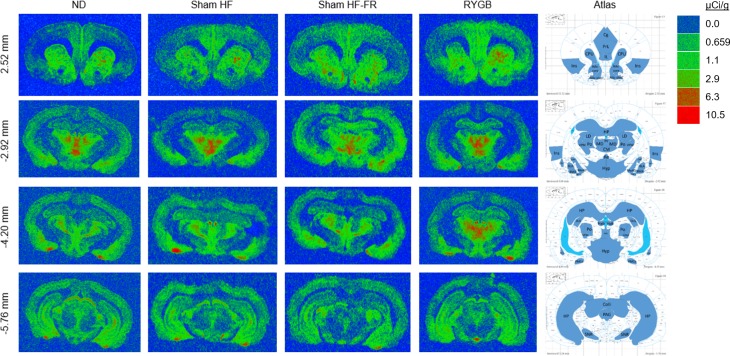
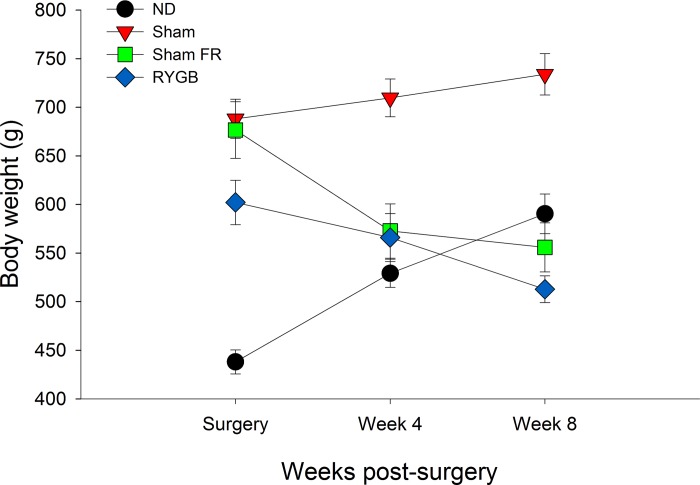
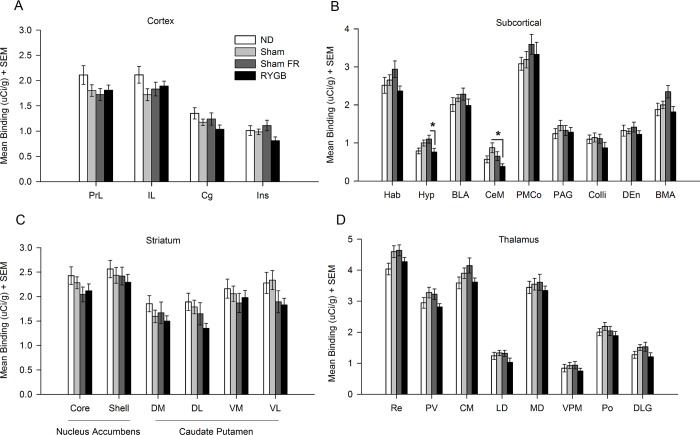
Roux-en-Y gastric bypass surgery (RYGB) is the most common and effective weight loss procedure for severe obesity. However, a significant increase in addictive behaviors and new-onset substance use disorder (SUD) are sometimes observed post-surgery. The endogenous opioid system is known to play a major role in motivated behavior and reward, as well as the abuse of substances, including alcohol, tobacco, opioids and highly palatable foods. Here, we examined the effects of RYGB on mu-opioid receptor levels in the brain. Male Sprague-Dawley rats were assigned to one of four groups: standard diet with sham surgery (control), ad libitum high-energy high-fat (HF) diet with sham surgery, calorie restricted HF diet with sham surgery (Sham-FR), or HF diet with RYGB surgery. Control and HF groups were fed their respective diets for 8 weeks, with surgery performed on the eighth week. After 9 weeks on their respective diets post-surgery, animals were sacrificed for mu-opioid receptor autoradiography using the [3H] [D-Ala2,N-Me-Phe4-Gly5-ol]- enkephalin (DAMGO) ligand. Rats with RYGB showed reduced DAMGO binding in the central amygdala compared to sham-operated HF diet controls, and in the hypothalamus compared to high-fat fed Sham-FR. Diet alone did not change [3H] DAMGO binding in any region. These findings show that RYGB surgery, independent of diet or caloric restriction, decreases mu opioid signaling in specific regions important for stress and energy regulation. Thus, RYGB surgery may lead to greater stress sensitivity via downregulated mu opioid signaling in the central amygdala, which may contribute to the observed increased risk in some subjects for addictive behavior.
胃旁路手术(RYGB)是治疗严重肥胖症最常用且有效的减重手术。然而,术后有时会观察到成瘾行为显著增加和新发生的物质使用障碍(SUD)。内源性阿片系统已知在动机行为和奖励以及物质滥用中发挥重要作用,包括酒精、烟草、阿片类药物和高美味食物。在这里,我们研究了 RYGB 对大脑中μ-阿片受体水平的影响。雄性 Sprague-Dawley 大鼠分为四组之一:假手术(对照)标准饮食、自由进食高能量高脂肪(HF)饮食加假手术、假手术热量限制 HF 饮食(Sham-FR)或 HF 饮食加 RYGB 手术。对照和 HF 组分别喂食各自的饮食 8 周,第八周进行手术。手术后各自的饮食 9 周后,使用 [3H] [D-Ala2,N-Me-Phe4-Gly5-ol]-脑啡肽(DAMGO)配体进行 μ-阿片受体放射自显影,以牺牲动物。与 HF 饮食对照相比,RYGB 大鼠的中央杏仁核中 DAMGO 结合减少,与高脂肪喂养的 Sham-FR 相比,下丘脑 DAMGO 结合减少。单独的饮食在任何区域均未改变 [3H] DAMGO 结合。这些发现表明,RYGB 手术,独立于饮食或热量限制,会降低特定于应激和能量调节的重要区域的 μ 阿片信号。因此,RYGB 手术可能会通过下调中央杏仁核中的 μ 阿片信号导致更大的应激敏感性,这可能导致一些患者观察到的成瘾行为风险增加。