Executive Medical Center, Totsuka Royal Clinic, Tokyo Women's Medical University, Tokyo, Japan.
Halberg Chronobiology Center, University of Minnesota, Minneapolis, Minnesota, USA.
Sci Rep. 2019 Jun 20;9(1):8995. doi: 10.1038/s41598-019-45387-6.
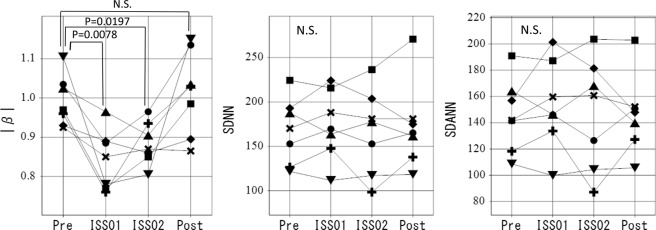
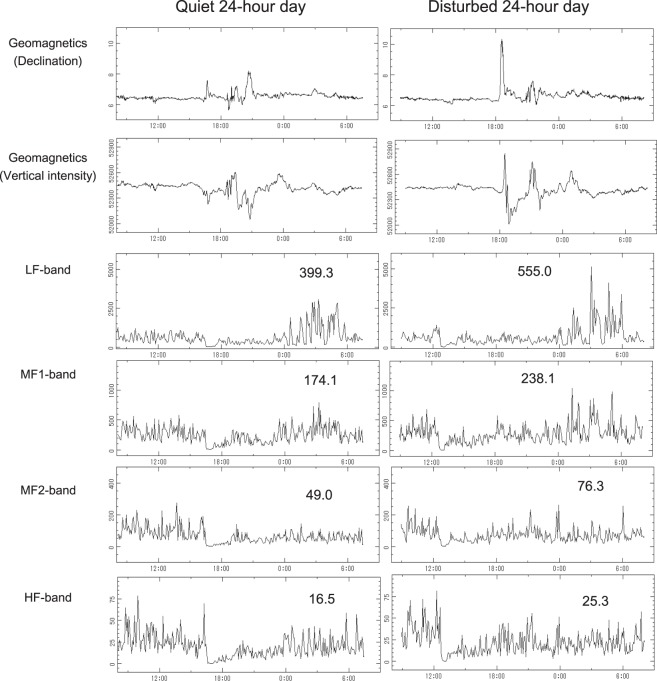
Reports that aging slows down in space prompted this investigation of anti-aging effects in humans by analyzing astronauts' heart rate variability (HRV). Ambulatory 48-hour electrocardiograms from 7 astronauts (42.1 ± 6.8 years; 6 men) 20.6 ± 2.7 days (ISS01) and 138.6 ± 21.8 days (ISS02) after launch were divided into 24-hour spans of relative lower or higher magnetic disturbance, based on geomagnetic measures in Tromso, Norway. Magnetic disturbances were significantly higher on disturbed than on quiet days (ISS01: 72.01 ± 33.82 versus 33.96 ± 17.90 nT, P = 0.0307; ISS02: 71.06 ± 51.52 versus 32.53 ± 27.27 nT, P = 0.0308). SDNNIDX was increased on disturbed days (by 5.5% during ISS01, P = 0.0110), as were other HRV indices during ISS02 (SDANN, 12.5%, P = 0.0243; Triangular Index, 8.4%, P = 0.0469; and TF-component, 17.2%, P = 0.0054), suggesting the action of an anti-aging or longevity effect. The effect on TF was stronger during light (12:00-17:00) than during darkness (0:00-05:00) (P = 0.0268). The brain default mode network (DMN) was activated, gauged by increases in the LF-band (9.7%, P = 0.0730) and MF1-band (9.9%, P = 0.0281). Magnetic changes in the magnetosphere can affect and enhance HRV indices in space, involving an anti-aging or longevity effect, probably in association with the brain DMN, in a light-dependent manner and/or with help from the circadian clock.
报告称,太空中的衰老速度会减缓,这促使人们通过分析宇航员的心率变异性(HRV)来研究人类的抗衰老效果。对 7 名宇航员(42.1±6.8 岁;6 名男性)的 48 小时动态心电图进行了分析,这些宇航员在发射后 20.6±2.7 天(ISS01)和 138.6±21.8 天(ISS02)时的心电图被分为相对较低或较高磁场干扰的 24 小时跨度,磁场干扰是根据挪威特罗姆瑟的地磁测量结果划分的。ISS01 期间,干扰日的磁场干扰明显高于安静日(72.01±33.82 对 33.96±17.90 nT,P=0.0307);ISS02 期间,干扰日的磁场干扰也明显高于安静日(71.06±51.52 对 32.53±27.27 nT,P=0.0308)。ISS01 期间,SDNNIDX 升高(增加了 5.5%,P=0.0110),ISS02 期间其他 HRV 指数也升高(SDANN,增加 12.5%,P=0.0243;三角指数增加 8.4%,P=0.0469;TF 成分增加 17.2%,P=0.0054),这表明存在抗衰老或长寿效应。TF 的影响在光照期间(12:00-17:00)比在黑暗期间(0:00-05:00)更强(P=0.0268)。大脑默认模式网络(DMN)被激活,低频带(LF)增加了 9.7%(P=0.0730),中频带 1(MF1)增加了 9.9%(P=0.0281)。磁层中的磁场变化会影响和增强太空中的 HRV 指数,这涉及到抗衰老或长寿效应,可能与大脑 DMN 有关,这种影响依赖于光照,或者需要生物钟的帮助。