Division of Preventive Medicine, Department of Medicine, Brigham and Women's Hospital, Harvard Medical School, 900 Commonwealth Avenue, Boston, MA 02146, USA.
Deutsches Herzzentrum München, Klinik für Herz- und Kreislauferkrankungen, Technische Universität München, Deutsches Zentrum für Herz- und Kreislauf-Forschung (DZHK) e.V., Partner Site Munich Heart Alliance, Lazarettstrasse 36, 80636 Munich, Germany.
Eur Heart J. 2019 Nov 1;40(41):3385-3392. doi: 10.1093/eurheartj/ehz384.
Efficacy of aspirin in primary prevention of cardiovascular disease (CVD) may be influenced by a common allele in guanylate cyclase GUCY1A3, which has been shown to modify platelet function and increase CVD risk.
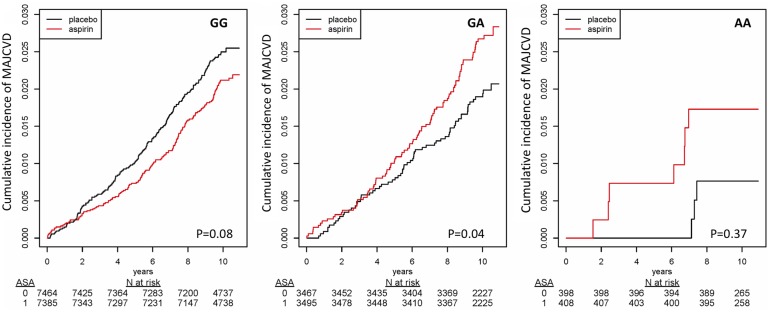
We investigated whether homozygotes of the GUCY1A3 rs7692387 risk (G) allele benefited from aspirin in two long-term, randomized placebo-controlled trials of aspirin in primary CVD prevention: the Women's Genome Health Study (WGHS, N = 23 294) and a myocardial infarction (MI, N = 550) and stroke (N = 382) case-control set from the Physician's Health Study (PHS, N = 22 071). Bleeding risk was evaluated in the WGHS. In the placebo group of the WGHS, the GUCY1A3 risk (G) allele was confirmed to increase CVD risk [hazard ratio 1.38; 95% confidence interval (CI) 1.08-1.78; P = 0.01]. Random-effects meta-analysis of the WGHS and PHS revealed that aspirin reduced CVD events among risk allele homozygotes [G/G: odds ratio (OR) 0.79; 95% CI 0.65-0.97; P = 0.03] but increased CVD events among non-risk allele carriers (e.g. G/A: OR 1.39; 95% CI 1.03-1.87; P = 0.03) thus implying an interaction between genotype stratum and aspirin intake (Pinteraction = 0.01). Bleeding associated with aspirin increased in all genotype groups, with higher risks in heterozygotes.
In two randomized placebo-controlled trials in the setting of primary prevention, aspirin reduced the incidence of CVD events in individuals homozygous for the GUCY1A3 risk (G) allele, whereas heterozygote individuals had more events when taking aspirin.
已有研究表明,鸟苷酸环化酶 GUCY1A3 中的常见等位基因可改变血小板功能并增加心血管疾病(CVD)风险,其可能会影响阿司匹林在 CVD 一级预防中的疗效。
我们在两项阿司匹林用于 CVD 一级预防的长期、随机、安慰剂对照试验中,即女性基因组健康研究(WGHS,N=23294)和来自医师健康研究(PHS)的心肌梗死(MI,N=550)和中风(N=382)病例对照研究中,探讨了 GUCY1A3 rs7692387 风险(G)等位基因纯合子是否可从阿司匹林中获益:WGHS 中评估了出血风险。在 WGHS 安慰剂组中,GUCY1A3 风险(G)等位基因被证实可增加 CVD 风险[风险比 1.38;95%置信区间(CI)1.08-1.78;P=0.01]。WGHS 和 PHS 的随机效应荟萃分析显示,阿司匹林可降低风险等位基因纯合子的 CVD 事件[G/G:比值比(OR)0.79;95%CI 0.65-0.97;P=0.03],但增加了非风险等位基因携带者的 CVD 事件(如 G/A:OR 1.39;95%CI 1.03-1.87;P=0.03),提示基因型与阿司匹林摄入之间存在交互作用(P 交互=0.01)。在所有基因型组中,与阿司匹林相关的出血均增加,杂合子的风险更高。
在两项 CVD 一级预防的随机安慰剂对照试验中,阿司匹林可降低 GUCY1A3 风险(G)等位基因纯合子个体 CVD 事件的发生率,而服用阿司匹林的杂合子个体事件更多。