Department of Radiation Oncology, Faculty of Medicine, Karadeniz Technical University, Trabzon, Turkey.
Department of Radiation Oncology, Kanuni Research and Education Hospital, Trabzon, Turkey.
J Appl Clin Med Phys. 2019 Jul;20(7):135-141. doi: 10.1002/acm2.12668. Epub 2019 Jun 24.
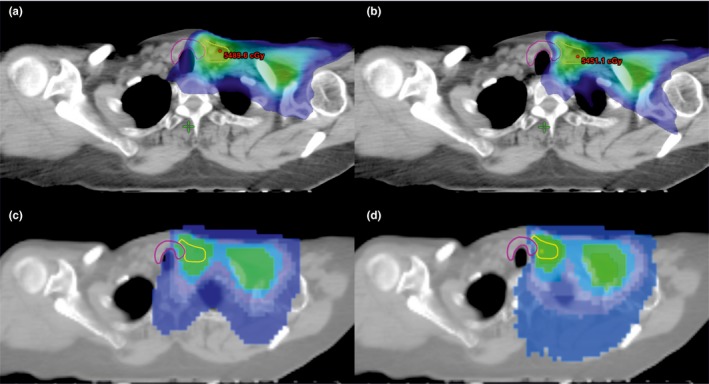
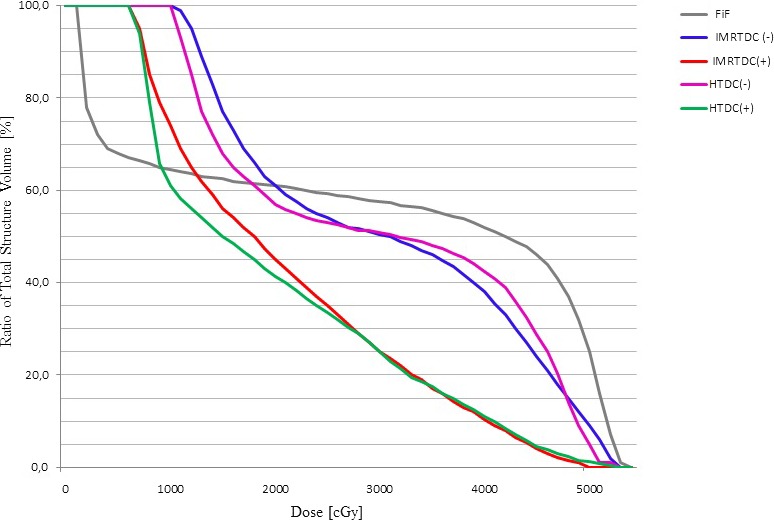
The aim of the present study was to compare radiation dose received by thyroid gland using different radiotherapy (RT) techniques with or without thyroid dose constraint (DC) for breast cancer patients. Computerized tomography (CT) image sets for 10 patients with breast cancer were selected. All patients were treated originally with opposite tangential field-in field (FinF) for the chest wall and anteroposterior fields for the ipsilateral supraclavicular field. The thyroid gland was not contoured on the CT images at the time of the original scheduled treatment. Four new treatment plans were created for each patient, including intensity-modulated radiotherapy (IMRT) and helical tomotherapy (HT) plans with thyroid DC exclusion and inclusion (IMRT , IMRT , HT , and HT , respectively). Thyroid DCs were used to create acceptable dose limits to avoid hypothyroidism as follows: percentage of thyroid volume exceeding 30 Gy less than 50% (V < 50%) and mean dose of thyroid (TD ) ≤ 21 Gy. Dose-volume histograms (DVHs) for TD and percentages of thyroid volume exceeding 10, 20, 30, 40, and 50 Gy (V , V , V , V , and V , respectively) were also analyzed. The D of the FinF, IMRT , HT , IMRT and HT plans were 30.56 ± 5.38 Gy, 25.56 ± 6.66 Gy, 27.48 ± 4.16 Gy, 18.57 ± 2.14 Gy, and 17.34 ± 2.70 Gy, respectively. Median V values were 55%, 33%, 36%, 18%, and 17%, for FinF, IMRT , HT , IMRT , and HT , respectively. Differences between treatment plans with or without DC with respect to D and V values were statistically significant (P < 0.05). When thyroid DC during breast cancer RT was applied to IMRT and HT, the TD and V values significantly decreased. Therefore, recognition of the thyroid as an organ at risk (OAR) and the use of DCs during IMRT and HT planning to minimize radiation dose and thyroid volume exposure are recommended.
本研究旨在比较乳腺癌患者接受不同放射治疗(RT)技术(包括有无甲状腺剂量限制(DC))时甲状腺所受辐射剂量。选择了 10 例乳腺癌患者的计算机断层扫描(CT)图像集。所有患者最初均采用对侧切线野-内野(FinF)和同侧锁骨上野前后野治疗。在最初计划治疗时,CT 图像上未勾画甲状腺。为每位患者创建了 4 个新的治疗计划,包括排除和包括甲状腺 DC 的调强放疗(IMRT)和螺旋断层放疗(HT)计划(分别为 IMRT、IMRT、HT 和 HT)。使用甲状腺 DC 来创建可接受的剂量限制,以避免甲状腺功能减退,具体如下:甲状腺体积超过 30Gy 的百分比(V < 50%)和甲状腺平均剂量(TD)≤21Gy。还分析了 TD 和甲状腺体积超过 10、20、30、40 和 50Gy 的百分比(V、V、V、V 和 V)的剂量-体积直方图(DVH)。FinF、IMRT、HT、IMRT 和 HT 计划的 D 分别为 30.56±5.38Gy、25.56±6.66Gy、27.48±4.16Gy、18.57±2.14Gy 和 17.34±2.70Gy。FinF、IMRT、HT、IMRT 和 HT 计划的中位 V 值分别为 55%、33%、36%、18%和 17%。有或无 DC 的治疗计划之间在 D 和 V 值方面的差异具有统计学意义(P < 0.05)。当在乳腺癌 RT 期间应用甲状腺 DC 时,TD 和 V 值显著降低。因此,建议在 IMRT 和 HT 计划中认识到甲状腺是一个危及器官(OAR),并使用 DC 来最小化辐射剂量和甲状腺体积暴露。