Makame James, Cronje Tanita, Emmambux Naushad M, De Kock Henriette
Department of Consumer and Food Sciences, University of Pretoria, Private Bag X20, Hatfield, Pretoria 0028, South Africa.
Department of Statistics, University of Pretoria, Private Bag X20, Hatfield, Pretoria 0028, South Africa.
Foods. 2019 Jun 21;8(6):221. doi: 10.3390/foods8060221.
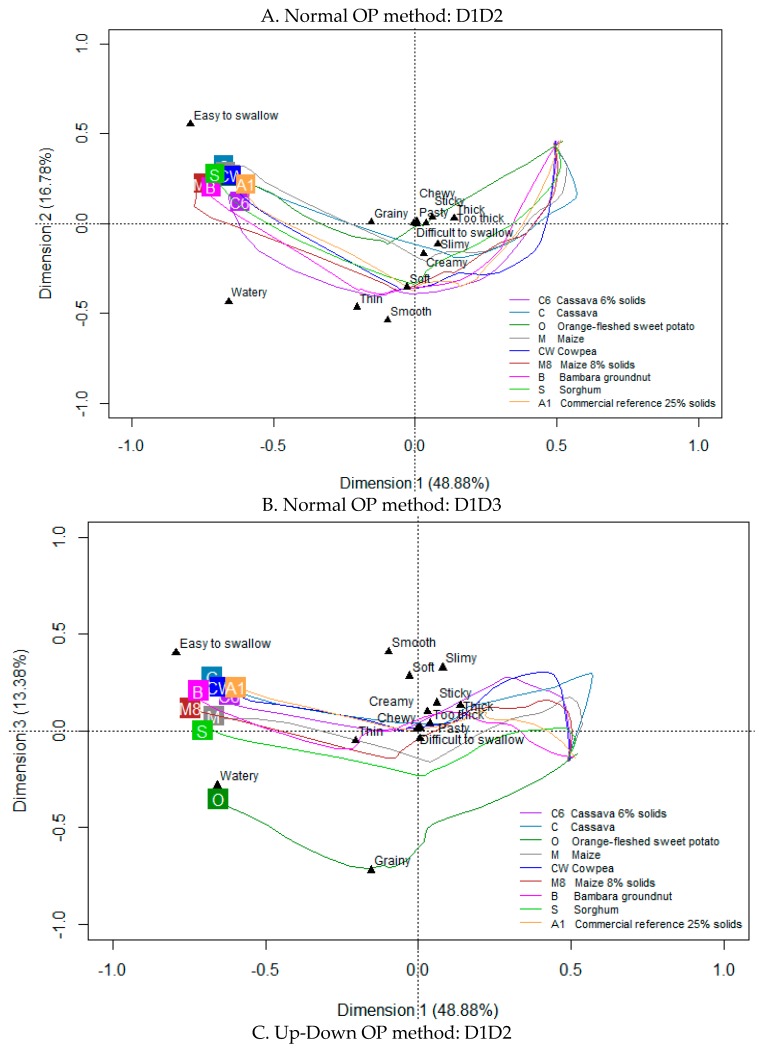
Child malnutrition remains a major public health problem in low-income African communities, caused by factors including the low nutritional value of indigenous/local complementary porridges (CP) fed to infants and young children. Most African children subsist on locally available starchy foods, whose oral texture is not well-characterized in relation to their sensorimotor readiness. The sensory quality of CP affects oral processing (OP) abilities in infants and young children. Unsuitable oral texture limits nutrient intake, leading to protein-energy malnutrition. The perception of the oral texture of selected African CPs ( = 13, Maize, Sorghum, Cassava, Orange-fleshed sweet potato (OFSP), Cowpea, and Bambara) was investigated by a trained temporal-check-all-that-apply (TCATA) panel ( = 10), alongside selected commercial porridges ( = 19). A simulated OP method (Up-Down mouth movements- munching) and a control method (lateral mouth movements- normal adult-like chewing) were used. TCATA results showed that Maize, Cassava, and Sorghum porridges were initially too thick, sticky, slimy, and pasty, and also at the end not easy to swallow even at low solids content-especially by the Up-Down method. These attributes make CPs difficult to ingest for infants given their limited OP abilities, thus, leading to limited nutrient intake, and this can contribute to malnutrition. Methods to improve the texture properties of indigenous CPs are needed to optimize infant nutrient intake.
儿童营养不良仍然是非洲低收入社区的一个主要公共卫生问题,其成因包括喂养婴幼儿的本土/当地辅食粥(CP)营养价值低等因素。大多数非洲儿童以当地可得的淀粉类食物为生,这些食物的口感与其感觉运动准备状态之间的关系尚未得到充分描述。辅食粥的感官质量会影响婴幼儿的口腔加工(OP)能力。不合适的口感会限制营养摄入,导致蛋白质能量营养不良。一个由10名经过培训的适用于所有选项的时间检查(TCATA)小组成员,对13种选定的非洲辅食粥(玉米、高粱、木薯、橙色肉甘薯(OFSP)、豇豆和 Bambara)以及19种选定的商业粥的口腔质地感知进行了调查。使用了一种模拟口腔加工方法(上下嘴部运动——咀嚼)和一种对照方法(横向嘴部运动——类似正常成年人的咀嚼)。TCATA结果显示,玉米、木薯和高粱粥一开始过于浓稠、黏糊、滑腻且呈糊状,即使在固体含量较低时,最后也不容易吞咽——尤其是通过上下嘴部运动的方法。鉴于婴幼儿有限的口腔加工能力,这些特性使得辅食粥难以被他们摄入,从而导致营养摄入受限,这可能会导致营养不良。需要改进本土辅食粥质地特性的方法来优化婴幼儿的营养摄入。