TUM School of Life and Food Sciences Weihenstephan, Technical University of Munich, Biothermodynamics, Maximus-von-Imhof-Forum 2, 85354 Freising, Germany.
Friedrich-Alexander-Universität Erlangen-Nürnberg (FAU), Separation Science & Technology, Egerlandstr. 3, 91058 Erlangen, Germany.
Molecules. 2019 Jun 25;24(12):2334. doi: 10.3390/molecules24122334.
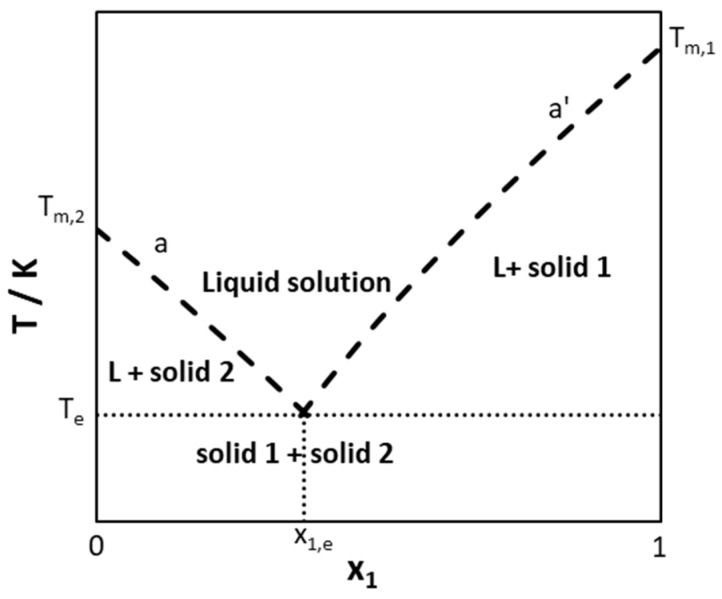
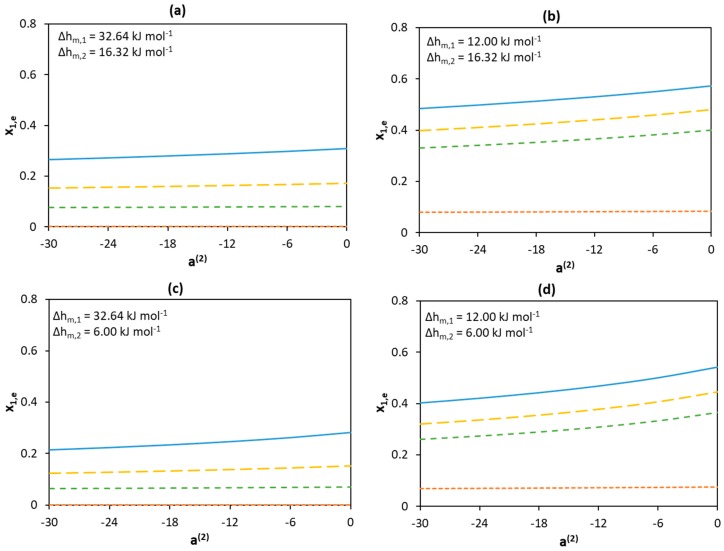
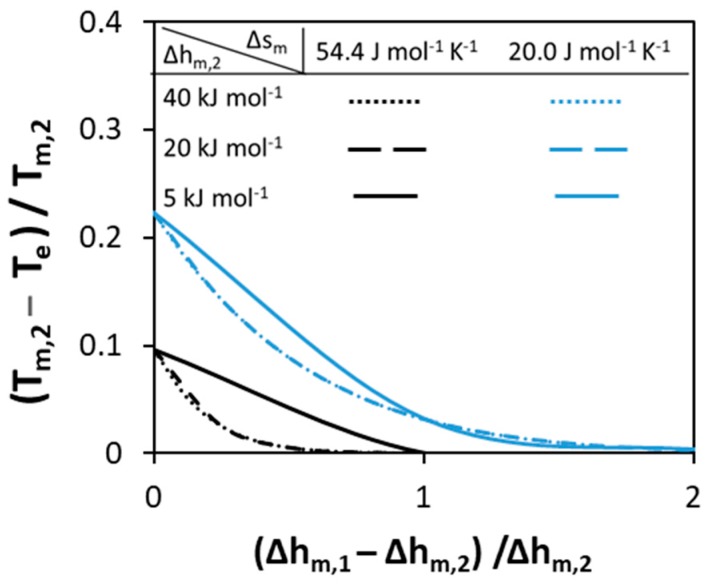
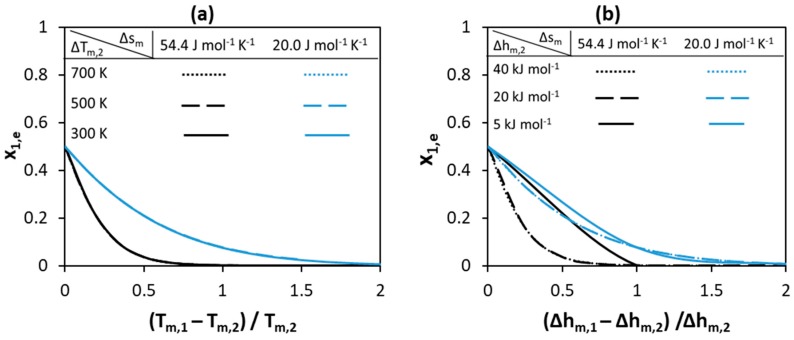
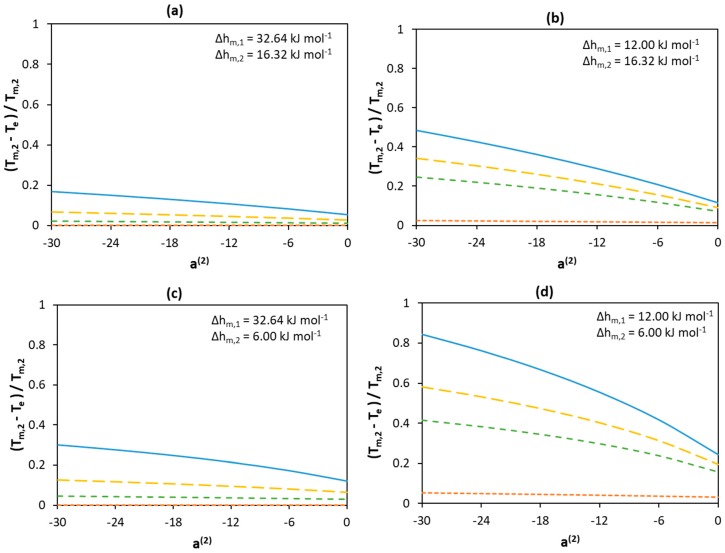
Deep eutectic solvents (DESs) are potential alternatives to many conventional solvents in process applications. Knowledge and understanding of solid-liquid equilibria (SLE) are essential to characterize, design, and select a DES for a specific application. The present study highlights the main aspects that should be taken into account to yield better modeling, prediction, and understanding of SLE in DESs. The work is a comprehensive study of the parameters required for thermodynamic modeling of SLE-i.e., the melting properties of pure DES constituents and their activity coefficients in the liquid phase. The study is carried out for a hypothetical binary mixture as well as for selected real DESs. It was found that the deepest eutectic temperature is possible for components with low melting enthalpies and strong negative deviations from ideality in the liquid phase. In fact, changing the melting enthalpy value of a component means a change in the difference between solid and liquid reference state chemical potentials which results in different values of activity coefficients, leading to different interpretations and even misinterpretations of interactions in the liquid phase. Therefore, along with reliable modeling of liquid phase non-ideality in DESs, accurate estimation of the melting properties of their pure constituents is of clear significance in understanding their SLE behavior and for designing new DES systems.
深共晶溶剂 (DESs) 在过程应用中是许多传统溶剂的潜在替代品。为了对 DES 进行表征、设计和选择,了解固液平衡 (SLE) 的知识和理解是至关重要的。本研究强调了在 DES 中获得更好的 SLE 建模、预测和理解时应考虑的主要方面。这项工作是对 SLE 热力学建模所需参数的综合研究,即纯 DES 成分的熔融性质及其在液相中的活度系数。该研究针对假设的二元混合物以及选定的实际 DES 进行了研究。结果表明,对于在液相中具有低熔融焓和强烈负偏离理想状态的成分,可能存在最深的共晶温度。事实上,改变成分的熔融焓值意味着固相与液相参考状态化学势之间的差值发生变化,从而导致活度系数的值不同,导致对液相中相互作用的不同解释,甚至误解。因此,除了对 DES 中液相非理想性的可靠建模外,准确估计其纯成分的熔融性质对于理解其 SLE 行为以及设计新的 DES 系统具有明显的意义。