Center for Veterinary Medicine, U.S. Food and Drug Administration, Laurel, Maryland, USA
Center for Veterinary Medicine, U.S. Food and Drug Administration, Laurel, Maryland, USA.
mSphere. 2019 Jun 26;4(3):e00367-19. doi: 10.1128/mSphere.00367-19.
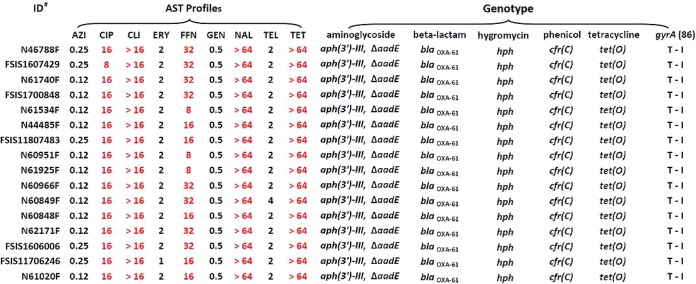
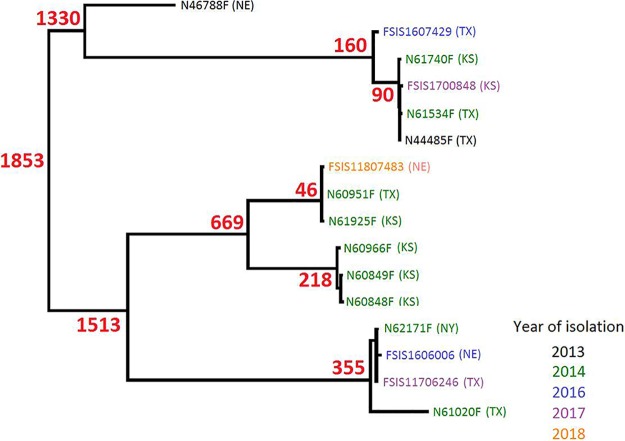
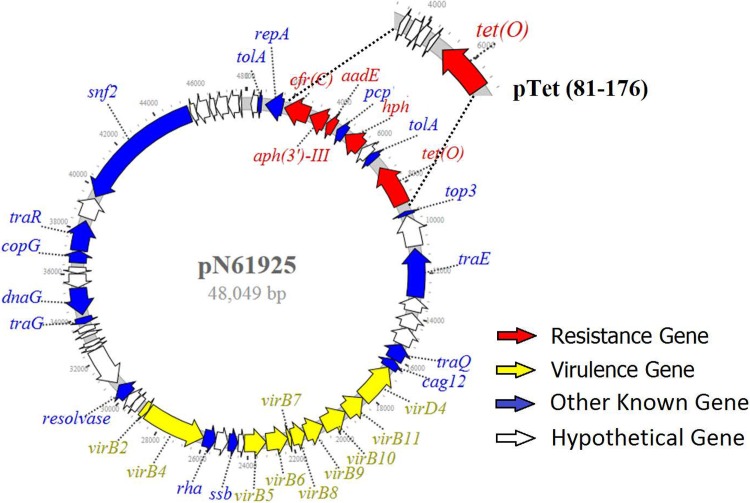
Genomic analyses were performed on florfenicol-resistant (FFN) isolates recovered from cattle, and the (C) gene-associated multidrug resistance (MDR) plasmid was characterized. Sixteen FFN isolates recovered between 2013 and 2018 from beef cattle were sequenced using MiSeq. Genomes and plasmids were found to be closed for three of the isolates using the PacBio system. Single nucleotide polymorphisms (SNPs) across the genome and the structures of MDR plasmids were investigated. Conjugation experiments were performed to determine the transferability of (C)-associated MDR plasmids. The spectrum of resistance encoded by the (C) gene was further investigated by agar dilution antimicrobial susceptibility testing. All 16 FFN isolates were MDR and exhibited coresistance to ciprofloxacin, nalidixic acid, clindamycin, and tetracycline. All isolates shared the same resistance genotype, carrying , , (truncated), , (C), and (O) genes plus a mutation of GyrA (T86I). The (C), , , , and (O) genes were colocated on transferable MDR plasmids ranging in size from 48 to 50 kb. These plasmids showed high sequence homology with the pTet plasmid and carried several virulence genes, including , , , , , , , , , and The (C) gene conferred resistance to florfenicol (8 to 32 μg/ml), clindamycin (512 to 1,024 μg/ml), linezolid (128 to 512 μg/ml), and tiamulin (1,024 μg/ml). Phylogenetic analysis showed SNP differences ranging from 11 to 2,248 SNPs among the 16 isolates. The results showed that the (C) gene located in the conjugative pTet MDR/virulence plasmid is present in diverse strains, where it confers high levels of resistance to several antimicrobials, including linezolid, a critical drug for treating infections by Gram-positive bacteria in humans. This report highlights the power of genomic antimicrobial resistance surveillance to uncover the intricacies of transmissible coresistance and provides information that is needed for accurate risk assessment and mitigation strategies. is a leading cause of foodborne diarrheal illness worldwide, with more than one million cases each year in the United States alone. The global emergence of antimicrobial resistance in this pathogen has become a growing public health concern. Florfenicol-resistant (FFN) has been very rare in the United States. In this study, we employed whole-genome sequencing to characterize 16 multidrug-resistant isolates recovered from cattle in the United States. A gene [(C)] was found to be responsible for resistance not only to florfenicol but also to several other antimicrobials, including linezolid, a critical drug for treating infections by Gram-positive bacteria in humans. The results showed that (C) is located in a conjugative pTet MDR/virulence plasmid. This report highlights the power of antimicrobial resistance surveillance to uncover the intricacies of transmissible coresistance and provides information that is needed for accurate risk assessment and mitigation strategies.
对从牛身上分离出的氟苯尼考耐药(FFN)分离株进行基因组分析,并对与(C)基因相关的多药耐药(MDR)质粒进行了特征分析。使用 MiSeq 对 2013 年至 2018 年间从肉牛中分离出的 16 株 FFN 分离株进行测序。使用 PacBio 系统发现其中 3 株的基因组和质粒是闭合的。研究了全基因组单核苷酸多态性(SNP)和 MDR 质粒的结构。进行了接合实验以确定与(C)相关的 MDR 质粒的可转移性。通过琼脂稀释抗菌药敏试验进一步研究了(C)基因编码的耐药谱。所有 16 株 FFN 分离株均为 MDR,对环丙沙星、萘啶酸、克林霉素和四环素表现出核心耐药性。所有分离株均具有相同的耐药基因型,携带 、 、 (截断)、 、 (C)和 (O)基因,以及 GyrA (T86I)的突变。 (C)、 、 、 、 (O)基因位于大小为 48 至 50kb 的可转移 MDR 质粒上。这些质粒与 pTet 质粒具有高度的序列同源性,并携带多个毒力基因,包括 、 、 、 、 、 、 、 。 (C)基因赋予氟苯尼考(8 至 32μg/ml)、克林霉素(512 至 1024μg/ml)、利奈唑胺(128 至 512μg/ml)和泰妙菌素(1024μg/ml)的耐药性。系统发育分析显示,16 株分离株之间的 SNP 差异范围为 11 至 2248 个 SNP。结果表明,位于可接合的 pTet MDR/毒力质粒中的 (C)基因存在于多种菌株中,该基因赋予对几种抗生素的高水平耐药性,包括利奈唑胺,这是治疗人类革兰氏阳性菌感染的关键药物。本报告强调了基于基因组的抗菌药物耐药性监测揭示可传播核心耐药性复杂性的能力,并提供了准确风险评估和缓解策略所需的信息。 是导致全球食源性腹泻病的主要原因,仅在美国每年就有超过 100 万例病例。该病原体对抗菌药物的全球耐药性的出现已成为一个日益严重的公共卫生问题。在美国,氟苯尼考耐药(FFN)非常罕见。在这项研究中,我们采用全基因组测序技术对从美国牛身上分离出的 16 株多药耐药 进行了特征描述。发现一个基因[(C)]不仅对氟苯尼考而且对几种其他抗菌药物(包括利奈唑胺)具有耐药性,利奈唑胺是治疗人类革兰氏阳性菌感染的关键药物。结果表明,(C)位于一个可接合的 pTet MDR/毒力质粒中。本报告强调了抗菌药物耐药性监测揭示可传播核心耐药性复杂性的能力,并提供了准确风险评估和缓解策略所需的信息。