Department of Gastrointestinal Oncology, Key Laboratory of Carcinogenesis and Translational Research (Ministry of Education/Beijing), Peking University Cancer Hospital & Institute, Beijing, China.
Cancer Med. 2019 Aug;8(10):4766-4781. doi: 10.1002/cam4.2360. Epub 2019 Jun 26.
As the most abundant epigenetic modification on mRNAs and long non-coding RNAs, N6-methyladenosine (m6A) modification extensively exists in mammalian cells. Controlled by writers (methyltransferases), readers (signal transducers), and erasers (demethylases), m6A influences mRNA structure, maturation, and stability, thus negatively regulating protein expression in a post-translational manner. Nevertheless, current understanding of m6A's roles in tumorigenesis, especially in gastric cancer (GC) remains to be unveiled. In this study, we assessed m6A's clinicopathological relevance to GC and explored the underlying mechanisms.
By referring to a proteomics-based GC cohort we previously generated and the TCGA-GC cohort, we merged expressions of canonical m6A writers (METTL3/METTL14), readers (YTHDF1/YTHDF2/YTHDF3), and erasers (ALKBH5/FTO), respectively, as W, R, and E signatures to represent m6A modification. We stratified patients according to these signatures to decipher m6A's associations with crucial mutations, prognosis, and clinical indexes. m6A's biological functions in GC were predicted by gene set enrichment analysis (GSEA) and validated by in vitro experiments.
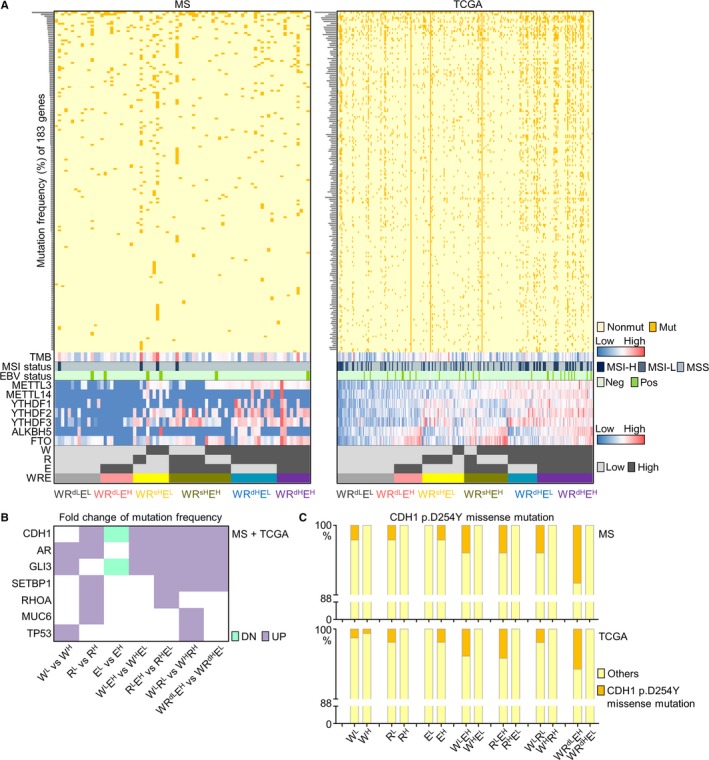
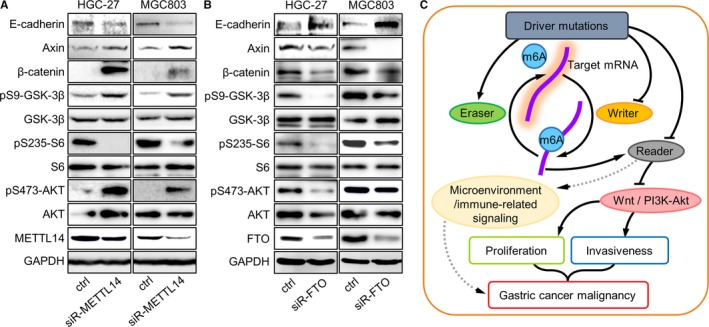
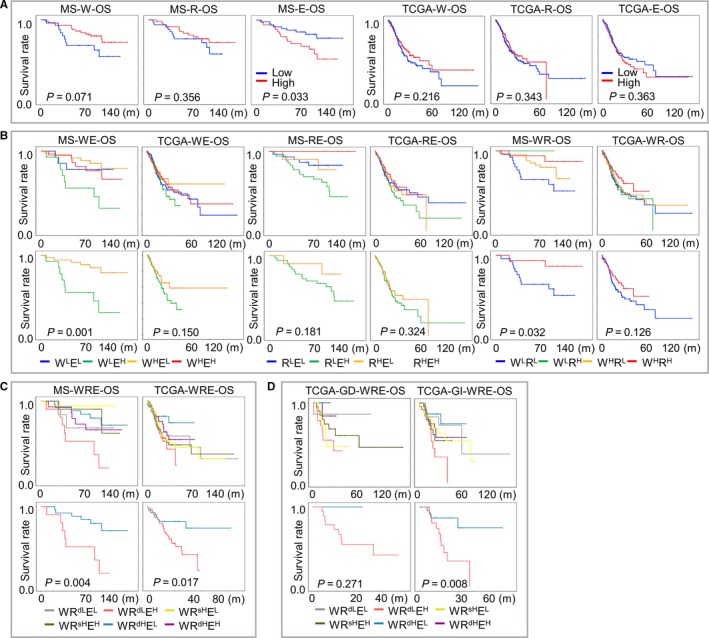
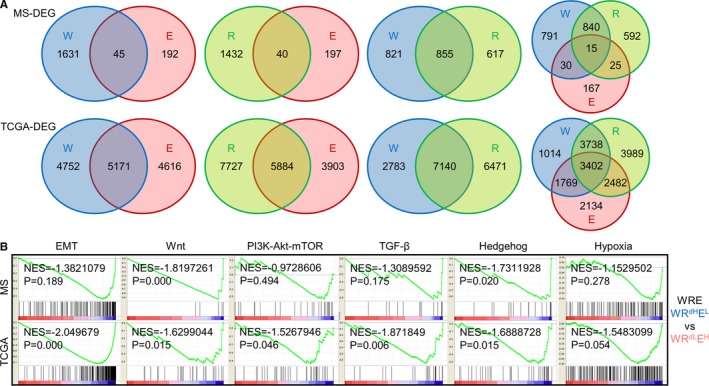
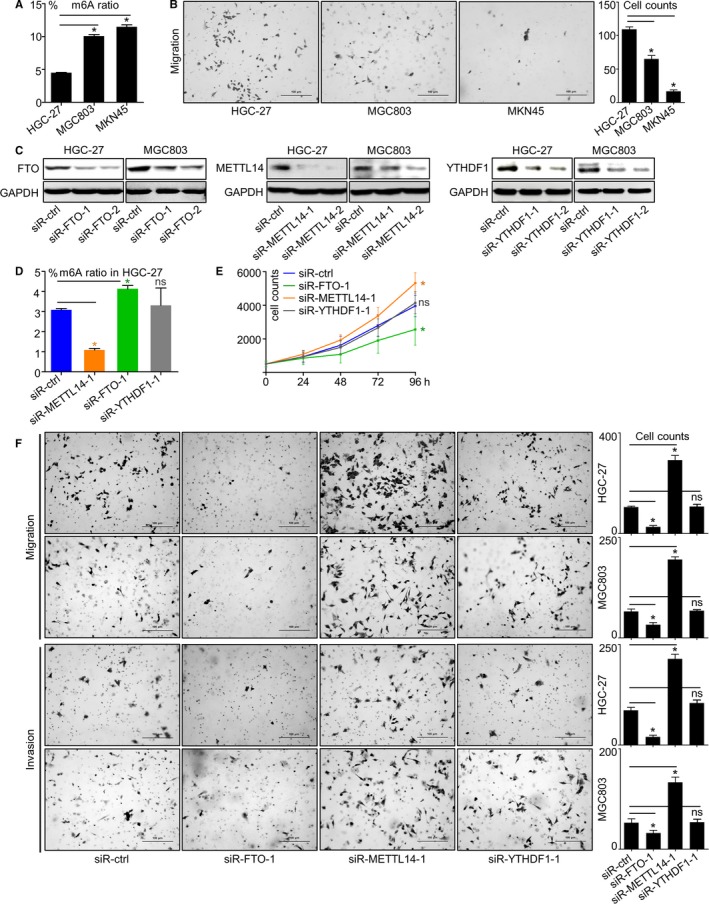
We discovered that W and R were potential tumor suppressive signatures, while E was a potential oncogenic signature in GC. According to W/R/E stratifications, patients with low m6A-indications were accompanied with higher mutations of specific genes (CDH1, AR, GLI3, SETBP1, RHOA, MUC6, and TP53) and also demonstrated adverse clinical outcomes. GSEA suggested that reduced m6A was correlated with oncogenic signaling and phenotypes. Through in vitro experiments, we proved that m6A suppression (represented by METTL14 knockdown) promoted GC cell proliferation and invasiveness through activating Wnt and PI3K-Akt signaling, while m6A elevation (represented by FTO knockdown) reversed these phenotypical and molecular changes. m6A may also be involved in interferon signaling and immune responses of GC.
Our work demonstrated that low-m6A signatures predicted adverse clinicopathological features of GC, while the reduction of RNA m6A methylation activated oncogenic Wnt/PI3K-Akt signaling and promoted malignant phenotypes of GC cells.
作为 mRNA 和长非编码 RNA 上最丰富的表观遗传修饰,N6-甲基腺苷(m6A)修饰广泛存在于哺乳动物细胞中。m6A 由写入器(甲基转移酶)、读取器(信号转导器)和擦除器(去甲基酶)控制,影响 mRNA 的结构、成熟和稳定性,从而以翻译后方式负调控蛋白质表达。然而,目前对 m6A 在肿瘤发生中的作用,特别是在胃癌(GC)中的作用仍有待揭示。在这项研究中,我们评估了 m6A 与 GC 的临床病理相关性,并探讨了其潜在的机制。
通过参考我们之前生成的基于蛋白质组学的 GC 队列和 TCGA-GC 队列,我们分别将典型的 m6A 写入器(METTL3/METTL14)、读取器(YTHDF1/YTHDF2/YTHDF3)和擦除器(ALKBH5/FTO)的表达合并为 W、R 和 E 签名,以代表 m6A 修饰。我们根据这些签名对患者进行分层,以破译 m6A 与关键突变、预后和临床指标的关联。通过基因集富集分析(GSEA)预测 m6A 在 GC 中的生物学功能,并通过体外实验进行验证。
我们发现 W 和 R 是潜在的肿瘤抑制性签名,而 E 是 GC 中的潜在癌基因签名。根据 W/R/E 分层,低 m6A 指示的患者伴随着特定基因(CDH1、AR、GLI3、SETBP1、RHOA、MUC6 和 TP53)更高的突变率,并且也表现出不良的临床结局。GSEA 表明,m6A 减少与致癌信号和表型相关。通过体外实验,我们证明 m6A 抑制(以 METTL14 敲低表示)通过激活 Wnt 和 PI3K-Akt 信号促进 GC 细胞的增殖和侵袭性,而 m6A 升高(以 FTO 敲低表示)逆转了这些表型和分子变化。m6A 也可能参与 GC 的干扰素信号和免疫反应。
我们的工作表明,低 m6A 签名预测了 GC 的不良临床病理特征,而 RNA m6A 甲基化的减少激活了致癌的 Wnt/PI3K-Akt 信号,并促进了 GC 细胞的恶性表型。