Yeung Andy Wai Kan, Lee Johnson Chun Ming, Tanabe Hiroki C, Ng Sam Kwai Sang, Khong Pek-Lan, Leung Wai Keung, Goto Tazuko K
Oral and Maxillofacial Radiology, Applied Oral Sciences, Faculty of Dentistry, The University of Hong Kong, Hong Kong, China.
Private Practice, Hong Kong, China.
Front Hum Neurosci. 2019 Jun 11;13:204. doi: 10.3389/fnhum.2019.00204. eCollection 2019.
: Dental anxiety is a common reason for avoiding dental visits and is associated with poor dental status. The short version of Dental Anxiety Inventory (SDAxI) is an easy-to-use, multi-faceted questionnaire for assessing the level of trait dental anxiety. However, there was no neurophysiological data indicating if its score associates with the state anxiety when an individual is under real/mock dental environment. We hypothesized that there exists such an association. : Twenty systemic healthy adults with dental attendance experience and self-claimed free of dental phobia were recruited in this cross-sectional study, with their dental anxiety level assessed by SDAxI. Functional magnetic resonance imaging recorded their brain signals in response to audiovisual footages resembling dental scaler or turbine in action. After the brain imaging, they gave fear ratings to the footages in visual analog scale (VAS). : Participants' SDAxI scores positively correlated with their responses in the insular cortex ( = 0.388-0.445, < 0.005). Their SDAxI scores also positively correlated with their fear ratings of the footages ( = 0.415-0.555, < 0.005). : Our findings indicated a possible neurobiological relevance of SDAxI, and reinforced its neurobiological validity in assessing dental anxiety level of dental attenders.
牙科焦虑是人们避免看牙的常见原因,且与口腔健康状况不佳有关。牙科焦虑量表简版(SDAxI)是一种易于使用的多维度问卷,用于评估特质性牙科焦虑水平。然而,尚无神经生理学数据表明其得分与个体处于真实/模拟牙科环境时的状态焦虑是否相关。我们假设存在这种关联。
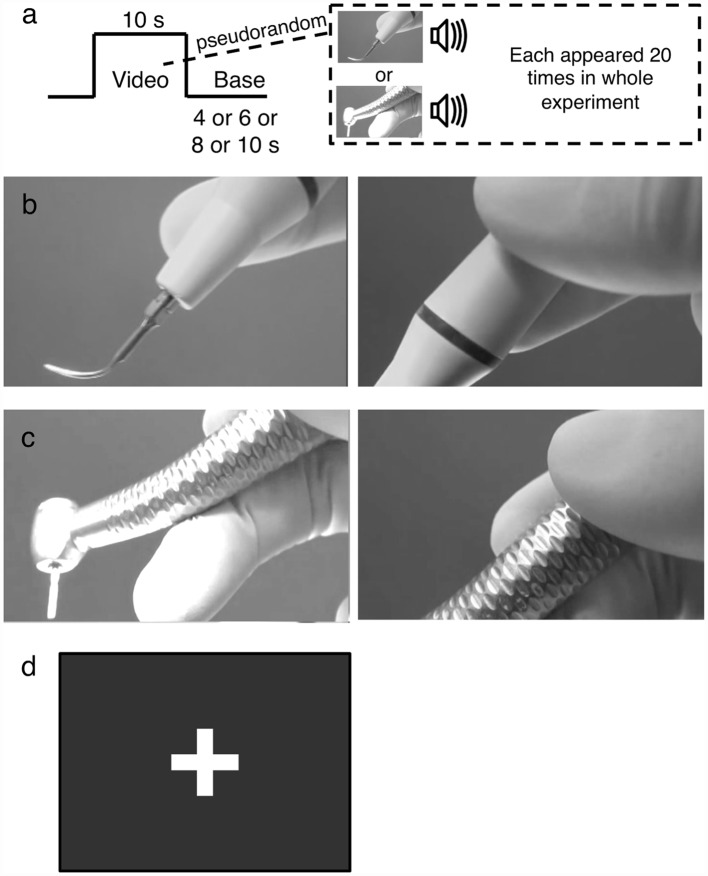
在这项横断面研究中,招募了20名有看牙经历且自称无牙科恐惧症的全身健康成年人,通过SDAxI评估他们的牙科焦虑水平。功能磁共振成像记录了他们对类似牙科洁治器或涡轮运转的视听片段的脑信号反应。脑成像后,他们用视觉模拟量表(VAS)对这些片段进行恐惧评分。
参与者的SDAxI得分与他们在岛叶皮质的反应呈正相关(r = 0.388 - 0.445,P < 0.005)。他们的SDAxI得分也与他们对片段的恐惧评分呈正相关(r = 0.415 - 0.555,P < 0.005)。
我们的研究结果表明SDAxI可能具有神经生物学相关性,并强化了其在评估看牙者牙科焦虑水平方面的神经生物学有效性。