Department of Radiology and Nuclear Medicine, Radboud university medical center, Nijmegen, the Netherlands.
Clinic for Nuclear Medicine, University Hospital Essen, Germany.
Theranostics. 2019 May 4;9(10):2924-2938. doi: 10.7150/thno.35274. eCollection 2019.
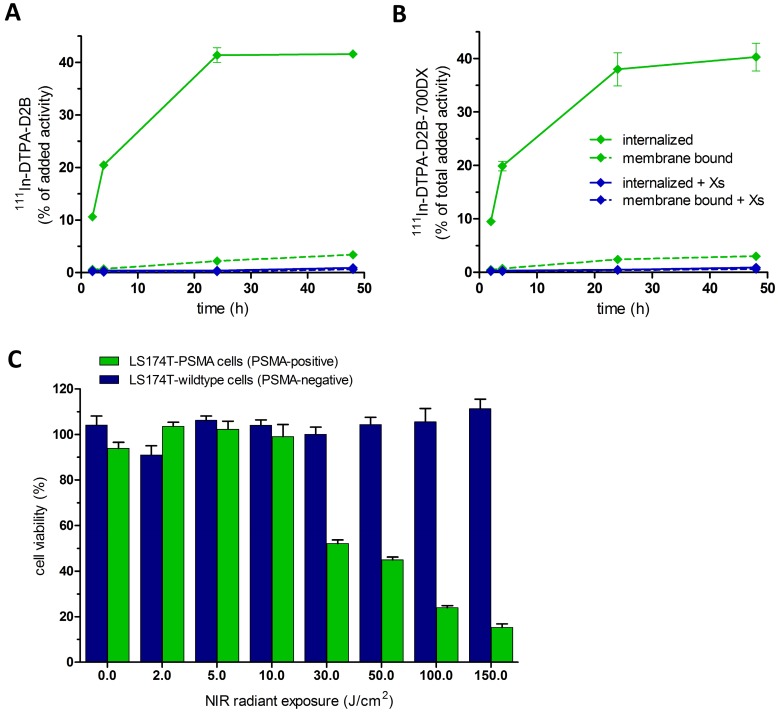
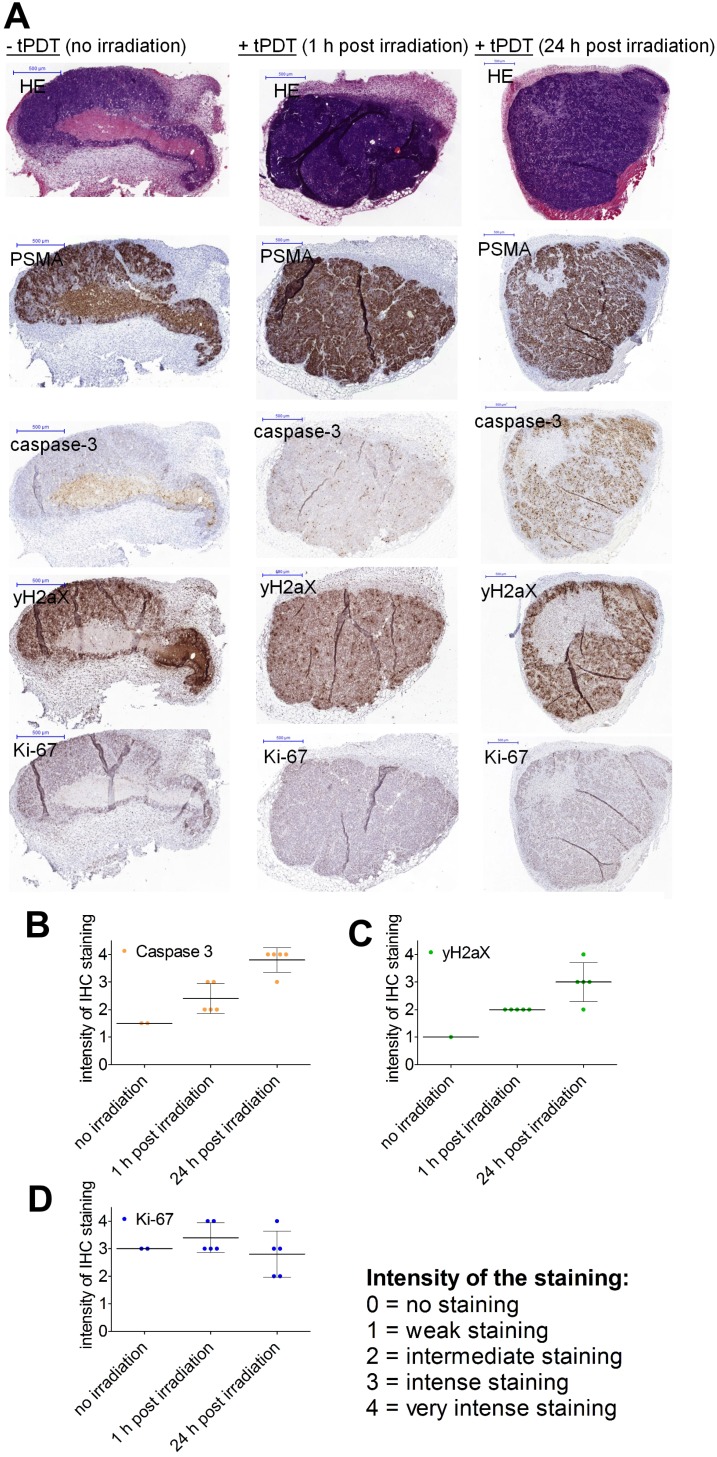
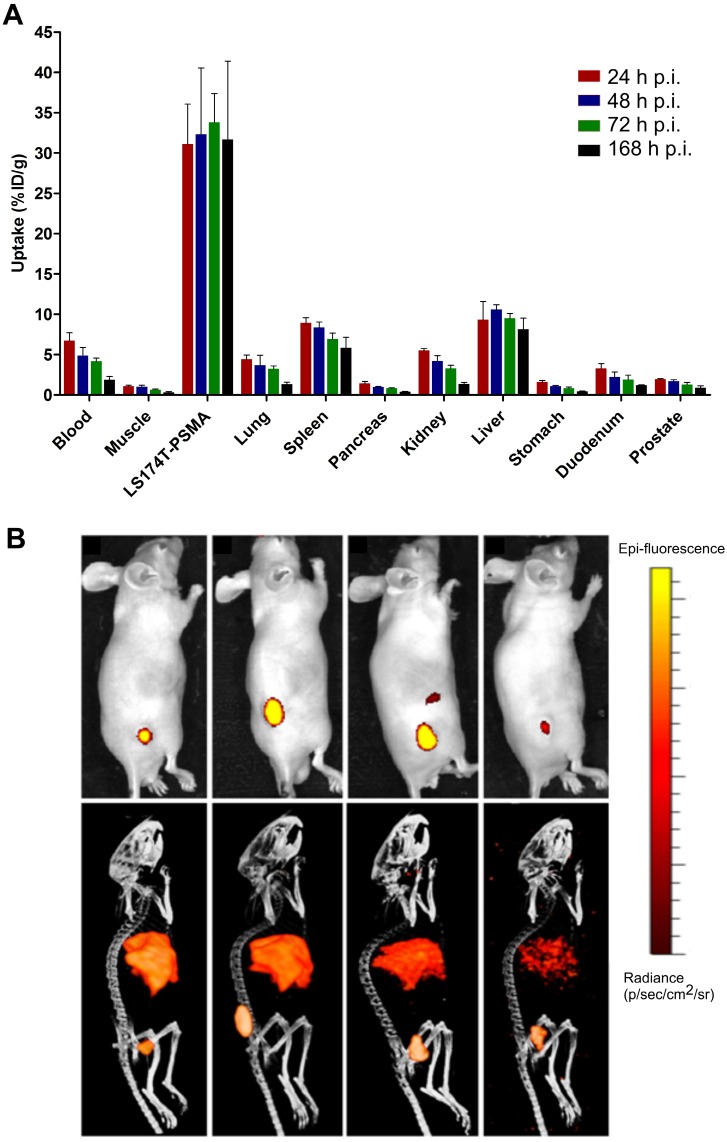
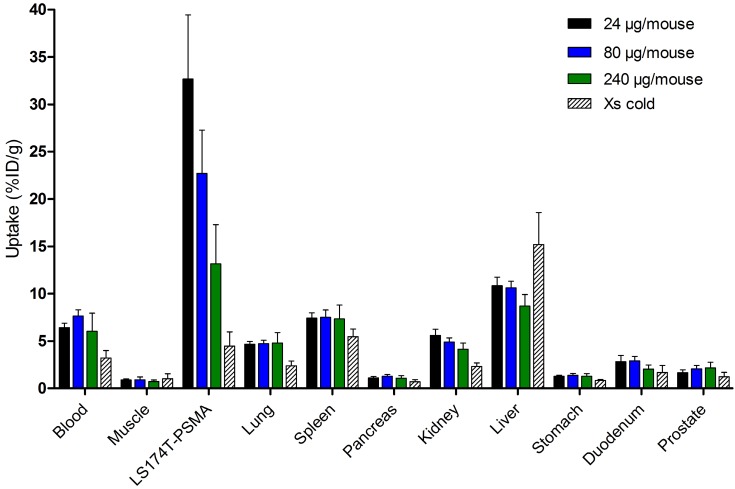
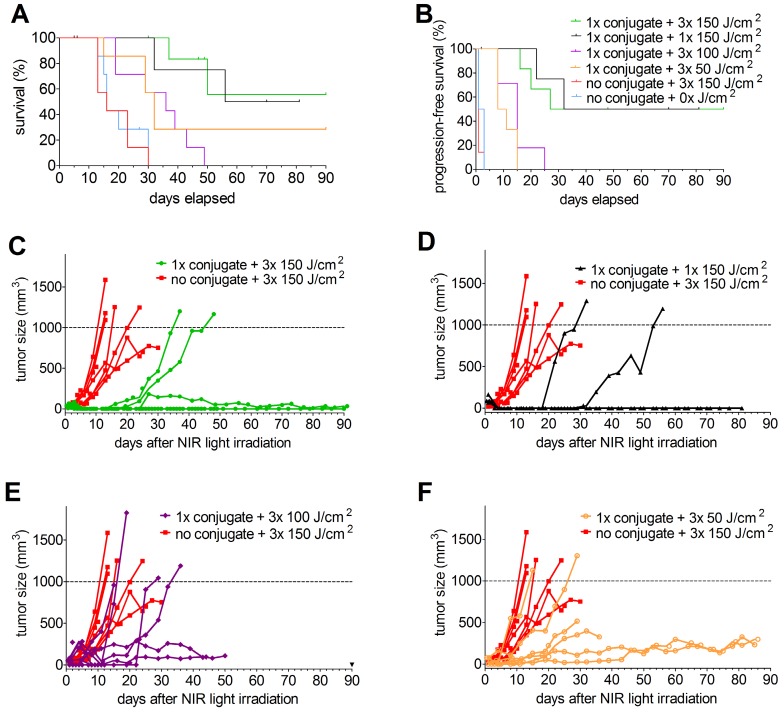
Prostate cancer (PCa) recurrences after surgery frequently occur. To improve the outcome after surgical resection of the tumor, the theranostic multimodal anti-PSMA targeting agent In-DTPA-D2B-IRDye700DX was developed and characterized for both pre- and intra-operative tumor localization and eradication of (residual) tumor tissue by PSMA-targeted photodynamic therapy (tPDT), which is a highly selective cancer treatment based on targeting molecules conjugated to photosensitizers that can induce cell destruction upon exposure to near-infrared (NIR) light. The anti-PSMA monoclonal antibody D2B was conjugated with IRDye700DX and DTPA and subsequently radiolabeled with In. To determine the optimal dose and time point for tPDT, BALB/c nude mice with PSMA-expressing (PSMA) s.c. LS174T-PSMA xenografts received the conjugate (24-240 µg/mouse) intravenously (8 MBq/mouse) followed by µSPECT/CT, near-infrared fluorescence imaging, and ex vivo biodistribution at 24, 48, 72 and 168 h p.i. Tumor growth of LS174T-PSMA xenografts and overall survival of mice treated with 1-3 times of NIR light irradiation (50, 100, 150 J/cm) 24 h after injection of 80 µg of DTPA-D2B-IRDye700DX was compared to control conditions. Highest specific tumor uptake was observed at conjugate doses of 80 µg/mouse. Biodistribution revealed no significant difference in tumor uptake in mice at 24, 48, 72 and 168 h p.i. PSMA tumors were clearly visualized with both µSPECT/CT and NIR fluorescence imaging. Overall survival in mice treated with 80 µg of DTPA-D2B-IRDye700DX and 1x 150 J/cm of NIR light at 24 h p.i. was significantly improved compared to the control group receiving neither conjugate nor NIR light (73 days vs. 16 days, respectively, p=0.0453). Treatment with 3x 150 J/cm resulted in significantly prolonged survival compared to treatment with 3x 100 J/cm (p = 0.0067) and 3x 50 J/cm (p = 0.0338). In-DTPA-D2B-IRDye700DX can be used for pre- and intra-operative detection of PSMA tumors with radionuclide and NIR fluorescence imaging and PSMA-targeted PDT. PSMA-tPDT using this multimodal agent resulted in significant prolongation of survival and shows great potential for treatment of (metastasized) prostate cancer.
前列腺癌(PCa)手术后经常复发。为了提高肿瘤切除术后的治疗效果,开发了一种用于前列腺特异性膜抗原(PSMA)靶向治疗的诊断和治疗的多模态抗 PSMA 靶向剂 In-DTPA-D2B-IRDye700DX,用于术前和术中肿瘤定位以及通过 PSMA 靶向光动力治疗(tPDT)消除(残留)肿瘤组织,tPDT 是一种基于与光敏剂结合的靶向分子的高度选择性癌症治疗方法,当暴露于近红外(NIR)光时可以诱导细胞破坏。 抗 PSMA 单克隆抗体 D2B 与 IRDye700DX 和 DTPA 缀合,随后用 In 标记。为了确定 tPDT 的最佳剂量和时间点,用表达 PSMA(PSMA)的皮下 LS174T-PSMA 异种移植的 BALB/c 裸鼠静脉内(每只小鼠 8 MBq)给予该缀合物(24-240μg/小鼠),然后在注射后 24、48、72 和 168 h 进行µSPECT/CT、近红外荧光成像和离体生物分布。与对照条件相比,比较了 LS174T-PSMA 异种移植肿瘤的生长和注射 80μg DTPA-D2B-IRDye700DX 后 24 小时接受 1-3 次 NIR 光照射(50、100、150 J/cm)的小鼠的总生存情况。在 24、48、72 和 168 h 时,观察到每个小鼠的肿瘤摄取特异性最高,在每个时间点,肿瘤摄取量在小鼠之间没有明显差异。µSPECT/CT 和 NIR 荧光成像均清晰显示 PSMA 肿瘤。与对照组(既未接受缀合物也未接受 NIR 光照射)相比,在注射后 24 h 接受 80μg DTPA-D2B-IRDye700DX 和 1x 150 J/cm 的 NIR 光照射的小鼠的总生存时间显著延长(分别为 73 天和 16 天,p=0.0453)。与 3x 100 J/cm(p = 0.0067)和 3x 50 J/cm(p = 0.0338)相比,用 3x 150 J/cm 进行治疗可显著延长生存时间。In-DTPA-D2B-IRDye700DX 可用于放射性核素和近红外荧光成像以及 PSMA 靶向 PDT 的术前和术中检测。使用这种多模态试剂进行 PSMA-tPDT 可显著延长生存时间,显示出治疗(转移性)前列腺癌的巨大潜力。