Vyakaranam Achyut Ram, Crona Joakim, Norlén Olov, Hellman Per, Sundin Anders
Section of Radiology & Molecular Imaging, Department of Surgical Sciences, Uppsala University, Akademiska Sjukhuset, SE-751 85 Uppsala, Sweden.
Department of Surgical Sciences, Uppsala University, Akademiska Sjukhuset, SE-751 85 Uppsala, Sweden.
Cancers (Basel). 2019 Jun 19;11(6):847. doi: 10.3390/cancers11060847.
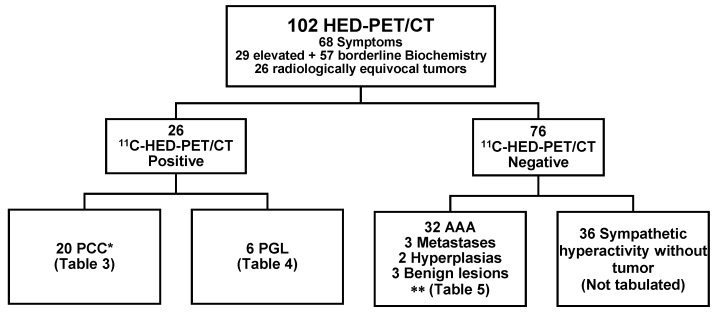
Pheochromocytomas (PCC) and paragangliomas (PGL) may be difficult to diagnose because of vague and uncharacteristic symptoms and equivocal biochemical and radiological findings. This was a retrospective cohort study in 102 patients undergoing C-hydroxy-ephedrine (C-HED)-PET/CT because of symptoms and/or biochemistry suspicious for PCC/PGL and/or with radiologically equivocal adrenal incidentalomas. Correlations utilized CT/MRI, clinical, biochemical, surgical, histopathological and follow-up data. C-HED-PET/CT correctly identified 19 patients with PCC and six with PGL, missed one PCC, attained one false positive result (nodular hyperplasia) and correctly excluded PCC/PGL in 75 patients. Sensitivity, specificity, positive and negative predictive values of C-HED-PET/CT for PCC/PGL diagnosis was 96%, 99%, 96% and 99%, respectively. In 41 patients who underwent surgical resection and for whom correlation to histopathology was available, the corresponding figures were 96%, 93%, 96% and 93%, respectively. Tumor C-HED-uptake measurements (standardized uptake value, tumor-to-normal-adrenal ratio) were unrelated to symptoms of catecholamine excess ( > 0.05) and to systolic blood pressure ( > 0.05). In PCC/PGL patients, norepinephrine and systolic blood pressure increased in parallel ( = 0.22, = 0.016). C-HED-PET/CT was found to be an accurate tool to diagnose and rule out PCC/PGL in complex clinical scenarios and for the characterization of equivocal adrenal incidentalomas. PET measurements of tumor C-HED uptake were not helpful for tumor characterization.
嗜铬细胞瘤(PCC)和副神经节瘤(PGL)可能难以诊断,因为其症状模糊且不具特征性,生化和放射学检查结果也不明确。这是一项回顾性队列研究,研究对象为102例因症状和/或生化检查结果怀疑患有PCC/PGL和/或肾上腺意外瘤放射学表现不明确而接受间碘苄胍(C-HED)-PET/CT检查的患者。研究采用了CT/MRI、临床、生化、手术、组织病理学和随访数据。C-HED-PET/CT正确识别出19例PCC患者和6例PGL患者,漏诊1例PCC,出现1例假阳性结果(结节性增生),并正确排除了75例患者的PCC/PGL。C-HED-PET/CT诊断PCC/PGL的敏感性、特异性、阳性预测值和阴性预测值分别为96%、99%、96%和99%。在41例接受手术切除且可与组织病理学进行对比的患者中,相应数值分别为96%、93%、96%和93%。肿瘤C-HED摄取测量值(标准化摄取值、肿瘤与正常肾上腺比值)与儿茶酚胺过量症状(>0.05)和收缩压(>0.05)无关。在PCC/PGL患者中,去甲肾上腺素和收缩压呈平行升高(r = 0.22,P = 0.016)。研究发现,C-HED-PET/CT是在复杂临床情况下诊断和排除PCC/PGL以及明确肾上腺意外瘤特征的准确工具。肿瘤C-HED摄取的PET测量值对肿瘤特征的判断并无帮助。