Morelli Vânia M, Sejrup Joakim K, Småbrekke Birgit, Rinde Ludvig B, Grimnes Gro, Isaksen Trond, Hansen John-Bjarne, Hindberg Kristian, Brækkan Sigrid K
K. G. Jebsen Thrombosis Research and Expertise Center (TREC), Department of Clinical Medicine, UiT - The Arctic University of Norway, Tromsø, Norway.
Division of Internal Medicine, University Hospital of North Norway, Tromsø, Norway.
TH Open. 2019 Feb 22;3(1):e50-e57. doi: 10.1055/s-0039-1681020. eCollection 2019 Jan.
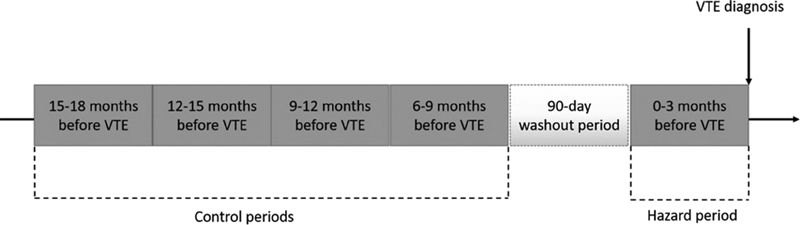
Stroke is associated with a short-term increased risk of subsequent venous thromboembolism (VTE). It is unclear to what extent this association is mediated by stroke-related complications that are potential triggers for VTE, such as immobilization and infection. We aimed to investigate the role of acute stroke as a trigger for incident VTE while taking other concomitant VTE triggers into account. We conducted a population-based case-crossover study with 707 VTE patients. Triggers were registered during the 90 days before a VTE event (hazard period) and in four preceding 90-day control periods. Conditional logistic regression was used to estimate odds ratios with 95% confidence intervals (CIs) for VTE according to triggers. Stroke was registered in 30 of the 707 (4.2%) hazard periods and in 6 of the 2,828 (0.2%) control periods, resulting in a high risk of VTE, with odds ratios of 20.0 (95% CI: 8.3-48.1). After adjustments for immobilization and infection, odds ratios for VTE conferred by stroke were attenuated to 6.0 (95% CI: 1.6-22.1), and further to 4.0 (95% CI: 1.1-14.2) when other triggers (major surgery, red blood cell transfusion, trauma, and central venous catheter) were added to the regression model. A mediation analysis revealed that 67.8% of the total effect of stroke on VTE risk could be mediated through immobilization and infection. Analyses restricted to ischemic stroke yielded similar results. In conclusion, acute stroke was a trigger for VTE, and the association between stroke and VTE risk appeared to be largely mediated by immobilization and infection.
中风与随后发生静脉血栓栓塞症(VTE)的短期风险增加相关。目前尚不清楚这种关联在多大程度上是由中风相关并发症介导的,这些并发症是VTE的潜在触发因素,如活动受限和感染。我们旨在研究急性中风作为新发VTE触发因素的作用,同时考虑其他伴随的VTE触发因素。我们对707例VTE患者进行了一项基于人群的病例交叉研究。在VTE事件发生前的90天(危险期)以及之前的四个90天对照期内记录触发因素。采用条件逻辑回归根据触发因素估计VTE的比值比及95%置信区间(CI)。在707个危险期中有30个(4.2%)记录到中风,在2828个对照期中有6个(0.2%)记录到中风,导致VTE风险很高,比值比为20.0(95%CI:8.3 - 48.1)。在对活动受限和感染进行调整后,中风导致VTE的比值比降至6.0(95%CI:1.6 - 22.1),当将其他触发因素(大手术、红细胞输血、创伤和中心静脉导管)加入回归模型时,进一步降至4.0(95%CI:1.1 - 14.2)。中介分析显示,中风对VTE风险的总效应中67.8%可通过活动受限和感染介导。仅限于缺血性中风的分析得出了类似结果。总之,急性中风是VTE的触发因素,中风与VTE风险之间的关联似乎很大程度上是由活动受限和感染介导的。