Lyons Larry R, Zou Ying, Nishimura Yukitoshi, Gallardo-Lacourt Bea, Angelopulos Vassilis, Donovan Eric F
1Department of Atmospheric and Oceanic Sciences, University of California, Los Angeles, CA 90095-1565 USA.
2Center for Space Physics and Department of Astronomy, Boston University, Boston, MA 02215 USA.
Earth Planets Space. 2018;70(1):81. doi: 10.1186/s40623-018-0857-x. Epub 2018 May 15.
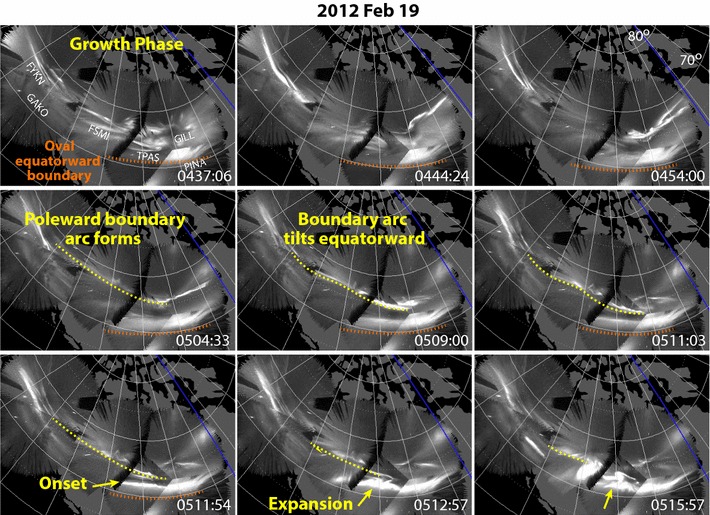
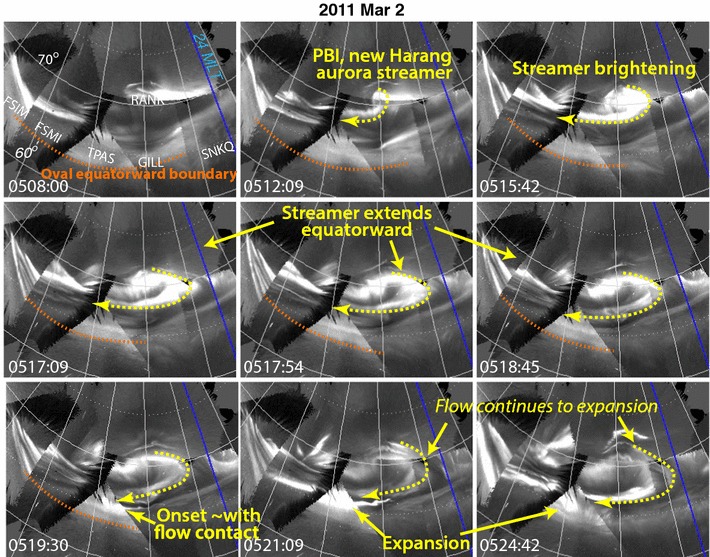
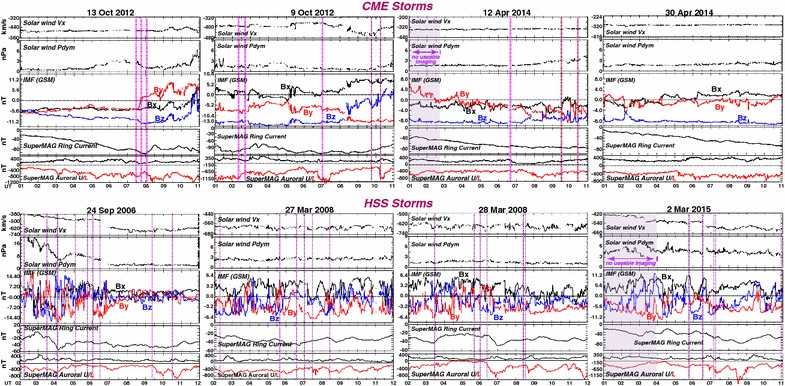
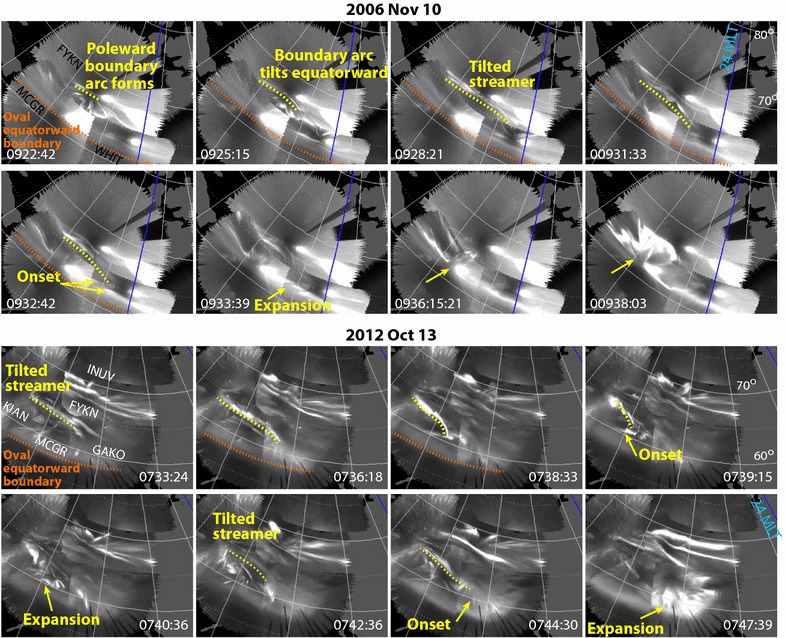
Bright auroral emissions during geomagnetic storms provide a good opportunity for testing the proposal that substorm onset is frequently triggered by plasma sheet flow bursts that are manifested in the ionosphere as auroral streamers. We have used the broad coverage of the ionospheric mapping of the plasma sheet offered by the high-resolution THEMIS all-sky-imagers (ASIs) and chose the main phases of 9 coronal mass ejection (CME) related and 9 high-speed stream (HSS)-related geomagnetic storms, and identified substorm auroral onsets defined as brightening followed by poleward expansion. We found a detectable streamer heading to near the substorm onset location for all 60 onsets that we identified and were observed well by the ASIs. This indicates that substorm onsets are very often triggered by the intrusion of plasma with lower entropy than the surrounding plasma to the onset region, with the caveat that the ASIs do not give a direct measure of the intruding plasma. The majority of the triggering streamers are "tilted streamers," which extend eastward as their eastern tip tilts equatorward to near the substorm onset location. Fourteen of the 60 cases were identified as "Harang streamers," where the streamer discernibly turns toward the west poleward of reaching to near the onset latitude, indicating flow around the Harang reversal. Using the ASI observations, we observed substantially less substorm onsets for CME storms than for HSS storms, a result in disagreement with a recent finding of approximately equal substorm occurrences. We suggest that this difference is a result of strong non-substorm streamers that give substorm-like signatures in ground magnetic field observations but are not substorms based on their auroral signature. Our results from CME storms with steady, strong southward IMF are not consistent with the ~ 2-4 h repetition of substorms that has been suggested for moderate to strong southward IMF conditions. Instead, our results indicate substantially lower substorm occurrence during such steady driving conditions. Our results also show the much more frequent occurrence of substorms during HSS period, which is likely due to the highly fluctuating IMF.
地磁暴期间明亮的极光发射为检验一种观点提供了一个很好的机会,该观点认为亚暴起始经常由等离子体片流爆发触发,这些爆发在电离层中表现为极光电弧。我们利用高分辨率THEMIS全天空成像仪(ASI)提供的对等离子体片的电离层映射的广泛覆盖,选择了9次与日冕物质抛射(CME)相关和9次与高速流(HSS)相关的地磁暴的主要阶段,并确定了亚暴极光起始,定义为亮度增强随后向极地方向扩展。我们发现,在我们确定并被ASI很好观测到的所有60次起始中,都有一条可探测到的极光电弧指向亚暴起始位置附近。这表明亚暴起始经常由熵比周围等离子体低的等离子体侵入起始区域触发,但需要注意的是,ASI不能直接测量侵入的等离子体。大多数触发极光电弧是“倾斜极光电弧”,它们向东延伸,其东端向赤道方向倾斜至亚暴起始位置附近。60个案例中有14个被确定为“哈朗极光电弧”,在这种情况下,极光电弧在到达起始纬度附近时明显转向西极方向,表明在哈朗反转附近有流动。利用ASI的观测结果,我们发现CME风暴的亚暴起始比HSS风暴少得多,这一结果与最近一项关于亚暴发生率大致相等的发现不一致。我们认为这种差异是由于强烈的非亚暴极光电弧在地面磁场观测中给出了类似亚暴的特征,但根据它们的极光特征并非亚暴。我们对具有稳定、强烈南向行星际磁场(IMF)的CME风暴的结果与在中等至强烈南向IMF条件下所提出的亚暴约2 - 4小时重复出现不一致。相反,我们的结果表明在这种稳定驱动条件下亚暴发生率要低得多。我们的结果还表明在HSS期间亚暴发生得更为频繁,这可能是由于IMF高度波动所致。