Department Cœur-Vaisseaux, Cardiac Surgery center, University Hospital of Lausanne, Lausanne, Switzerland.
Cardiovascular Research Center, University of Leicester, Leicester, UK.
Cardiovasc Drugs Ther. 2019 Aug;33(4):407-414. doi: 10.1007/s10557-019-06887-9.
In pulmonary hypertension (PH), hypoxia represents both an outcome and a cause of exacerbation. We addressed the question whether hypoxia adaptation might affect the mechanisms underlying PH alleviation through phosphodiesterase-5 (PDE5) inhibition.
Eight-week-old male Sprague-Dawley rats were divided into two groups depending on treatment (placebo or sildenafil, a drug inhibiting PDE5) and were exposed to hypoxia (10% O) for 0 (t0, n = 9/10), 2 (t2, n = 5/5) or 4 (t4, n = 5/5) weeks. The rats were treated (0.3 mL i.p.) with either saline or sildenafil (1.4 mg/Kg per day).
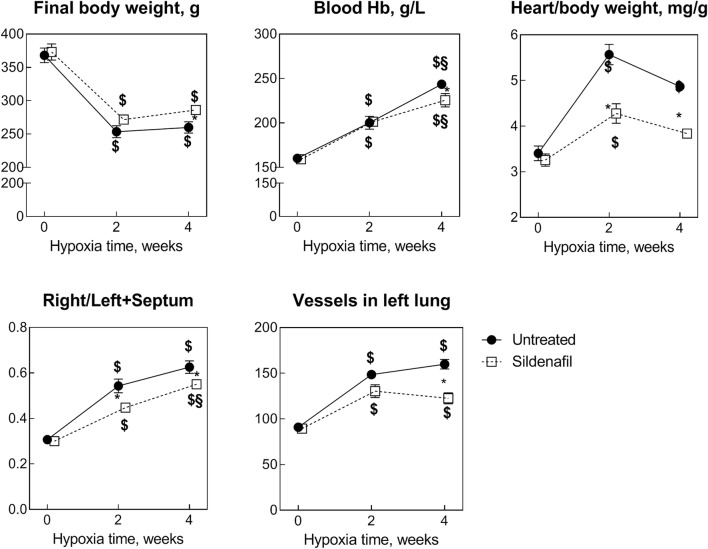
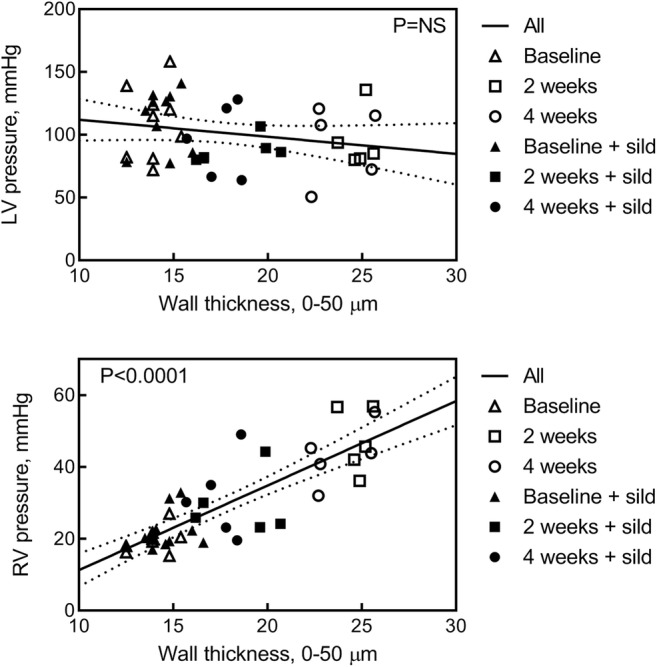
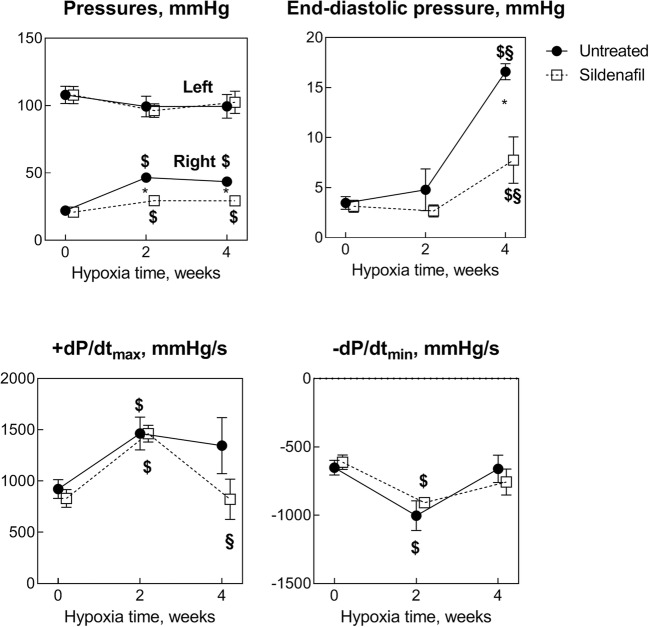
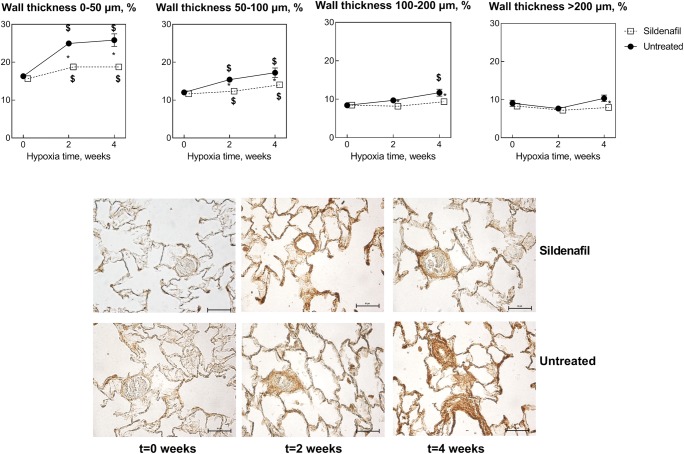
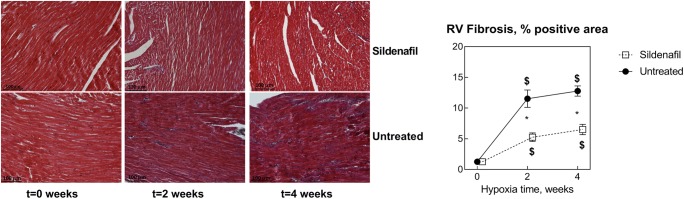
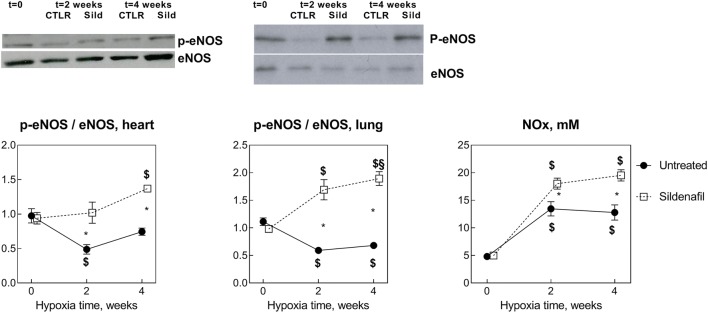
Two-week hypoxia changed the body weight (- 31% vs. - 27%, respectively, P = NS), blood hemoglobin (+ 25% vs. + 27%, P = NS) and nitrates+nitrites (+ 175% vs. + 261%, P = 0.007), right ventricle fibrosis (+ 814% vs. + 317%, P < 0.0001), right ventricle hypertrophy (+ 84% vs. + 49%, P = 0.007) and systolic pressure (+ 108% vs. + 41%, P = 0.001), pulmonary vessel density (+ 61% vs. + 46%, P = NS), and the frequency of small (< 50 µm wall thickness) vessels (+ 35% vs. + 13%, P = 0.0001). Most of these changes were maintained for 4-week hypoxia, except blood hemoglobin and right ventricle hypertrophy that continued increasing (+ 52% vs. + 42%, P = NS; and + 104% vs. + 83%, P = 0.04). To further assess these observations, small vessel frequency was found to be linearly related with the right ventricle-developed pressure independent of hypoxia duration.
Thus, although hypoxia adaptation is not yet accomplished after 4 weeks, PH alleviation by PDE5 inhibition might nevertheless provide an efficient strategy for the management of this disease.
在肺动脉高压(PH)中,缺氧既是病情恶化的结果也是原因。我们研究了缺氧适应是否会通过磷酸二酯酶-5(PDE5)抑制影响 PH 缓解的机制。
将 8 周龄雄性 Sprague-Dawley 大鼠根据治疗(安慰剂或西地那非,一种抑制 PDE5 的药物)分为两组,并暴露于缺氧(10% O2)0(t0,n = 9/10)、2(t2,n = 5/5)或 4(t4,n = 5/5)周。大鼠接受(0.3 mL i.p.)生理盐水或西地那非(1.4 mg/Kg 每天一次)治疗。
2 周的缺氧改变了体重(分别减少 31%和 27%,P = NS)、血血红蛋白(分别增加 25%和 27%,P = NS)和硝酸盐+亚硝酸盐(分别增加 175%和 261%,P = 0.007)、右心室纤维化(分别增加 814%和 317%,P < 0.0001)、右心室肥厚(分别增加 84%和 49%,P = 0.007)和收缩压(分别增加 108%和 41%,P = 0.001)、肺血管密度(分别增加 61%和 46%,P = NS)和小血管(<50 µm 壁厚)的频率(分别增加 35%和 13%,P = 0.0001)。这些变化中的大多数在 4 周的缺氧后仍持续存在,除了血血红蛋白和右心室肥厚继续增加(分别增加 52%和 42%,P = NS;和增加 104%和 83%,P = 0.04)。为了进一步评估这些观察结果,发现小血管频率与右心室发展压力呈线性相关,与缺氧持续时间无关。
因此,尽管 4 周后缺氧适应尚未完成,但 PDE5 抑制缓解 PH 可能仍然是治疗这种疾病的有效策略。