Department of Radiation Oncology, Sun Yat-sen University Cancer Center, Guangzhou, Guangdong Province, People's Republic of China.
State Key Laboratory of Oncology in South China, Guangzhou, Guangdong Province, People's Republic of China.
Cancer Med. 2019 Aug;8(10):4633-4643. doi: 10.1002/cam4.2339. Epub 2019 Jul 3.
To define the clinical characteristics and prognostic value of pre-retreatment plasma Epstein-Barr virus (EBV) DNA, we investigated EBV status in locoregional recurrent nasopharyngeal carcinoma (lrNPC) patients.
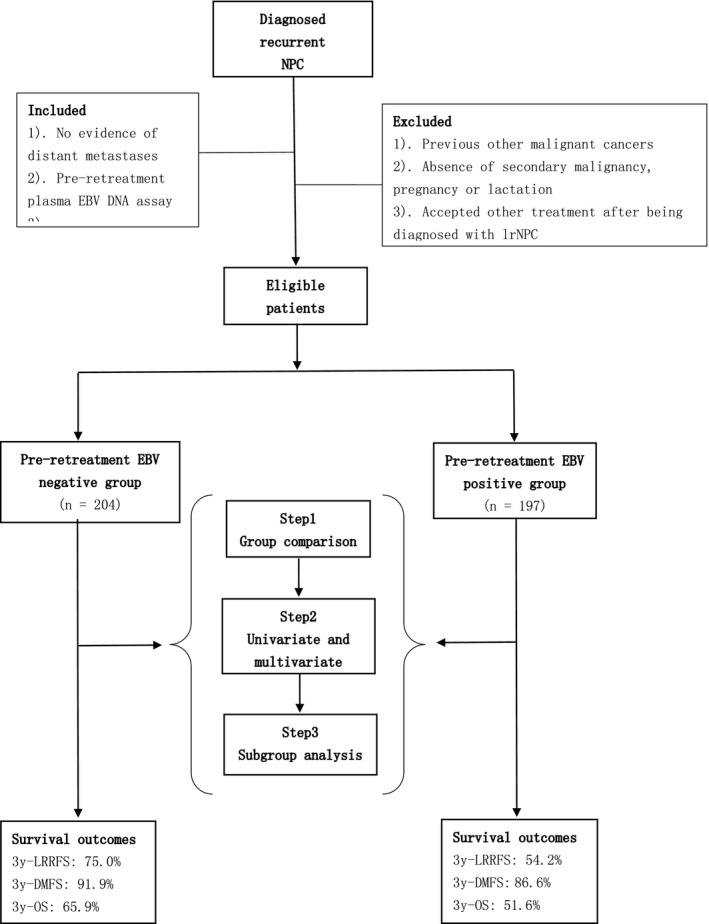
Between April 2008 and August 2016, the data of patients with nonmetastatic lrNPC were retrospectively reviewed. The survival indexes of patients between different pre-retreatment EBV status groups were compared.
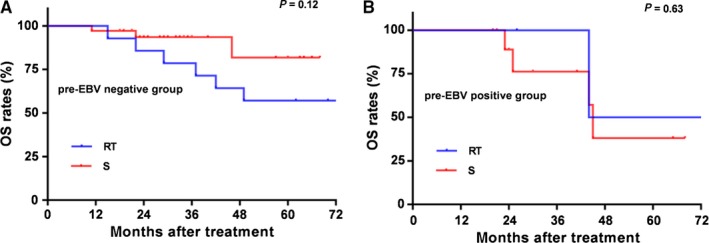
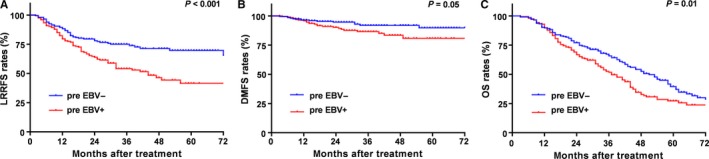
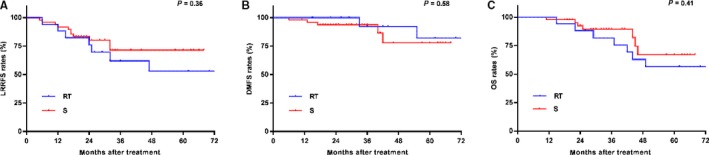
A total of 401 patients with nonmetastatic lrNPC were enrolled, and 197 (49.1%) patients had detectable pre-retreatment plasma EBV DNA. Treatment included radiotherapy alone (n = 37 patients), surgery alone (n = 105), radiotherapy (n = 208), surgery combined with radiotherapy (n = 20), chemotherapy and targeted therapy (n = 31). Median follow-up was 32 months. The 3-year locoregional relapse-free survival (LRRFS), distant metastasis-free survival (DMFS), and overall survival (OS) rates for the entire cohort were 64.8%, 89.4%, and 58.8%, respectively. The estimated 3-year LRRFS, DMFS, and OS rates for the pre EBV-positive group vs the pre EBV-negative group were 54.2% vs 75.0% (P < 0.001), 86.6% vs 91.9% (P = 0.05), 51.6% vs 65.9% (P = 0.01), respectively. Among patients in the clinical stage rI/II, there were 17 patients in the radiotherapy alone group and 49 patients in the surgery alone group. And there was no significant difference in overall survival between radiotherapy and surgery, even among the different pre-EBV statuses (P > 0.05). In terms of long-term toxic and side effects, the incidence of radioactive temporal lobe injury in the radiotherapy group was higher than that in the surgery group (35.3% vs 8.2%, P < 0.001), and no statistically significant difference was found in other long-term toxic and side effects.
The positive rate of pre-retreatment plasma EBV DNA in lrNPC is lower than primary NPC. The prognosis of EBV DNA negative group is better than positive group. For locally early-stage lrNPC, regardless of EBV DNA status, radiotherapy and surgery are available options and both can achieve better long-term survival.
为了明确治疗前血浆 Epstein-Barr 病毒(EBV)DNA 的临床特征和预后价值,我们对局部复发性鼻咽癌(lrNPC)患者的 EBV 状态进行了研究。
我们对 2008 年 4 月至 2016 年 8 月期间的局部复发性鼻咽癌患者的临床资料进行了回顾性分析。比较了不同治疗前 EBV 状态患者的生存指标。
共纳入 401 例局部复发性鼻咽癌患者,其中 197 例(49.1%)患者治疗前可检测到血浆 EBV DNA。治疗包括单纯放疗(n=37 例)、单纯手术(n=105 例)、放疗(n=208 例)、手术联合放疗(n=20 例)、化疗联合靶向治疗(n=31 例)。中位随访时间为 32 个月。全组患者的 3 年局部无复发生存率(LRRFS)、无远处转移生存(DMFS)和总生存(OS)率分别为 64.8%、89.4%和 58.8%。与 EBV 阴性组相比, EBV 阳性组的 3 年 LRRFS、DMFS 和 OS 率分别为 54.2%比 75.0%(P<0.001)、86.6%比 91.9%(P=0.05)和 51.6%比 65.9%(P=0.01)。在临床分期 rI/II 患者中,单纯放疗组 17 例,单纯手术组 49 例,放疗和手术的总生存差异无统计学意义(P>0.05),且与 EBV 状态无关。在长期毒性和副作用方面,放疗组放射性颞叶损伤的发生率高于手术组(35.3%比 8.2%,P<0.001),但其他长期毒性和副作用差异无统计学意义。
局部复发性鼻咽癌患者治疗前血浆 EBV DNA 的阳性率低于初治鼻咽癌患者。 EBV DNA 阴性组的预后好于阳性组。对于局部早期 lrNPC,无论 EBV DNA 状态如何,放疗和手术均为可行的选择,均可获得较好的长期生存。