Department of Surgical and Perioperative Sciences at Umeå University, Umeå.
Section of Orthopaedics, Department of Surgical Sciences, Uppsala University, Uppsala.
Acta Orthop. 2019 Dec;90(6):537-541. doi: 10.1080/17453674.2019.1637469. Epub 2019 Jul 4.
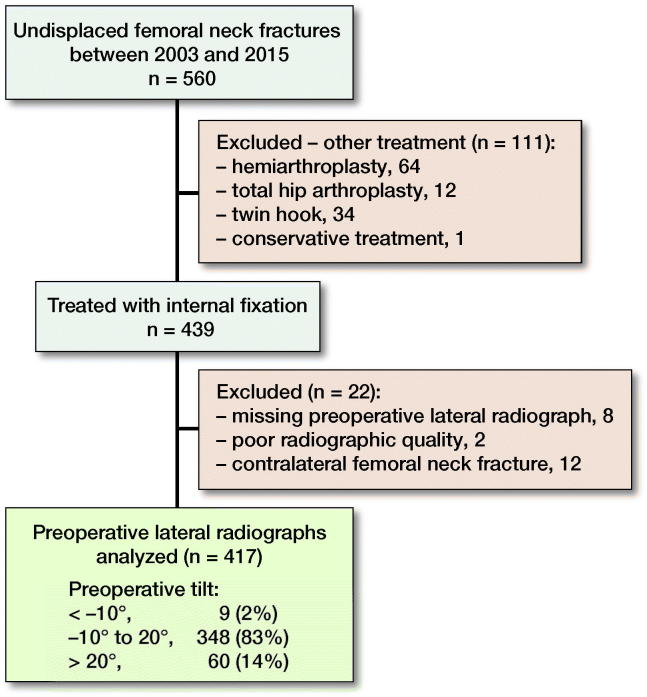
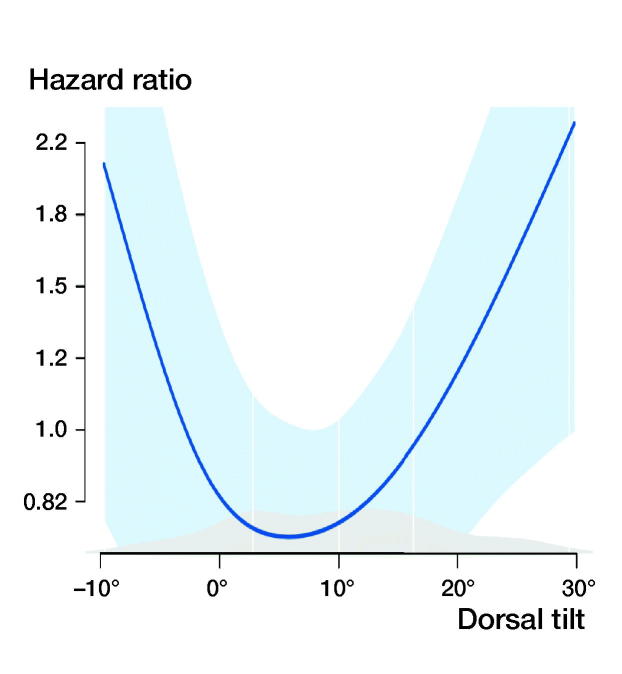
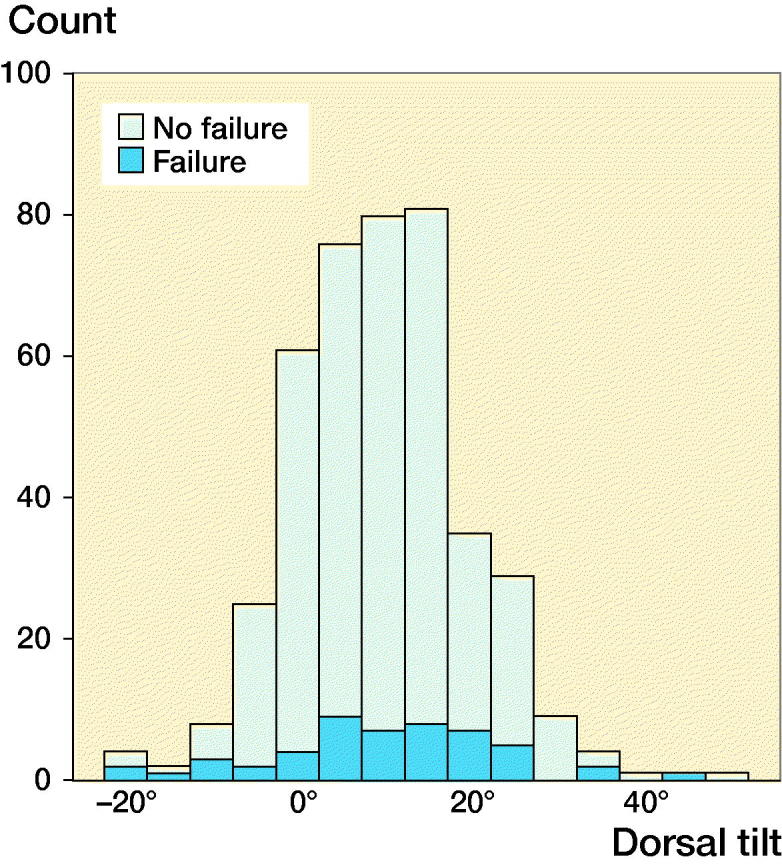
Background and purpose - Preoperative posterior tilt of the femoral head as seen on lateral radiographs has been reported to affect the risk of fixation failure in cases of minimally displaced femoral neck fractures (Garden I-II). We investigated radiological risk factors of treatment failure.Patients and methods - We included 417 patients (68% women, median age: 78 years (50-108) with a minimally displaced femoral neck fracture (Garden I-II) treated with internal fixation in a retrospective cohort study. The patients were followed for 3.4 years (2-14). Data on age, sex, housing, cognitive impairment, implant angulation, pre- and postoperative tilt, hip complications, and reoperations were recorded. The risk of fixation failure was assessed using Cox proportional hazards regression analysis.Results - The overall reoperation rate was 17%, and the rate of treatment failure (fixation failure, nonunion, avascular necrosis, or posttraumatic osteoarthritis) was 13%. Cox proportional hazard analysis revealed an increased risk of treatment failure with a preoperative posterior tilt of at least 20° and a preoperative anterior tilt greater than 10°. A failure occurred in 13 of the 65 patients with a posterior tilt of at least 20° and in 5 of the 9 patients with an anterior tilt greater than 10°.Interpretation - A preoperative posterior tilt of 20° and an anterior tilt greater than 10° in cases of Garden I and II femoral neck fractures increase the risk of fixation failure necessitating additional surgery. In this group of patients, there is a need for future interventional studies regarding the feasibility of primary hip arthroplasty.
背景与目的 - 侧位 X 线片上所见的股骨头术前前倾已被报道会影响股骨颈骨折(Garden I-II 型)微小移位病例内固定治疗失败的风险。我们研究了与治疗失败相关的影像学危险因素。
患者与方法 - 我们回顾性纳入了 417 例(68%为女性,中位年龄 78 岁(50-108 岁)的股骨颈骨折(Garden I-II 型)患者,这些患者接受了内固定治疗。研究纳入了最小移位型股骨颈骨折(Garden I-II 型)患者,平均随访 3.4 年(2-14 年)。记录了年龄、性别、住房、认知障碍、植入物角度、术前和术后倾斜、髋关节并发症和再手术的数据。使用 Cox 比例风险回归分析评估固定失败的风险。
结果 - 总的再手术率为 17%,治疗失败(固定失败、不愈合、股骨头坏死或创伤后骨关节炎)率为 13%。Cox 比例风险分析显示,术前前倾至少 20°和术前前倾大于 10°的患者治疗失败风险增加。在至少有 20°前倾的 65 例患者中有 13 例出现失败,在前倾大于 10°的 9 例患者中有 5 例出现失败。
结论 - Garden I 和 II 型股骨颈骨折患者术前前倾至少 20°和前倾大于 10°会增加固定失败的风险,需要进行额外的手术。在这组患者中,需要进一步的干预性研究来探讨原发性髋关节置换术的可行性。