Department of Forest and Wildlife Ecology, University of Wisconsin-Madison, 1630 Linden Dr., Madison, Wisconsin, 53706, USA.
Grupo de Investigaciones en Biología de la Conservación, Laboratorio Ecotono, INIBIOMA (CONICET-Universidad Nacional del Comahue), Quintral 1250, Bariloche, Rio Negro, 8400, Argentina.
Sci Rep. 2019 Jul 4;9(1):9680. doi: 10.1038/s41598-019-45769-w.
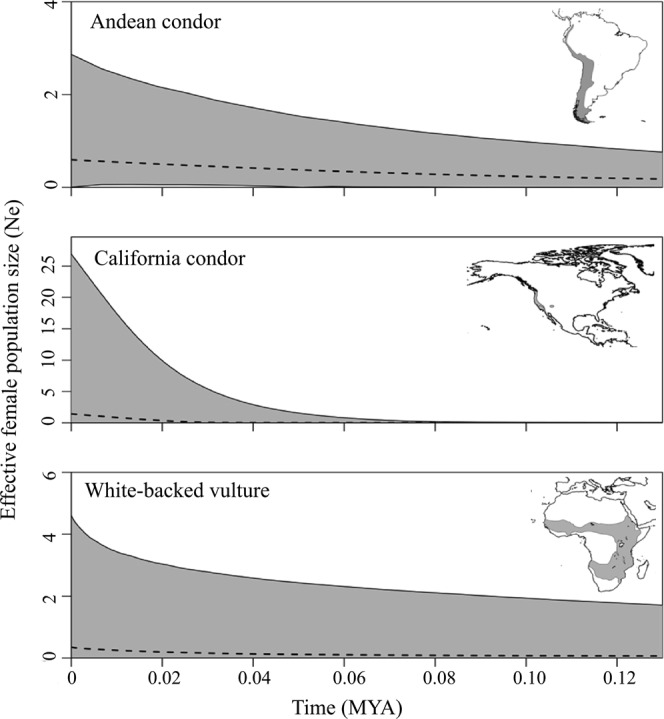
The late Quaternary megafauna extinctions reshaped species assemblages, yet we know little about how extant obligate scavengers responded to this abrupt ecological change. To explore whether obligate scavengers persisted by depending on contemporary community linkages or via foraging flexibility, we tested the importance of the trophic interaction between pumas (Puma concolor) and native camelids (Vicugna vicugna and Lama guanicoe) for the persistence of Andean condors (Vultur gryphus) in southern South America, and compared the demographic history of three vultures in different continents. We sequenced and compiled mtDNA to reconstruct past population dynamics. Our results suggest that Andean condors increased in population size >10 KYA, whereas vicuñas and pumas showed stable populations and guanacos a recent (<10 KYA) demographic expansion, suggesting independent trajectories between species. Further, vultures showed positive demographic trends: white-backed vultures (Gyps africanus) increased in population size, matching attenuated community changes in Africa, and California condors (Gymnogyps californianus) exhibited a steep demographic expansion ~20 KYA largely concurrent with North American megafaunal extinctions. Our results suggest that dietary plasticity of extant vulture lineages allowed them to thrive despite historical environmental changes. This dietary flexibility, however, is now detrimental as it enhances risk to toxicological compounds harbored by modern carrion resources.
晚第四纪巨型动物灭绝重塑了物种组合,但我们对现存的专性食腐动物如何应对这种突然的生态变化知之甚少。为了探索专性食腐动物是否通过依赖当代社区联系或通过觅食灵活性而得以持续存在,我们测试了美洲狮(Puma concolor)和本地骆驼(Vicugna vicugna 和 Lama guanicoe)与安第斯秃鹫(Vultur gryphus)之间的营养相互作用对其在南美洲南部的持久性的重要性,并比较了三种不同大陆秃鹫的种群历史。我们对 mtDNA 进行了测序和编译,以重建过去的种群动态。我们的结果表明,安第斯秃鹫的种群数量在>10 KYA 时增加,而骆马和美洲狮的种群保持稳定,羊驼则在最近(<10 KYA)出现了种群扩张,表明物种之间存在独立的轨迹。此外,秃鹫表现出积极的种群趋势:非洲白背秃鹫(Gyps africanus)的种群数量增加,与非洲社区变化减弱相匹配,加利福尼亚秃鹫(Gymnogyps californianus)在~20 KYA 时表现出急剧的种群扩张,与北美巨型动物灭绝大致同时发生。我们的结果表明,现存秃鹫谱系的饮食可塑性使它们能够在历史环境变化中茁壮成长。然而,这种饮食灵活性现在是有害的,因为它增加了对现代腐肉资源中含有的毒理学化合物的风险。