Department of Psychiatry, Kaohsiung Medical University Hospital, Kaohsiung, Taiwan.
Department of Psychiatry, School of Medicine, College of Medicine, Kaohsiung Medical University, Kaohsiung, Taiwan.
Int J Neuropsychopharmacol. 2019 Oct 1;22(10):609-615. doi: 10.1093/ijnp/pyz038.
We investigated the efficacy of electroconvulsive therapy in patients with major depressive disorder and concomitant anxiety symptoms and explored the relationships between depression symptoms and anxiety symptoms during acute electroconvulsive therapy.
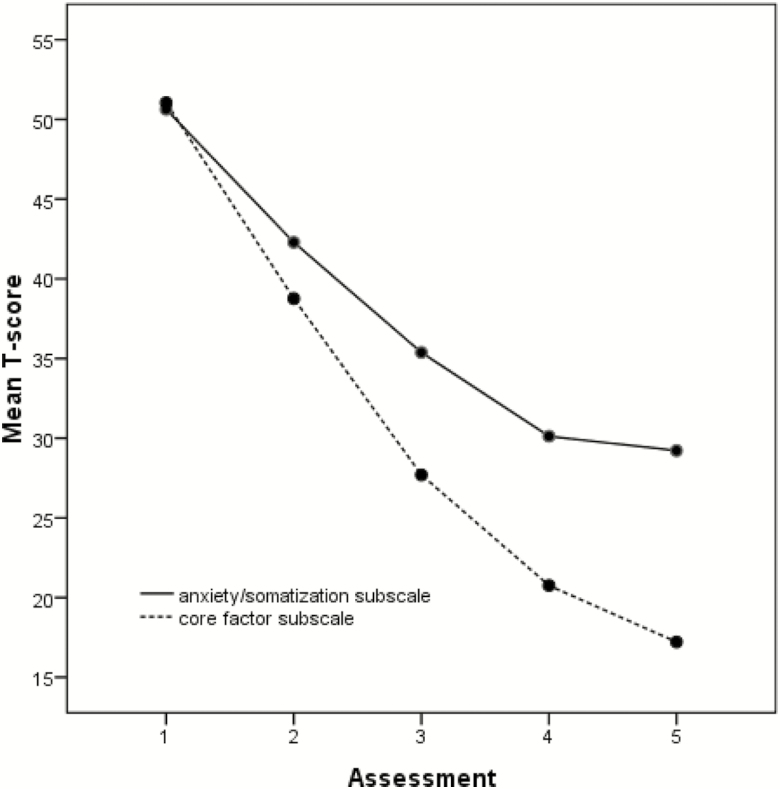
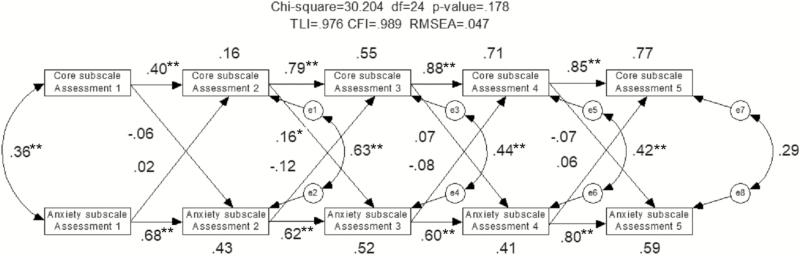
Major depressive disorder inpatients (N = 130) requiring electroconvulsive therapy were recruited for a maximum of 12 treatments each. Depression symptoms, using the core factor subscale derived from the 17-item Hamilton Depression Rating Scale, and anxiety symptoms, using the anxiety/somatization subscale from the Hamilton Depression Rating Scale-17, were assessed before electroconvulsive therapy, after every 3 electroconvulsive therapy treatments, and after the final electroconvulsive therapy. Both core factor subscale and anxiety/somatization subscale scores were converted to T-score units to compare the degrees of changes between depression symptoms and anxiety symptoms after electroconvulsive therapy. The relationships between core factor subscale and anxiety/somatization subscale were analyzed using the cross-lagged longitudinal model during acute electroconvulsive therapy.
A total 116 patients who completed at least the first 3 electroconvulsive therapy treatments were included in the analysis. Reduction of core factor scale T-scores was significantly greater than that of anxiety/somatization subscale T-scores. The model satisfied all indices of goodness-of-fit (chi-square = 30.204, df = 24, P = 0.178, Tucker-Lewis Index = 0.976, Comparative Fit Index = 0.989, Root Mean Square Error of Approximation = 0.047). Core factor subscale changes did not definitely predict subsequent anxiety/somatization subscale changes.
Electroconvulsive therapy is effective in the acute treatment of major depressive disorder patients associated with anxiety symptoms. Anxiety symptoms improved less than depression symptoms during acute electroconvulsive therapy. However, earlier reduction in depression symptoms does not definitely drive subsequent relief in anxiety symptoms.
我们研究了电抽搐治疗对伴有焦虑症状的重性抑郁障碍患者的疗效,并探讨了电抽搐治疗期间抑郁症状和焦虑症状之间的关系。
我们招募了 130 名需要电抽搐治疗的重性抑郁障碍住院患者,每位患者最多接受 12 次治疗。在电抽搐治疗前、每 3 次电抽搐治疗后和最后 1 次电抽搐治疗后,使用 17 项汉密尔顿抑郁量表的核心因子子量表评估抑郁症状,使用汉密尔顿抑郁量表-17 的焦虑/躯体化子量表评估焦虑症状。将核心因子子量表和焦虑/躯体化子量表的评分转换为 T 分数单位,以比较电抽搐治疗后抑郁症状和焦虑症状的变化程度。在电抽搐治疗期间,使用交叉滞后纵向模型分析核心因子子量表和焦虑/躯体化子量表之间的关系。
共有 116 名患者完成了至少前 3 次电抽搐治疗,纳入了分析。核心因子量表 T 分数的降低明显大于焦虑/躯体化子量表 T 分数的降低。该模型满足了所有良好拟合指标(卡方值=30.204,自由度=24,P=0.178,Tucker-Lewis 指数=0.976,比较拟合指数=0.989,近似均方根误差=0.047)。核心因子子量表的变化并不能明确预测随后的焦虑/躯体化子量表的变化。
电抽搐治疗对伴有焦虑症状的重性抑郁障碍患者在急性期是有效的。在电抽搐治疗期间,焦虑症状的改善不如抑郁症状明显。然而,抑郁症状的早期缓解并不能明确导致焦虑症状的随后缓解。