Adderley Nicola J, Subramanian Anuradhaa, Nirantharakumar Krishnarajah, Yiangou Andreas, Gokhale Krishna M, Mollan Susan P, Sinclair Alexandra J
Institute of Applied Health Research, University of Birmingham, Birmingham, United Kingdom.
Centre for Endocrinology, Diabetes, and Metabolism, Birmingham Health Partners, Birmingham, United Kingdom.
JAMA Neurol. 2019 Sep 1;76(9):1088-1098. doi: 10.1001/jamaneurol.2019.1812.
Cardiovascular disease (CVD) risk has not been previously evaluated in a large matched cohort study in idiopathic intracranial hypertension (IIH).
To estimate the risk of composite cardiovascular events, heart failure, ischemic heart disease, stroke/transient ischemic attack (TIA), type 2 diabetes, and hypertension in women with idiopathic intracranial hypertension and compare it with the risk in women, matched on body mass index (BMI) and age, without the condition; and to evaluate the prevalence and incidence of IIH.
DESIGN, SETTING, AND PARTICIPANTS: This population-based matched controlled cohort study used 28 years of data, from January 1, 1990, to January 17, 2018, from The Health Improvement Network (THIN), an anonymized, nationally representative electronic medical records database in the United Kingdom. All female patients aged 16 years or older were eligible for inclusion. Female patients with IIH (n = 2760) were included and randomly matched with up to 10 control patients (n = 27 125) by BMI and age.
Adjusted hazard ratios (aHRs) of cardiovascular outcomes were calculated using Cox regression models. The primary outcome was a composite of any CVD (heart failure, ischemic heart disease, and stroke/TIA), and the secondary outcomes were each CVD outcome, type 2 diabetes, and hypertension.
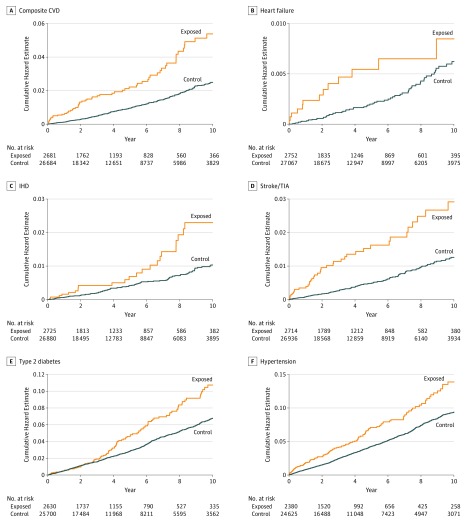
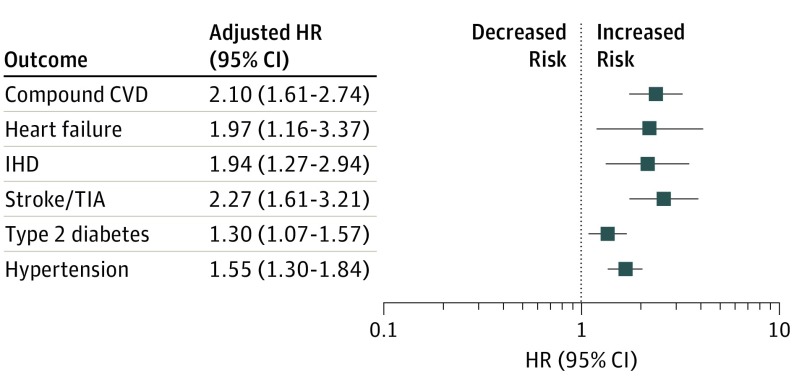
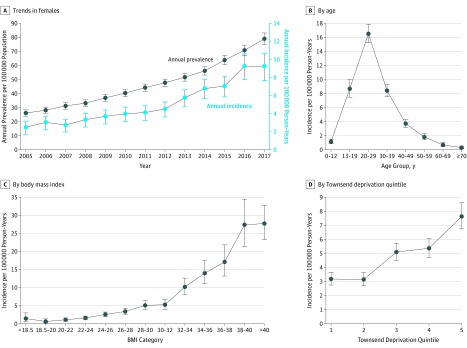
In total, 2760 women with IIH and 27 125 women without IIH were included. Age and BMI were similar between the 2 groups, with a median (interquartile range) age of 32.1 (25.6-42.0) years in the exposed group and 32.1 (25.7-42.1) years in the control group; in the exposed group 1728 women (62.6%) were obese, and in the control group 16514 women (60.9%) were obese. Higher absolute risks for all cardiovascular outcomes were observed in women with IIH compared with control patients. The aHRs were as follows: composite cardiovascular events, 2.10 (95% CI, 1.61-2.74; P < .001); heart failure, 1.97 (95% CI, 1.16-3.37; P = .01); ischemic heart disease, 1.94 (95% CI, 1.27-2.94; P = .002); stroke/TIA, 2.27 (95% CI, 1.61-3.21; P < .001); type 2 diabetes, 1.30 (95% CI, 1.07-1.57; P = .009); and hypertension, 1.55 (95% CI, 1.30-1.84; P < .001). The incidence of IIH in female patients more than tripled between 2005 and 2017, from 2.5 to 9.3 per 100 000 person-years. Similarly, IIH prevalence increased in the same period, from 26 to 79 per 100 000 women. Incidence increased markedly with BMI higher than 30.
Idiopathic intracranial hypertension in women appeared to be associated with a 2-fold increase in CVD risk; change in patient care to modify risk factors for CVD may reduce long-term morbidity for women with IIH and warrants further evaluation.
此前尚未在一项针对特发性颅内高压(IIH)的大型匹配队列研究中评估心血管疾病(CVD)风险。
评估特发性颅内高压女性发生复合心血管事件、心力衰竭、缺血性心脏病、中风/短暂性脑缺血发作(TIA)、2型糖尿病和高血压的风险,并将其与体重指数(BMI)和年龄相匹配的无此病女性的风险进行比较;评估IIH的患病率和发病率。
设计、背景和参与者:这项基于人群的匹配对照队列研究使用了来自英国一个匿名的、具有全国代表性的电子病历数据库“健康改善网络”(THIN)的28年数据,时间跨度为1990年1月1日至2018年1月17日。所有16岁及以上的女性患者均符合纳入标准。纳入患有IIH的女性患者(n = 2760),并按BMI和年龄将其与最多10名对照患者(n = 27125)进行随机匹配。
使用Cox回归模型计算心血管结局的调整风险比(aHRs)。主要结局是任何CVD(心力衰竭、缺血性心脏病和中风/TIA)的复合情况,次要结局是每种CVD结局、2型糖尿病和高血压。
总共纳入了2760例患有IIH的女性和27125例无IIH的女性。两组之间的年龄和BMI相似,暴露组的年龄中位数(四分位间距)为32.1(25.6 - 42.0)岁,对照组为32.1(25.7 - 42.1)岁;暴露组中1728名女性(62.6%)肥胖,对照组中16514名女性(60.9%)肥胖。与对照患者相比,IIH女性发生所有心血管结局的绝对风险更高。aHRs如下:复合心血管事件为2.10(95%CI,1.61 - 2.74;P <.001);心力衰竭为1.97(95%CI,1.16 - 3.37;P = 0.01);缺血性心脏病为1.94(95%CI,1.27 - 2.94;P = 0.002);中风/TIA为2.27(95%CI,1.61 - 3.21;P <.001);2型糖尿病为1.30(95%CI,1.07 - 1.57;P = 0.009);高血压为1.55(95%CI,1.30 - 1.84;P <.001)。2005年至2017年期间,女性患者中IIH的发病率增加了两倍多,从每10万人年2.5例增至9.3例。同样,同期IIH的患病率也有所增加,从每10万名女性26例增至79例。BMI高于30时发病率显著增加。
女性特发性颅内高压似乎与CVD风险增加两倍相关;改变患者护理方式以改变CVD风险因素可能会降低IIH女性的长期发病率,值得进一步评估。