
一种基于卡尔曼滤波和双速率控制的使用慢速传感器的自动驾驶车辆远程控制策略。
A Remote Control Strategy for an Autonomous Vehicle with Slow Sensor Using Kalman Filtering and Dual-Rate Control.
作者信息
Cuenca Ángel, Zhan Wei, Salt Julián, Alcaina José, Tang Chen, Tomizuka Masayoshi
机构信息
Instituto Universitario de Automática e Informática Industrial, Universitat Politècnica de València, 46022 València, Spain.
Mechanical Engineering Department, University of California, Berkeley, CA 94720, USA.
出版信息
Sensors (Basel). 2019 Jul 6;19(13):2983. doi: 10.3390/s19132983.
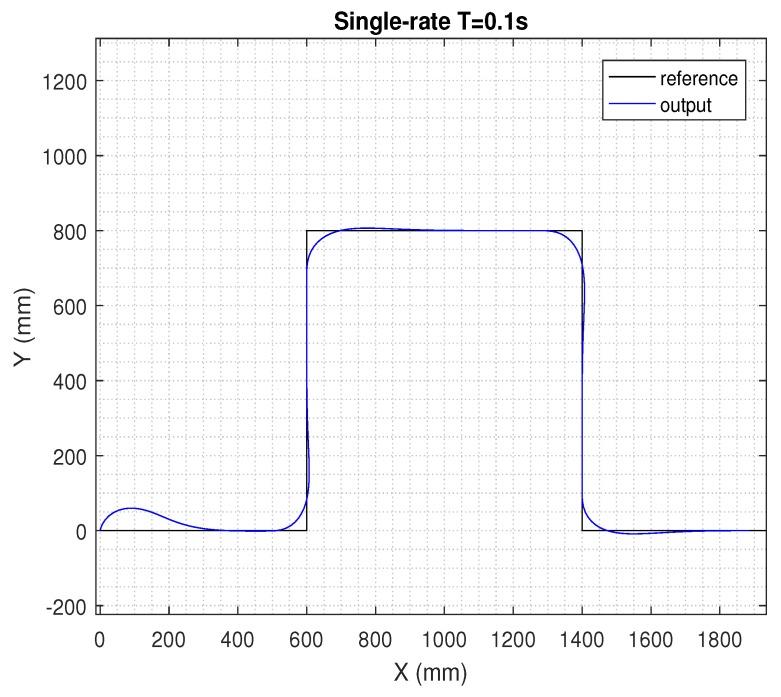
This work presents a novel remote control solution for an Autonomous Vehicle (AV), where the system structure is split into two sides. Both sides are assumed to be synchronized and linked through a communication network, which introduces time-varying delays and packet disorder. An Extended Kalman Filter (EKF) is used to cope with the non-linearities that appear in the global model of the AV. The EKF fuses the data provided by the sensing devices of the AV in order to estimate the AV state, reducing the noise effect. Additionally, the EKF includes an -step-ahead state prediction stage, which, together with the consideration of a packet-based control strategy, enables facing the network-induced delays. Since the AV position is provided by a camera, which is a slow sensing device, a dual-rate controller is required to achieve certain desired (nominal) dynamic control performance. The use of a dual-rate control framework additionally enables saving network bandwidth and deals with packet disorder. As the path-tracking control algorithm, pure pursuit is used. Application results show that, despite existing communication problems and slow-rate measurements, the AV is able to track the desired path, keeping the nominal control performance.
这项工作提出了一种针对自动驾驶车辆(AV)的新型远程控制解决方案,其中系统结构分为两部分。假定两侧通过通信网络进行同步和链接,这会引入时变延迟和数据包无序问题。扩展卡尔曼滤波器(EKF)用于处理自动驾驶车辆全局模型中出现的非线性问题。EKF融合自动驾驶车辆传感设备提供的数据以估计其状态,从而降低噪声影响。此外,EKF包括一个提前一步的状态预测阶段,该阶段与基于数据包的控制策略相结合,能够应对网络诱导延迟。由于自动驾驶车辆的位置由摄像头提供,而摄像头是一种慢速传感设备,因此需要一个双速率控制器来实现某些期望的(标称)动态控制性能。双速率控制框架的使用还能够节省网络带宽并处理数据包无序问题。作为路径跟踪控制算法,采用了纯追踪法。应用结果表明,尽管存在通信问题和低速率测量,但自动驾驶车辆仍能够跟踪期望路径,保持标称控制性能。




 Zotero 插件