Department of Development Studies, School of Public Health and Social Sciences, Muhimbili University of Health and Allied Sciences, P.O Box 65454, Dar es Salaam, Tanzania.
Department of International Health, Johns Hopkins Bloomberg School of Public Health, 615 N. Wolfe Street, Baltimore, MD, USA.
BMC Public Health. 2019 Jul 8;19(1):895. doi: 10.1186/s12889-019-7179-1.
It is recommended that Antenatal Care (ANC) be initiated within the first trimester of pregnancy for essential interventions, such folic acid supplementation, to be effective. In Tanzania, only 24% of mothers attend their first ANC appointment during their first trimester. Studies have shown that women who have had contact with a health worker are more likely to attend their first antenatal care appointment earlier in pregnancy. Community health workers (CHWs) are in an opportune position to be this contact. This study explored CHW experiences with identifying women early in gestation to refer them to facility-based antenatal care services in Morogoro, Tanzania.
This qualitative study employed 10 semi-structured focus group discussions, 5 with 34 CHWs and 5 with 34 recently delivered women in three districts in Morogoro, Tanzania. A thematic analytical approach was used to identify emerging themes among the CHW and RDW responses.
Study findings show CHWs play a major role in identifying pregnant women in their communities and linking them with health facilities. Lack of trust and other factors, however, affect early pregnancy identification by the CHWs. They utilize several methods to identify pregnant women, including: asking direct questions to households when collecting information on the national census, conducting frequent household visits and getting information about pregnant women from health facilities.
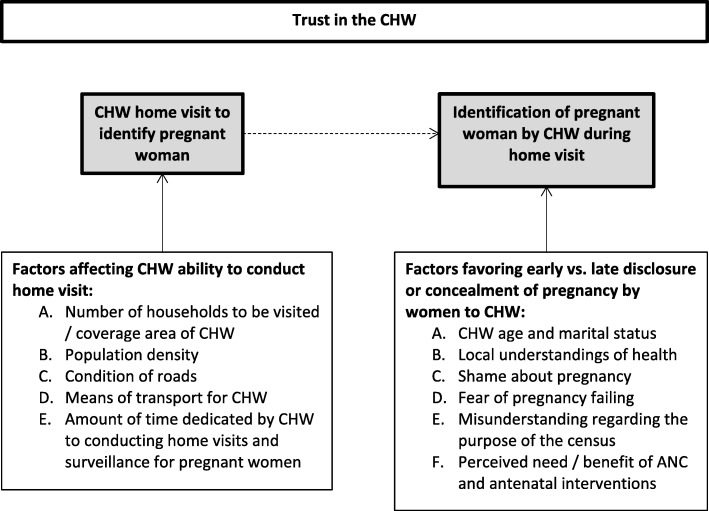
We present a framework for the interaction of factors that affect CHWs' ability to identify pregnant women early in gestation. Further studies need to be conducted investigating optimal workload for CHWs, as well as reasons pregnant women might conceal their pregnancies.
建议孕妇在怀孕的前三个月内接受第一次产前护理(ANC),以便能够有效地进行叶酸补充等基本干预措施。然而,在坦桑尼亚,只有 24%的母亲在怀孕的前三个月内接受第一次产前护理预约。研究表明,与卫生工作者有过接触的妇女更有可能在怀孕早期更早地预约第一次产前护理。社区卫生工作者(CHW)是能够接触到这些妇女的最佳人选。本研究探讨了 CHW 在莫罗戈罗地区识别早期妊娠妇女并将其转介到基于设施的产前护理服务的经验。
本定性研究采用了 10 次半结构式焦点小组讨论,其中 5 次是与 34 名 CHW 进行的,5 次是与 34 名最近分娩的妇女在坦桑尼亚莫罗戈罗的三个地区进行的。采用主题分析方法,从 CHW 和 RDW 的回答中确定出现的主题。
研究结果表明,CHW 在识别社区中的孕妇并将她们与卫生机构联系方面发挥了重要作用。然而,缺乏信任和其他因素影响了 CHW 对早期妊娠的识别。他们利用几种方法来识别孕妇,包括:在进行全国人口普查时直接向家庭询问问题,频繁进行家访,并从卫生机构获取孕妇信息。
我们提出了一个影响 CHW 早期识别孕妇能力的因素相互作用的框架。需要进一步研究,调查 CHW 的最佳工作量,以及孕妇可能隐瞒怀孕的原因。