HIV Dynamics and Replication Program, National Cancer Institute Frederick, National Institutes of Health, Frederick, MD, United States of America.
Cancer Research Technology Program, Leidos Biomedical Research Inc., Frederick National Laboratory for Cancer Research, Frederick MD, United States of America.
PLoS Pathog. 2019 Jul 10;15(7):e1007869. doi: 10.1371/journal.ppat.1007869. eCollection 2019 Jul.
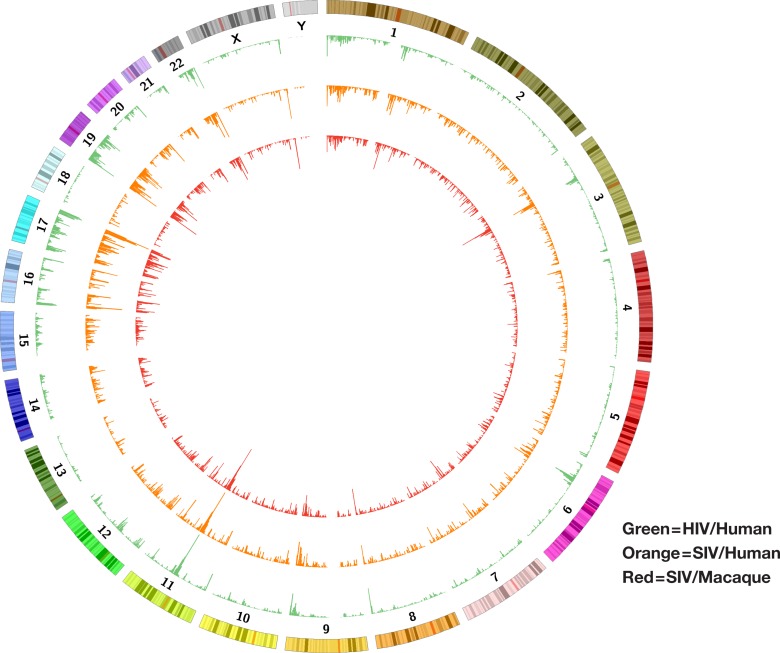
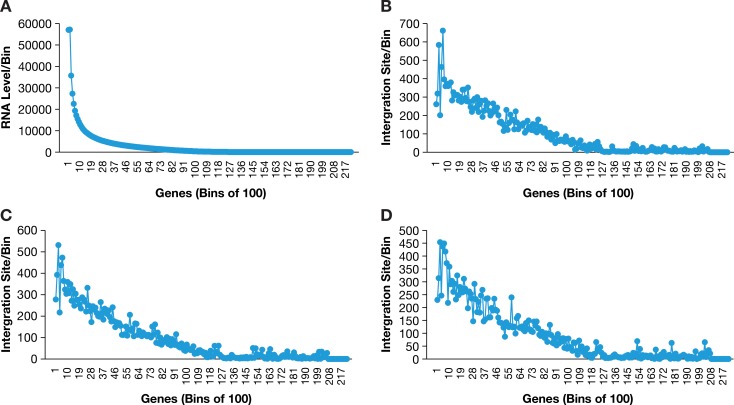
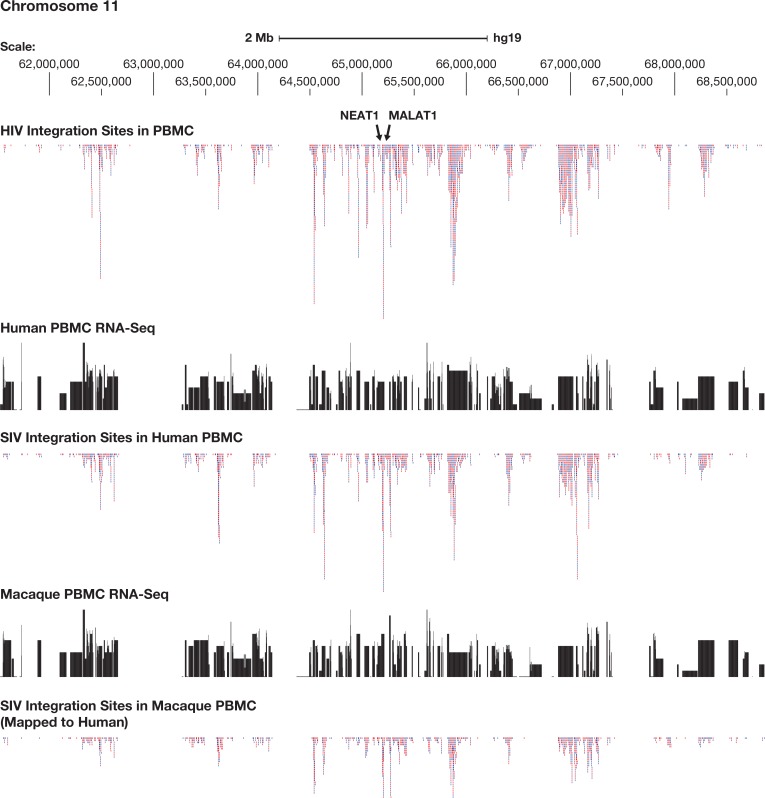
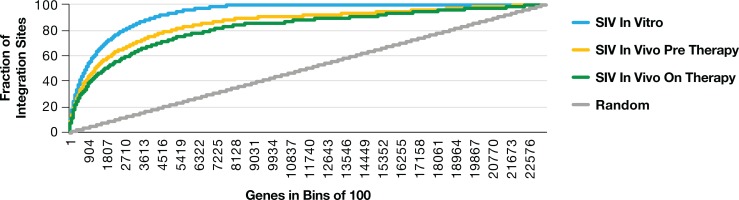
Clonal expansion of HIV infected cells plays an important role in the formation and persistence of the reservoir that allows the virus to persist, in DNA form, despite effective antiretroviral therapy. We used integration site analysis to ask if there is a similar clonal expansion of SIV infected cells in macaques. We show that the distribution of HIV and SIV integration sites in vitro is similar and that both viruses preferentially integrate in many of the same genes. We obtained approximately 8000 integration sites from blood samples taken from SIV-infected macaques prior to the initiation of ART, and from blood, spleen, and lymph node samples taken at necropsy. Seven clones were identified in the pre-ART samples; one persisted for a year on ART. An additional 100 clones were found only in on-ART samples; a number of these clones were found in more than one tissue. The timing and extent of clonal expansion of SIV-infected cells in macaques and HIV-infected cells in humans is quite similar. This suggests that SIV-infected macaques represent a useful model of the clonal expansion of HIV infected cells in humans that can be used to evaluate strategies intended to control or eradicate the viral reservoir.
HIV 感染细胞的克隆扩增在形成和维持病毒储库中起着重要作用,尽管有有效的抗逆转录病毒治疗,但这种储库仍能以 DNA 形式存在。我们使用整合位点分析来研究 SIV 感染的细胞是否存在类似的克隆扩增。我们发现,HIV 和 SIV 整合位点在体外的分布相似,并且两种病毒都优先整合到许多相同的基因中。我们从接受 SIV 感染的猕猴在开始接受抗逆转录病毒治疗之前的血液样本以及死后的血液、脾脏和淋巴结样本中获得了大约 8000 个整合位点。在 ART 之前的样本中鉴定出了 7 个克隆,其中一个在接受 ART 治疗一年后仍然存在。在接受 ART 的样本中还发现了另外 100 个克隆,其中一些克隆存在于多种组织中。SIV 感染的猕猴细胞和 HIV 感染的人类细胞的克隆扩增的时间和程度非常相似。这表明,感染 SIV 的猕猴代表了人类 HIV 感染细胞克隆扩增的有用模型,可以用来评估旨在控制或清除病毒储库的策略。