Luo Minxia, Robbins Megan L, Martin Mike, Demiray Burcu
Department of Psychology, University of Zurich, Zurich, Switzerland.
University Research Priority Program "Dynamics of Healthy Aging", University of Zurich, Zurich, Switzerland.
Front Psychol. 2019 Jun 25;10:1412. doi: 10.3389/fpsyg.2019.01412. eCollection 2019.
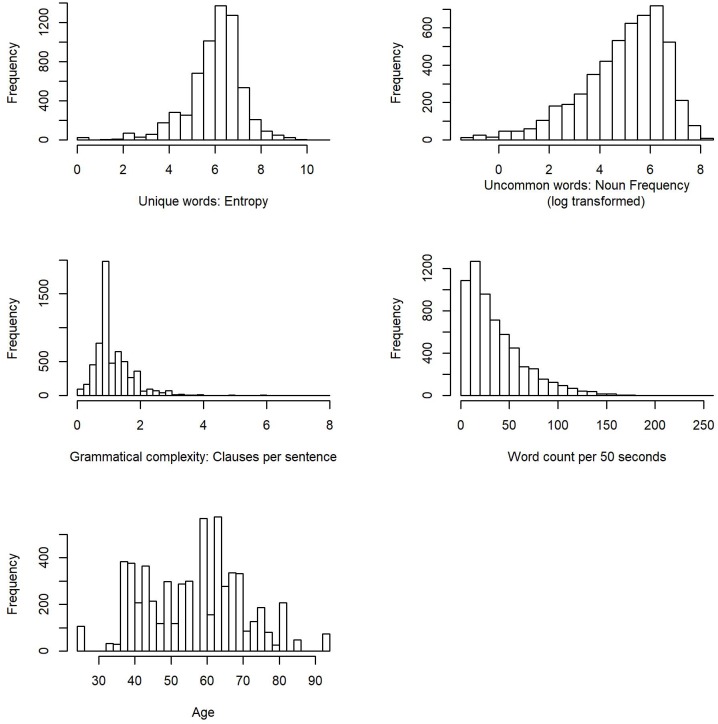
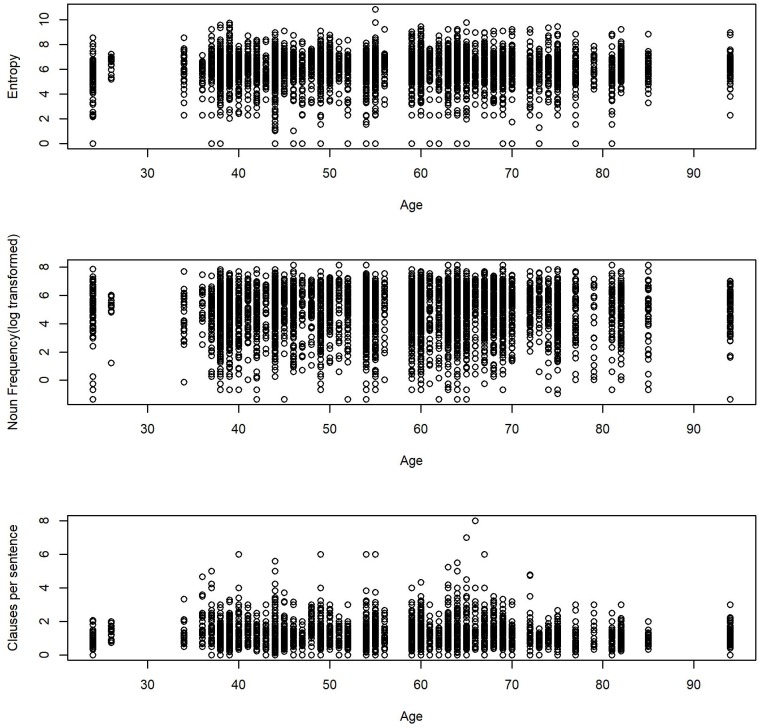
Amid the growing interest in studying language use in real life, this study, for the first time, examined age effects on real-life language use, as well as within-person variations across different interlocutors. We examined speech samples collected via the Electronically Activated Recorder (i.e., portable audio recorder that periodically records ambient sounds) for a larger project. This existing dataset included more than 18,000 sound snippets (50-s long) from 53 American couples (breast cancer patients and their spouses; aged 24 to 94 years) in their natural environments. Sound snippets that included participant speech were coded for different interlocutors and given scores on three linguistic measures that are associated with age-related cognitive changes: usage of unique words, usage of uncommon words, and grammatical complexity. Multilevel models showed that there were no age effects on the three linguistic measures when interlocutors were not taken into account. We found that interlocutors influenced usage of unique words and grammatical complexity. More specifically, compared to talking with their spouse, participants used fewer unique words with children and friends; and used simpler grammatical structures with children, strangers, and in multiparty conversations. Next, we found that interlocutors influenced the associations between age and language use. More specifically, young adults used more unique words and more uncommon words with children than older adults. They used more uncommon words with friends and uttered more complex grammatical structures with strangers than older adults. Our results offer preliminary evidence for a new perspective to understand real-life language use: focusing not only on individual characteristics (i.e., age), but also context (i.e., interlocutors). This perspective should be useful to researchers who are interested in collecting "big data" and understanding cognitive activities in real life.
在对现实生活中语言使用的研究兴趣日益浓厚的背景下,本研究首次考察了年龄对现实生活中语言使用的影响,以及不同对话者之间的个体差异。我们为一个更大的项目检查了通过电子激活录音机(即定期记录周围声音的便携式录音机)收集的语音样本。这个现有数据集包含来自53对美国夫妇(乳腺癌患者及其配偶;年龄在24岁至94岁之间)在自然环境中的18000多个声音片段(时长50秒)。包含参与者语音的声音片段针对不同对话者进行编码,并根据与年龄相关的认知变化相关的三项语言指标进行评分:独特词汇的使用、罕见词汇的使用和语法复杂性。多层次模型显示,在不考虑对话者的情况下,年龄对这三项语言指标没有影响。我们发现对话者会影响独特词汇的使用和语法复杂性。更具体地说,与和配偶交谈相比,参与者与孩子和朋友交谈时使用的独特词汇较少;与孩子、陌生人交谈以及在多方对话中使用的语法结构更简单。接下来,我们发现对话者会影响年龄与语言使用之间的关联。更具体地说,与年长者相比,年轻人与孩子交谈时使用的独特词汇更多、罕见词汇更多。与年长者相比,他们与朋友交谈时使用的罕见词汇更多,与陌生人交谈时说出的语法结构更复杂。我们的研究结果为理解现实生活中的语言使用提供了一个新视角的初步证据:不仅关注个体特征(即年龄),还关注语境(即对话者)。这一视角对于有兴趣收集“大数据”并理解现实生活中认知活动的研究人员应该是有用的。