Bao Dapeng, Zhou Junhong, Hao Ying, Yang Xuedong, Jiao Wei, Hu Yang, Wang Xiaoying
Sport Science Research Center, Beijing Sport University, Beijing, China.
The Hinda and Arthur Marcus Institute for Aging Research, Hebrew SeniorLife, Roslindale, MA, United States.
Front Neurol. 2019 Jun 21;10:654. doi: 10.3389/fneur.2019.00654. eCollection 2019.
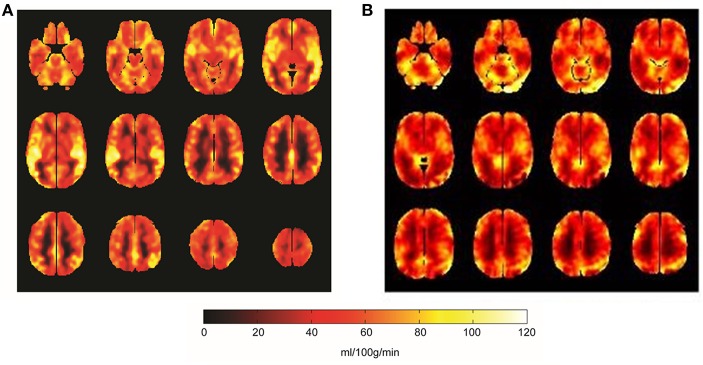
The fatigue in aerobic exercise affects the task performance. In addition to the fatigue in the muscular system, the diminished performance may arise from the altered cerebral blood supply and oxygen extraction. However, the effects of the fatiguing aerobic exercise on the ability of brain to regulate the cerebral blood flow (CBF) and to extract the oxygen are not fully understood. In this pilot study, we aim to quantify such effects via advanced functional MRI techniques. Twenty healthy younger elite athletes were recruited. In the screening visit, one circle ergometer test was used to screen the maximal relative oxygen consumption (V). Eleven eligible participants then completed the next MRI visit after 7 days. These participants completed a 2-min pulsed arterial spin labeling (ASL) using the PICORE/QUIPSS II and 5-min asymmetric spin echo (ASE) scan at baseline and immediately after the aerobic circle ergometer test. The CBF was then measured using the ASL images and the oxygen consumption of the brain was quantified using oxygen extraction fractions (OEF) derived from the ASE images. The test time, V, and anaerobic threshold were also recorded. As compared to baseline, participants had significant reduction of global CBF ( = 0.003). Specifically, the CBF in bilateral striatum, left middle temporal gyrus (MTG) and right inferior frontal gyrus (IFG) decreased significantly ( < 0.005, > 20). No significant changes of the OEFs were observed. Participants with greater OEF within the right striatum at baseline had longer test time, greater anaerobic threshold and relative V ( > 0.51, < 0.007). Those with longer test time had less reduction of CBF within the right IFG ( = 0.55, = 0.006) and of OEF within the left striatum ( = 0.52, = 0.008). Additionally, greater anaerobic threshold was associated with less reduction of OEF within the left MTG ( = 0.49, = 0.009). This pilot study provided first-of-its-kind evidence suggesting that the fatiguing aerobic exercise alters the cerebral blood supply in the brain, but has no significant effects on the ability of brain to extract oxygenation. Future studies are warranted to further establish the CBF and OEF as novel markers for physical and physiological function to help the assessment in the sports science and clinics.
有氧运动中的疲劳会影响任务表现。除了肌肉系统的疲劳外,表现下降可能源于脑供血和氧摄取的改变。然而,疲劳的有氧运动对大脑调节脑血流量(CBF)和摄取氧气能力的影响尚未完全了解。在这项初步研究中,我们旨在通过先进的功能磁共振成像技术量化此类影响。招募了20名健康的年轻精英运动员。在筛查访视中,使用一次蹬圈测力计测试来筛查最大相对耗氧量(V)。11名符合条件的参与者在7天后完成了下一次磁共振成像访视。这些参与者在基线时以及在有氧蹬圈测力计测试后立即使用PICORE/QUIPSS II完成了2分钟的脉冲动脉自旋标记(ASL)和5分钟的不对称自旋回波(ASE)扫描。然后使用ASL图像测量CBF,并使用从ASE图像得出的氧摄取分数(OEF)量化大脑的耗氧量。还记录了测试时间、V和无氧阈值。与基线相比,参与者的全脑CBF显著降低( = 0.003)。具体而言,双侧纹状体、左侧颞中回(MTG)和右侧额下回(IFG)的CBF显著降低( < 0.005, > 20)。未观察到OEF有显著变化。基线时右侧纹状体内OEF较高的参与者测试时间更长、无氧阈值和相对V更大( > 0.51, < 0.007)。测试时间较长的参与者右侧IFG内CBF的降低较少( = 0.55, = 0.006),左侧纹状体内OEF的降低较少( = 0.52, = 0.008)。此外,较高的无氧阈值与左侧MTG内OEF的降低较少相关( = 0.49, = 0.009)。这项初步研究提供了首个此类证据,表明疲劳的有氧运动改变了大脑的脑供血,但对大脑摄取氧合的能力没有显著影响。未来的研究有必要进一步将CBF和OEF确立为身体和生理功能的新标志物,以帮助体育科学和临床评估。