Khattab Hala A H, Abounasef Seham K, Bakheet Haneen L
Department of Food and Nutrition, Faculty of Home Economics, King Abdulaziz University, Jeddah, Saudi Arabia.
Department of Nutrition and Food Science, Faculty of Home Economics, Helwan University, Cairo, Egypt.
J Microsc Ultrastruct. 2019 Apr-Jun;7(2):65-71. doi: 10.4103/JMAU.JMAU_62_18.
The immune system is the body's defense against foreign organisms and harmful chemicals. Cyclosporine A (CsA) is an immunosuppressant drug widely used. root (EPR) extract is used as an immunostimulant plant.
The present study aimed at evaluation of the EPR effects against the CsA immunosuppressive rat model.
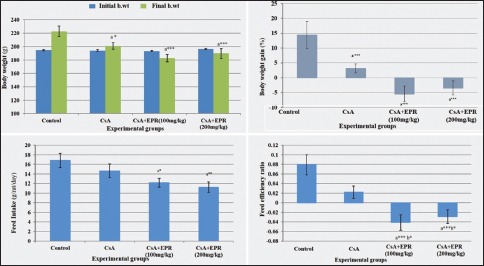
Thirty-two male Wistar albino rats were randomly divided into control, CsA (immunosuppressive models), CsA + EPR (100 mg/kg/day orally), and CsA + EPR (200 mg/kg/day orally). The biological parameters regarding the food consumption were assessed including feed intake (FI), feed efficiency ratio (FER), and body weights (BW). In addition, the splenic specimens were assessed histopathology. The blood was collected for measuring the blood parameters. All the measured parameters were collected and statistically analyzed. The biological results indicated a significant decrease in BW, FI, and FER in rats treated orally with low and high EPR doses as compared to the control group.
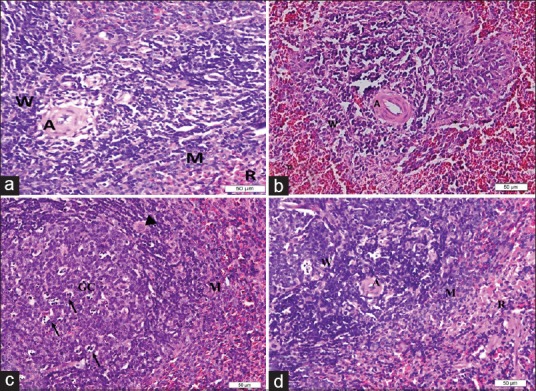
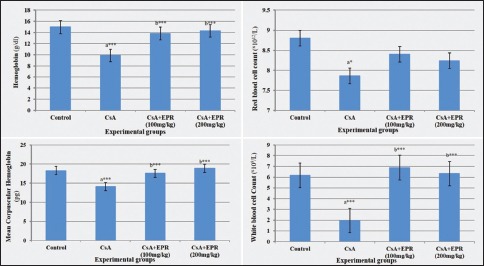
The results displayed that the CsA induced a significant decrease in red blood cells (RBCs) and white blood cells (WBCs) count. Histopathologically, CsA induced a marked decrease in the cellularity of the white pulp with congested blood sinusoids of the red pulp together with significant depletion of periarteriolar lymphoid sheath. Both the high and low doses of EPR significantly reversed the altered RBCs and WBCs counts. Histopathologically, both the low and high doses of EPR displayed apparently increase in the periarteriolar area together with the persistence of the congestion of the red pulp blood sinusoids compared to CsA group, indicating partial amelioration of the structural changes.
In a nutshell, the current findings revealed that EPR extract ameliorated the hematological changes. However, there was a partial correction of the CsA-induced microscopic changes of the rat spleen.
免疫系统是人体抵御外来生物体和有害化学物质的防御系统。环孢素A(CsA)是一种广泛使用的免疫抑制药物。紫锥菊根(EPR)提取物被用作免疫刺激植物。
本研究旨在评估EPR对CsA免疫抑制大鼠模型的影响。
将32只雄性Wistar白化大鼠随机分为对照组、CsA组(免疫抑制模型组)、CsA + EPR组(口服100 mg/kg/天)和CsA + EPR组(口服200 mg/kg/天)。评估与食物消耗相关的生物学参数,包括采食量(FI)、饲料效率比(FER)和体重(BW)。此外,对脾脏标本进行组织病理学评估。采集血液以测量血液参数。收集所有测量参数并进行统计分析。生物学结果表明,与对照组相比,口服低剂量和高剂量EPR的大鼠BW、FI和FER显著降低。
结果显示,CsA导致红细胞(RBCs)和白细胞(WBCs)计数显著降低。组织病理学上,CsA导致白髓细胞数量显著减少,红髓血窦充血,动脉周围淋巴鞘明显减少。高剂量和低剂量的EPR均显著逆转了RBCs和WBCs计数的改变。组织病理学上,与CsA组相比,低剂量和高剂量的EPR均显示动脉周围区域明显增加,红髓血窦充血持续存在,表明结构变化得到部分改善。
简而言之,目前的研究结果表明EPR提取物改善了血液学变化。然而,CsA诱导的大鼠脾脏微观变化仅得到部分纠正。