Drinkwater Eric J, Latella Christopher, Wilsmore Christopher, Bird Stephen P, Skein Melissa
Centre for Sport Research, School of Exercise and Nutrition Sciences, Deakin University, Geelong, VIC, Australia.
Centre for Exercise and Sports Science Research (CESSR), School of Health and Medical Sciences, Edith Cowan University, Joondalup, WA, Australia.
Front Physiol. 2019 Jun 26;10:768. doi: 10.3389/fphys.2019.00768. eCollection 2019.
Recovery from exercise-induced muscle damage (EIMD) is paramount in sports performance. Foam rolling (FR) has been suggested to improve acute performance; however, the ability to facilitate recovery from eccentric (ECC) exercise remains unclear.
Eleven males undertook 6 × 25 ECC knee extensions to induce muscular damage. Immediately, 24, 48, and 72 h post-training countermovement jump (CMJ), maximal voluntary isometric contraction (MVIC), pressure-pain threshold (PPT), knee flexion range of motion (ROM), and mid-thigh circumference (MTC) were assessed. Neurophysiological measures included voluntary activation (VA), peak twitch torque (PTT), time to peak twitch (PTT), and rate of twitch torque development (RTD). Participants then spent 15 min FR prior to each time point or control (CON). Repeated measures analysis of variance (ANOVA) and standardized effect sizes (Hedges' ) ± 95% confidence intervals (95% CI) were used to compare FR and CON.
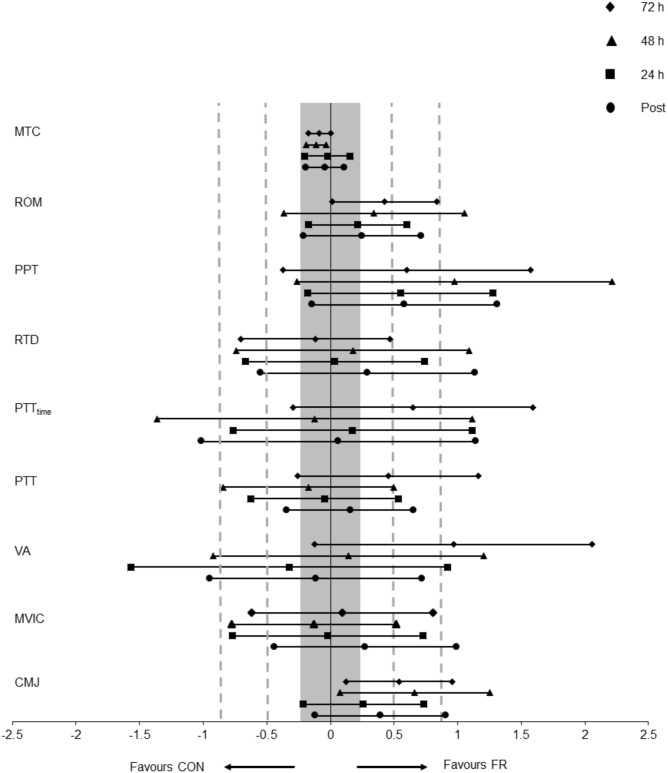
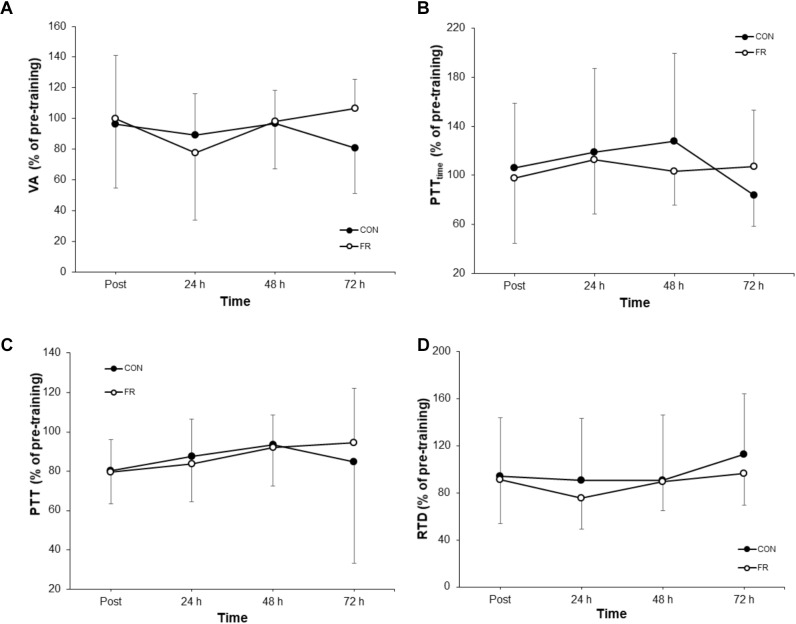
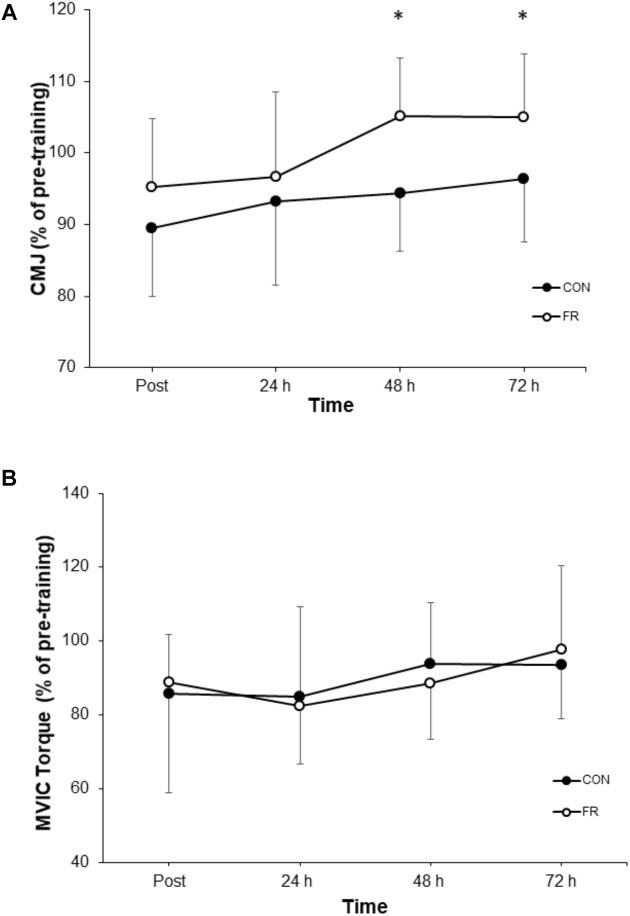
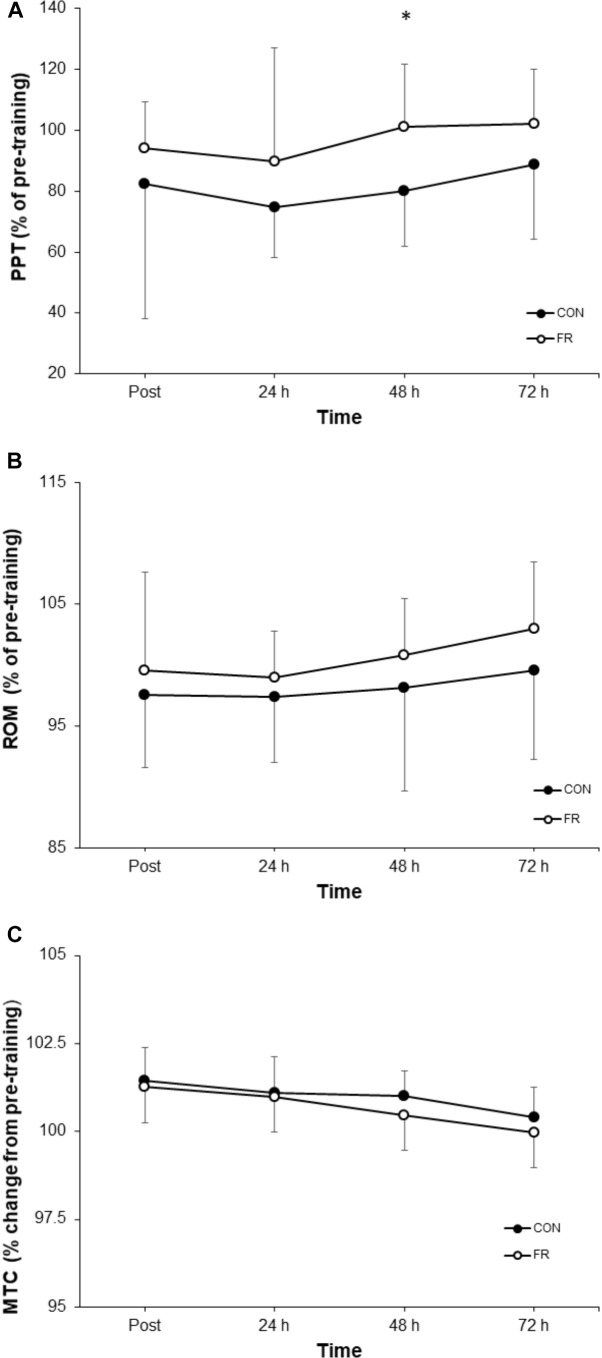
CMJ was greater for FR compared to CON ( = 0.030) at 72 h (8.6%, = 0.004) with moderate effects observed at 48 and 72 h ( = 0.54-0.66). PPT was greater with FR ( = 0.018) at 48 h only (23.7%, = 0.013), with moderate to large effects noted at all-time points ( = 0.55-0.98). No significant differences were reported for MVIC ( = 0.777, -5.1 to 4.2%), ROM ( = 0.432, 1.6-3.5%), VA ( = 0.050, 3.6-26.2%), PTT ( = 0.302, -3.9 to 9.9%), PTT ( = 0.702, -24.4 to 23.5%), RTD ( = 0.864, -16.0 to -1.0%), or MTC ( = 0.409, -0.5 to -0.1%) between conditions.
FR appears to improve jump performance in the later stages of recovery following ECC exercise. This may be in part due to improved pain tolerance; however, mechanical and neurophysiological are not modulated with FR.
从运动诱导的肌肉损伤(EIMD)中恢复对于运动表现至关重要。有人提出泡沫轴放松(FR)可改善急性运动表现;然而,其促进离心(ECC)运动后恢复的能力尚不清楚。
11名男性进行6组每组25次的ECC膝关节伸展运动以诱导肌肉损伤。在训练后即刻、24小时、48小时和72小时评估反向运动跳跃(CMJ)、最大自主等长收缩(MVIC)、压痛阈值(PPT)、膝关节屈曲活动范围(ROM)和大腿中部周长(MTC)。神经生理学指标包括自主激活(VA)、峰值抽搐扭矩(PTT)、达到峰值抽搐的时间(PTT)和抽搐扭矩发展速率(RTD)。然后,参与者在每个时间点之前进行15分钟的FR或作为对照(CON)。采用重复测量方差分析(ANOVA)和标准化效应量(Hedges')±95%置信区间(95%CI)来比较FR和CON。
与CON相比,FR在72小时时的CMJ更大(=0.030)(8.6%,=0.004),在48小时和72小时观察到中等效应(=0.54 - 0.66)。仅在48小时时,FR的PPT更大(=0.018)(23.7%,=0.013),在所有时间点均观察到中等至较大效应(=0.55 - 0.98)。在MVIC(=0.777,-5.1至4.2%)、ROM(=0.432,1.6至3.5%)、VA(=0.050,3.6至26.2%)、PTT(=0.302,-3.9至9.9%)、PTT(=0.702,-24.4至23.5%)、RTD(=0.864,-16.0至-1.0%)或MTC(=0.409,-0.5至-0.1%)方面,两种情况之间未报告显著差异。
FR似乎能改善ECC运动后恢复后期的跳跃表现。这可能部分归因于疼痛耐受性的提高;然而,FR并未调节机械和神经生理学指标。