Xu Guochao, Wu Anning, Xiao Lin, Han Ruizhi, Ni Ye
The Key Laboratory of Industrial Biotechnology, Ministry of Education, School of Biotechnology, Jiangnan University, Wuxi, 214122 Jiangsu China.
Biotechnol Biofuels. 2019 Jun 28;12:164. doi: 10.1186/s13068-019-1507-7. eCollection 2019.
has been proved to be one promising platform chassis for the production of various natural products, such as biofuels. Product toxicity is one of the main bottlenecks for achieving maximum production of biofuels. Host strain engineering is an effective approach to alleviate solvent toxicity issue in fermentation.
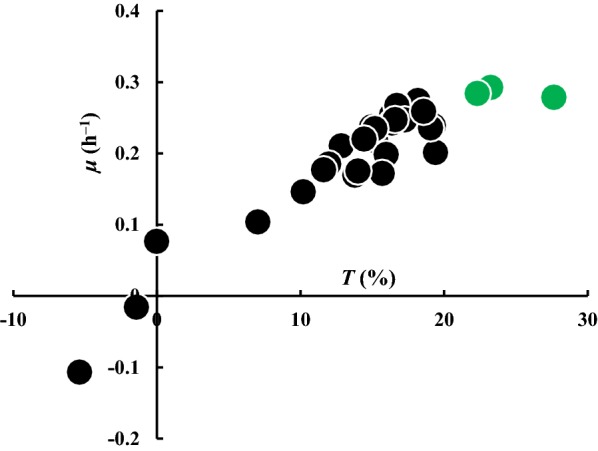
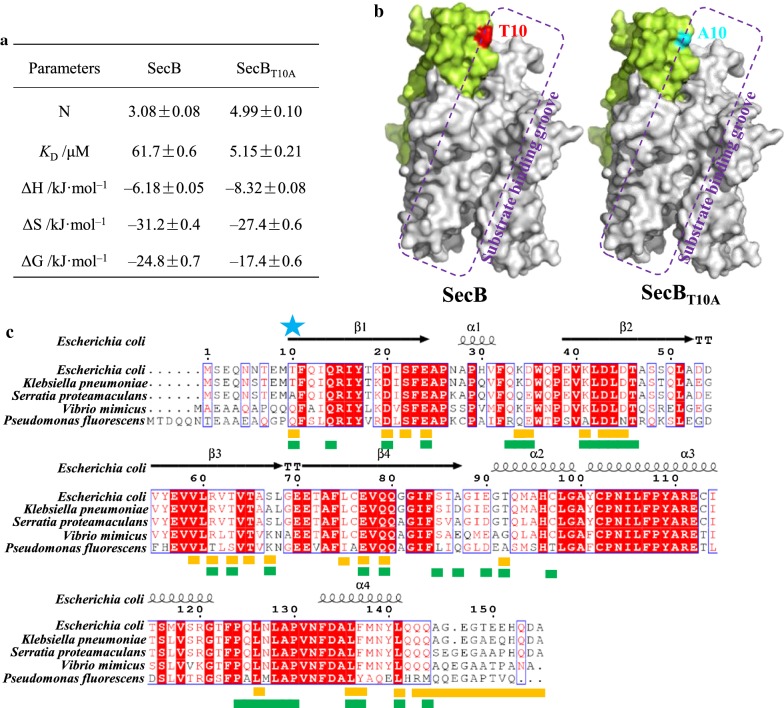
Thirty chaperones were overexpressed in JM109, and SecB recombinant strain was identified with the highest -butanol tolerance. The tolerance () of overexpressing SecB, calculated by growth difference in the presence and absence of solvents, was determined to be 9.13% at 1.2% (v/v) butanol, which was 3.2-fold of the control strain. Random mutagenesis of SecB was implemented and homologously overexpressed in , and mutant SecB was identified from 2800 variants rendering the highest butanol tolerance. Saturation mutagenesis on T10 site revealed that hydrophobic residues were required for high butanol tolerance of . Compared with wild-type (WT) SecB, the of SecB strain was further increased from 9.14 to 14.4% at 1.2% butanol, which was 5.3-fold of control strain. Remarkably, engineered with SecB could tolerate as high as 1.8% butanol (~ 14.58 g/L). The binding affinity of SecB toward model substrate unfolded maltose binding protein (preMBP) was 11.9-fold of that of WT SecB as determined by isothermal titration calorimetry. Residue T10 locates at the entrance of hydrophobic substrate binding groove of SecB, and might play an important role in recognition and binding of cargo proteins.
SecB chaperone was identified by chaperone mining to be effective in enhancing butanol tolerance of . Maximum butanol tolerance of could reach 1.6% and 1.8% butanol by engineering single gene of SecB or SecB. Hydrophobic interaction is vital for enhanced binding affinity between SecB and cargo proteins, and therefore improved butanol tolerance.
已被证明是生产各种天然产物(如生物燃料)的一个有前景的平台底盘。产物毒性是实现生物燃料最大产量的主要瓶颈之一。宿主菌株工程是减轻发酵中溶剂毒性问题的有效方法。
在JM109中过表达了30种伴侣蛋白,鉴定出SecB重组菌株具有最高的丁醇耐受性。通过在有和没有溶剂存在下的生长差异计算得出,过表达SecB的耐受性在1.2%(v/v)丁醇时为9.13%,是对照菌株的3.2倍。对SecB进行随机诱变并在JM109中同源过表达,从2800个变体中鉴定出突变体SecB,其具有最高的丁醇耐受性。对T10位点进行饱和诱变表明,疏水残基是JM109具有高丁醇耐受性所必需的。与野生型(WT)SecB相比,SecB菌株在1.2%丁醇时的耐受性从9.14%进一步提高到14.4%,是对照菌株的5.3倍。值得注意的是,用SecB工程改造的JM109能够耐受高达1.8%的丁醇(约14.58 g/L)。通过等温滴定量热法测定,SecB对模型底物未折叠麦芽糖结合蛋白(preMBP)的结合亲和力是WT SecB的11.9倍。残基T10位于SecB疏水底物结合槽的入口处,可能在货物蛋白的识别和结合中起重要作用。
通过伴侣蛋白筛选鉴定出SecB伴侣蛋白可有效提高JM109的丁醇耐受性。通过对SecB或SecB进行单基因工程改造,JM109的最大丁醇耐受性可分别达到1.6%和1.8%丁醇。疏水相互作用对于增强SecB与货物蛋白之间的结合亲和力至关重要,从而提高了丁醇耐受性。