Research Centre for Integrative Medicine, Guangzhou University of Chinese Medicine, Guangzhou 510006, China.
The Second Clinical College, Guangzhou University of Chinese Medicine, Guangzhou 510006, China.
Int J Mol Sci. 2019 Jul 15;20(14):3469. doi: 10.3390/ijms20143469.
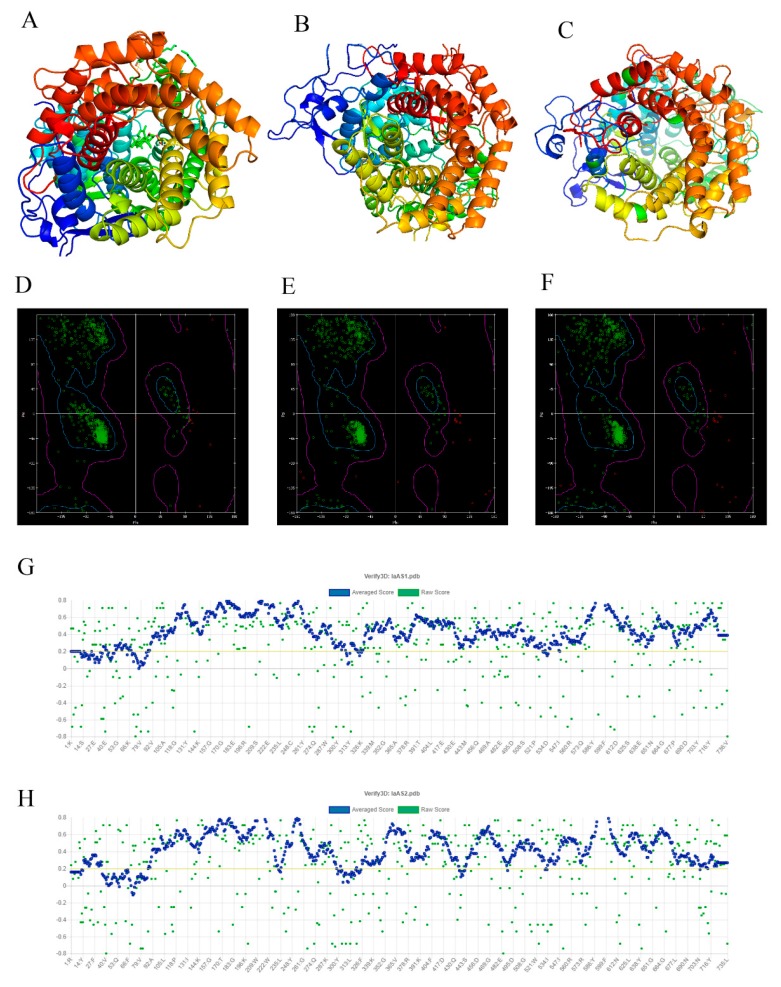
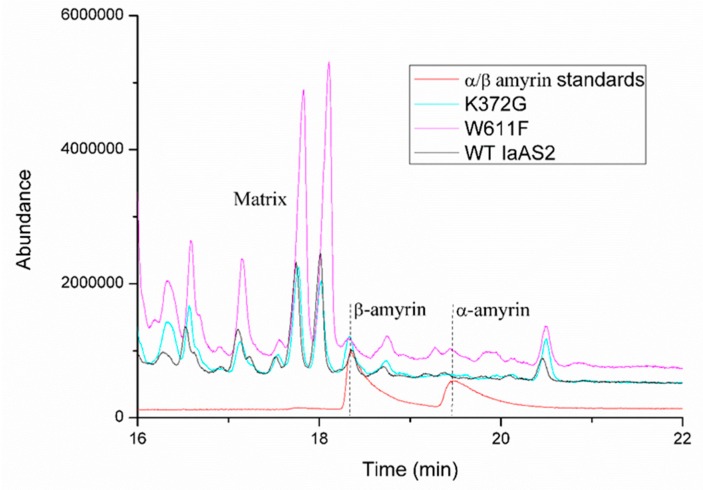
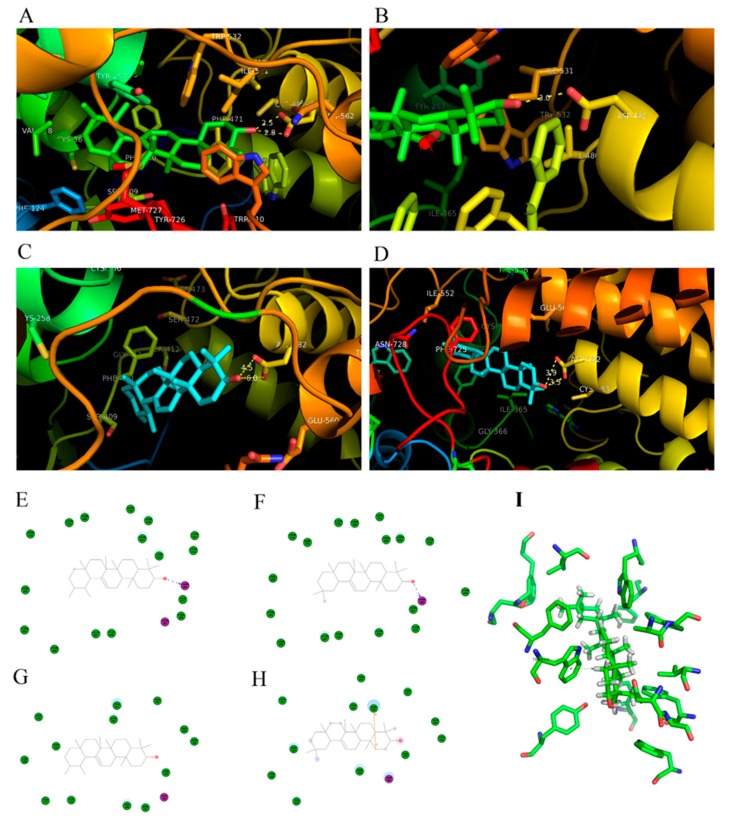
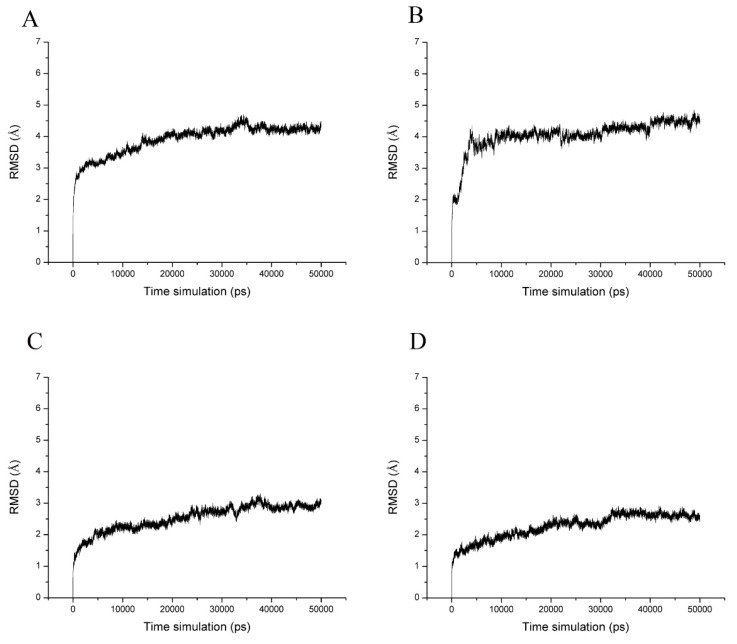
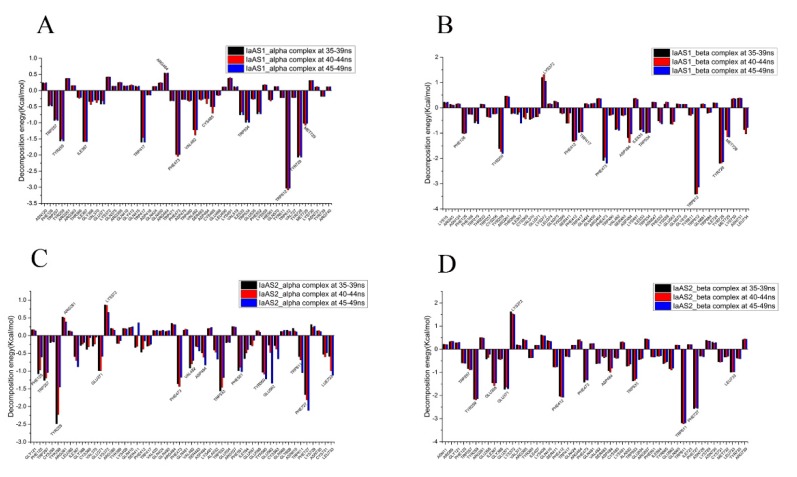
Amyrins are the immediate precursors of many pharmaceutically important pentacyclic triterpenoids. Although various amyrin synthases have been identified, little is known about the relationship between protein structures and the constituent and content of the products. IaAS1 and IaAS2 identified from in our previous work belong to multifunctional oxidosqualene cyclases and can produce α-amyrin and β-amyrin at different ratios. More than 80% of total production of IaAS1 is α-amyrin; while IaAS2 mainly produces β-amyrin with a yield of 95%. Here, we present a molecular modeling approach to explore the underlying mechanism for selective synthesis. The structures of IaAS1 and IaAS2 were constructed by homology modeling, and were evaluated by Ramachandran Plot and Verify 3D program. The enzyme-product conformations generated by molecular docking indicated that ASP484 residue plays an important role in the catalytic process; and TRP611 residue of IaAS2 had interaction with β-amyrin through π-σ interaction. MM/GBSA binding free energy calculations and free energy decomposition after 50 ns molecular dynamics simulations were performed. The binding affinity between the main product and corresponding enzyme was higher than that of the by-product. Conserved amino acid residues such as TRP257; TYR259; PHE47; TRP534; TRP612; and TYR728 for IaAS1 (TRP257; TYR259; PHE473; TRP533; TRP611; and TYR727 for IaAS2) had strong interactions with both products. GLN450 and LYS372 had negative contribution to binding affinity between α-amyrin or β-amyrin and IaAS1. LYS372 and ARG261 had strong repulsive effects for the binding of α-amyrin with IaAS2. The importance of Lys372 and TRP612 of IaAS1, and Lys372 and TRP611 of IaAS2, for synthesizing amyrins were confirmed by site-directed mutagenesis. The different patterns of residue-product interactions is the cause for the difference in the yields of two products.
倍半萜烯是许多具有重要药用价值的五环三萜的直接前体。尽管已经鉴定出各种法呢基焦磷酸合酶,但对于蛋白质结构与产物组成和含量之间的关系知之甚少。我们之前的工作中从 中鉴定出的 IaAS1 和 IaAS2 属于多功能角鲨烯环化酶,可产生不同比例的 α-香树精和 β-香树精。IaAS1 的总产量中超过 80%为 α-香树精;而 IaAS2 主要产生 β-香树精,产率为 95%。在这里,我们提出了一种分子建模方法来探索选择性合成的潜在机制。通过同源建模构建了 IaAS1 和 IaAS2 的结构,并通过 Ramachandran 图和 Verify 3D 程序进行了评估。分子对接生成的酶-产物构象表明,ASP484 残基在催化过程中起重要作用;而 IaAS2 的 TRP611 残基通过 π-σ 相互作用与 β-香树精相互作用。进行了 MM/GBSA 结合自由能计算和 50 ns 分子动力学模拟后的自由能分解。主要产物与相应酶的结合亲和力高于副产物。保守的氨基酸残基,如 IaAS1 的 TRP257;TYR259;PHE47;TRP534;TRP612;和 TYR728(IaAS2 的 TRP257;TYR259;PHE473;TRP533;TRP611;和 TYR727)与两种产物均具有很强的相互作用。GLN450 和 LYS372 对 α-香树精或 β-香树精与 IaAS1 之间的结合亲和力有负贡献。LYS372 和 ARG261 对 α-香树精与 IaAS2 的结合具有很强的排斥作用。通过定点突变证实了 IaAS1 的 Lys372 和 TRP612 以及 IaAS2 的 Lys372 和 TRP611 对合成香树精的重要性。两种产物产率差异的原因是残基-产物相互作用模式的不同。