Dong Xiyang, Bäcker Leonard E, Rahmatullah Mona, Schunk Daniel, Lens Guido, Meckenstock Rainer U
Biofilm Centre, University of Duisburg-Essen, Universitätsstrasse 5, 4514, Essen, Germany.
School of Marine Sciences, Sun Yat-Sen University, Zhuhai, 519000, China.
AMB Express. 2019 Jul 16;9(1):109. doi: 10.1186/s13568-019-0827-0.
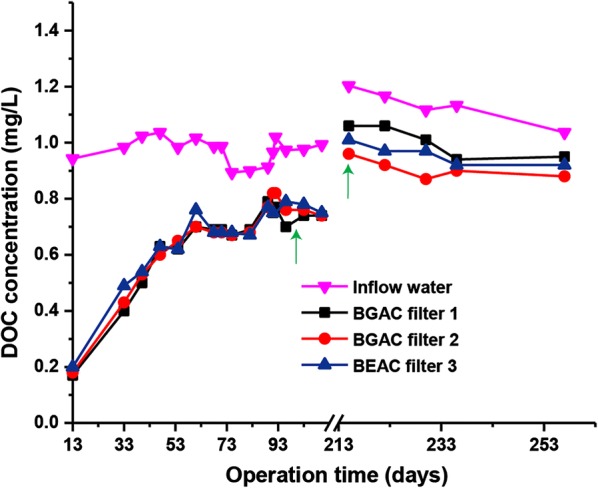
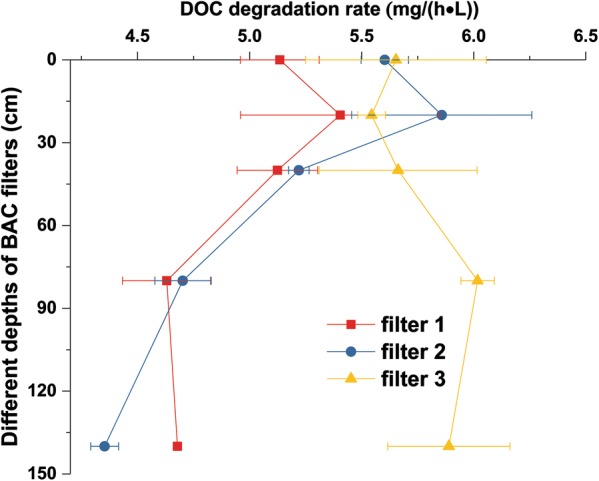
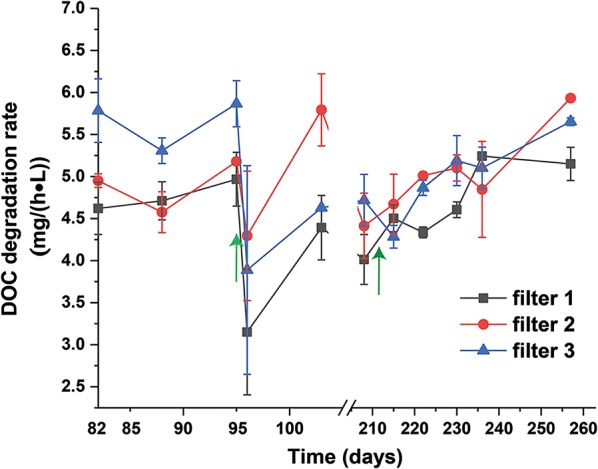
Biological activated carbon (BAC) filters are frequently used in drinking water production for removing dissolved organic carbon (DOC) via adsorption of organic compounds and microbial degradation. However, proper methods are still missing to distinguish the two processes. Here, we introduce reverse stable isotope labelling (RIL) for assessing microbial activity in BAC filters. We incubated BAC samples from three different BAC filters (two granular activated carbon- and one extruded activated carbon-based) in a buffer amended with C-labelled bicarbonate. By monitoring the release of C-CO from the mineralization of DOC, we could demonstrate the successful application of RIL in analysing microbial DOC degradation during drinking water treatment. Changing the water flow rates through BAC filters did not alter the microbial activities, even though apparent DOC removal efficiencies changed accordingly. Microbial DOC degradation activities quickly recovered from backwashing which was applied for removing particulate impurities and preventing clogging. The size distributions of activated carbon particles led to vertical stratification of microbial activities along the filter beds. Our results demonstrate that reverse isotope labelling is well suited to measure microbial DOC degradation on activated carbon particles, which provides a basis for improving operation and design of BAC filters.
生物活性炭(BAC)滤池常用于饮用水生产中,通过吸附有机化合物和微生物降解来去除溶解有机碳(DOC)。然而,目前仍缺乏区分这两个过程的合适方法。在此,我们引入反向稳定同位素标记(RIL)来评估BAC滤池中的微生物活性。我们将来自三种不同BAC滤池(两种基于颗粒活性炭和一种基于挤压活性炭)的BAC样品在添加了碳标记碳酸氢盐的缓冲液中进行孵育。通过监测DOC矿化过程中碳 - 二氧化碳的释放,我们能够证明RIL在分析饮用水处理过程中微生物对DOC降解方面的成功应用。尽管表观DOC去除效率相应改变,但改变通过BAC滤池的水流速并未改变微生物活性。微生物DOC降解活性在用于去除颗粒杂质和防止堵塞的反冲洗后迅速恢复。活性炭颗粒的尺寸分布导致微生物活性沿滤床垂直分层。我们的结果表明,反向同位素标记非常适合测量活性炭颗粒上微生物对DOC的降解,这为改进BAC滤池的运行和设计提供了依据。