Office of Informatics and Analytics, Tennessee Department of Health, Nashville.
University of Hawai'i at Mānoa, Office of Public Health Studies, Honolulu.
JAMA Netw Open. 2019 Jul 3;2(7):e197222. doi: 10.1001/jamanetworkopen.2019.7222.
Using opioids for acute pain can lead to long-term use and associated morbidity and mortality. Injury has been documented as a gateway to long-term opioid use in some populations, but data are limited for injured workers.
To evaluate the prevalence and risk factors of long-term opioid use after injury among workers in Tennessee who were opioid free at the time of injury.
DESIGN, SETTING, AND PARTICIPANTS: This cohort study identified injured workers aged 15 to 99 years who reported only 1 injury to the Tennessee Bureau of Workers' Compensation from March 2013 to December 2015 and had no opioid prescription in the 60 days before injury. Participants were matched to their prescription history in Tennessee's prescription drug monitoring program. Analysis was conducted from November 2017 to March 2018. Logistic regression models were used to calculate adjusted odds ratios (ORs) and 95% CIs for associations of demographic, injury, and opioid use variables with long-term use.
The primary outcome was long-term opioid use, defined as having an opioid supplied for 45 or more days in the 90 days after injury.
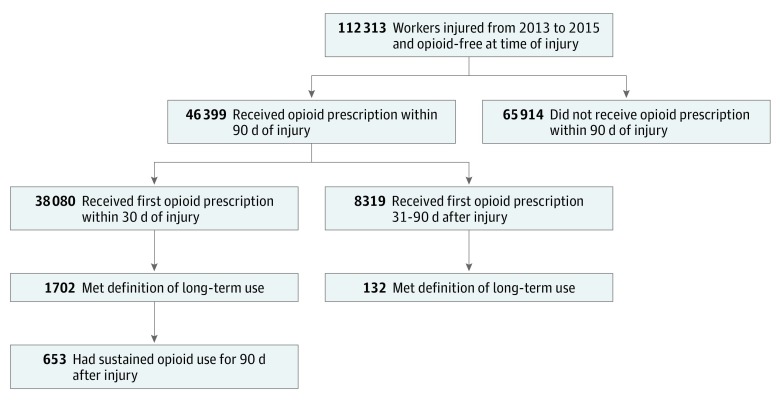
Among 58 278 injured workers who received opioids after injury (18 977 [32.5%] aged 15-34 years, 27 514 [47.2%] aged 35-54 years, and 11 787 [20.2%] aged 55-99 years; 32 607 [56.0%] men), 46 399 (79.6%) were opioid free at the time of injury. Among opioid-free injured workers, 1843 (4.0%) began long-term opioid use. After controlling for covariates, long-term use was associated with receiving 20 or more days' supply in the initial opioid prescription compared with receiving less than 5 days' supply (OR, 28.94; 95% CI, 23.44-35.72) and visiting 3 or more prescribers in the 90 days after injury compared with visiting 1 prescriber (OR, 14.91; 95% CI, 12.15-18.29). However, even just 5 days' to 9 days' supply was associated with an increase in the odds of long-term use compared with less than 5 days' supply (OR, 1.83; 95% CI, 1.56-2.14).
In this study of injured workers, injury was associated with long-term opioid use. The number of days' supply of the initial opioid prescription was the strongest risk factor of developing long-term use, highlighting the importance of careful prescribing for initial opioid prescriptions.
使用阿片类药物治疗急性疼痛可能导致长期使用,并伴有相关的发病率和死亡率。在某些人群中,受伤已被证明是长期使用阿片类药物的一个途径,但受伤工人的数据有限。
评估田纳西州受伤工人在受伤时没有使用阿片类药物的情况下,长期使用阿片类药物的患病率和风险因素。
设计、地点和参与者:这项队列研究确定了年龄在 15 岁至 99 岁之间的受伤工人,他们在 2013 年 3 月至 2015 年 12 月期间仅向田纳西州工人赔偿局报告了 1 次受伤,并且在受伤前 60 天内没有阿片类药物处方。参与者与田纳西州处方药物监测计划中的处方史相匹配。分析于 2017 年 11 月至 2018 年 3 月进行。使用逻辑回归模型计算与人口统计学、受伤和阿片类药物使用变量相关的长期使用的调整比值比(OR)和 95%置信区间。
主要结果是长期使用阿片类药物,定义为在受伤后 90 天内有 45 天或以上接受阿片类药物治疗。
在接受阿片类药物治疗的 58278 名受伤工人中(15-34 岁 18977 人[32.5%],35-54 岁 27514 人[47.2%],55-99 岁 11787 人[20.2%];32607 名男性),46399 人(56.0%)在受伤时没有使用阿片类药物。在没有使用阿片类药物的受伤工人中,有 1843 人(4.0%)开始长期使用阿片类药物。在控制了混杂因素后,与接受少于 5 天的供应量相比,接受 20 天或更多天的初始阿片类药物处方与长期使用相关(OR,28.94;95%置信区间,23.44-35.72),与在 90 天内就诊 1 名医生相比,就诊 3 名或更多医生与长期使用相关(OR,14.91;95%置信区间,12.15-18.29)。然而,即使是 5 天至 9 天的供应量也与长期使用的几率增加相关,与少于 5 天的供应量相比(OR,1.83;95%置信区间,1.56-2.14)。
在这项对受伤工人的研究中,受伤与长期使用阿片类药物有关。初始阿片类药物处方的供应量是发展为长期使用的最强风险因素,这突出了谨慎开具初始阿片类药物处方的重要性。