Yang Zhi-Hua, Shi Chang-He, Zhou Li-Na, Li Yu-Sheng, Yang Jing, Liu Yu-Tao, Mao Cheng-Yuan, Luo Hai-Yang, Xu Guo-Wang, Xu Yu-Ming
Department of Neurology, The First Affiliated Hospital of Zhengzhou University, Zhengzhou University, Zhengzhou, China.
CAS Key Laboratory of Separation Science for Analytical Chemistry, Dalian Institute of Chemical Physics, Chinese Academy of Sciences, Dalian, China.
Front Mol Neurosci. 2019 Jun 27;12:159. doi: 10.3389/fnmol.2019.00159. eCollection 2019.
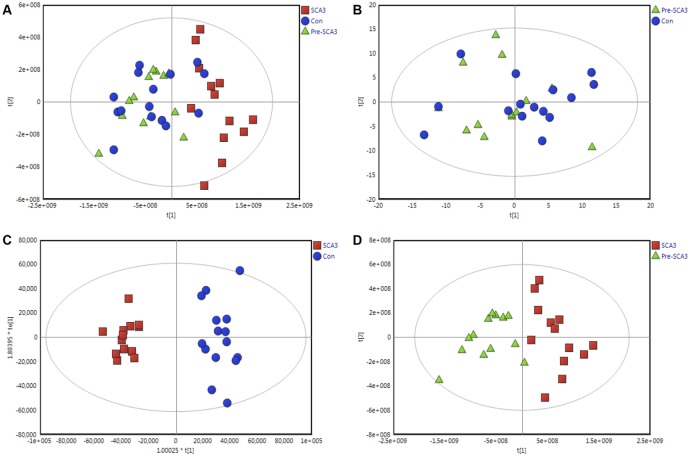
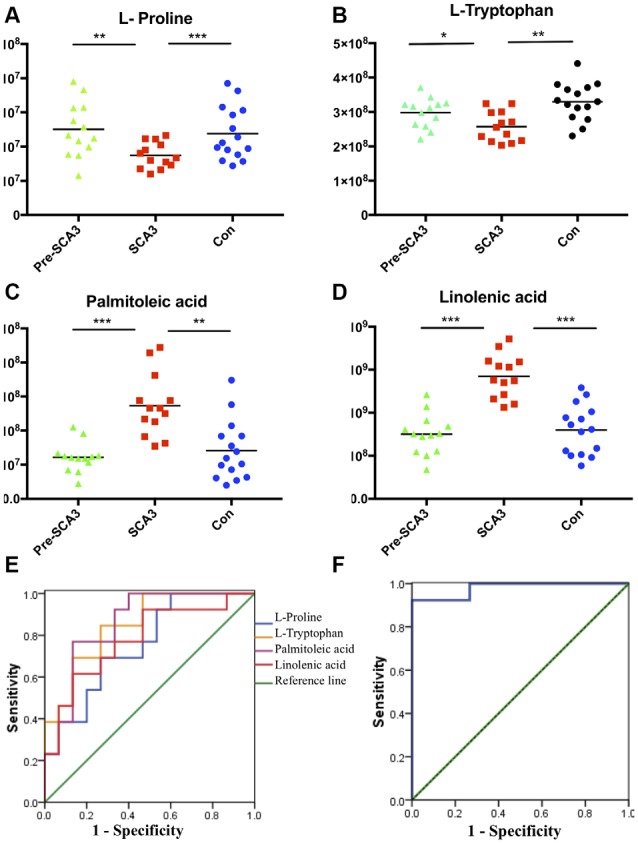
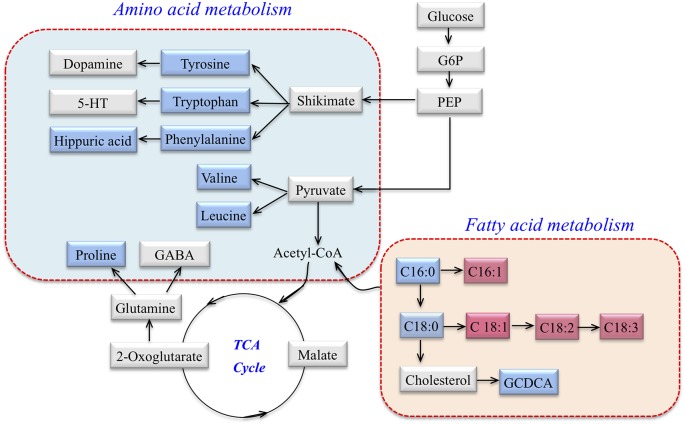
Spinocerebellar ataxia 3, also known as Machado-Joseph disease (SCA3/MJD), is a rare autosomal-dominant neurodegenerative disease caused by an abnormal expansion of CAG repeats in the gene. In the present study, we performed a global metabolomic analysis to identify pathogenic biochemical pathways and novel biomarkers implicated in SCA3 patients. Metabolic profiling of serum samples from 13 preclinical SCA3 patients, 13 symptomatic SCA3 patients, and 15 healthy controls were mapped using ultra-high-performance liquid chromatography-mass spectrometry and gas chromatography-mass spectrometry techniques. The symptomatic SCA3 patients showed a metabolic profile significantly distinct from those of the preclinical SCA3 patients and healthy controls. The principal differential metabolites were involved in the amino acid (AA) metabolism and fatty acid metabolism pathways. In addition, four candidate serum biomarkers, FFA 16:1 (palmitoleic acid), FFA 18:3 (linolenic acid), L-Proline and L-Tryptophan, were selected to discriminate between symptomatic SCA3 patients and healthy controls by receiver operator curve analysis with an area under the curve of 0.979. Our study demonstrates that symptomatic SCA3 patients present distinct metabolic profiles with perturbed AA metabolism and fatty acid metabolism, and FFA 16:1, FFA 18:3, L-Proline and L-Tryptophan are identified as potential disease biomarkers.
脊髓小脑共济失调3型,也称为马查多-约瑟夫病(SCA3/MJD),是一种罕见的常染色体显性神经退行性疾病,由该基因中CAG重复序列异常扩增引起。在本研究中,我们进行了一项全面的代谢组学分析,以确定与SCA3患者相关的致病生化途径和新型生物标志物。使用超高效液相色谱-质谱联用技术和气相色谱-质谱联用技术对13例临床前SCA3患者、13例有症状的SCA3患者和15名健康对照者的血清样本进行代谢谱分析。有症状的SCA3患者的代谢谱与临床前SCA3患者和健康对照者的代谢谱明显不同。主要差异代谢物参与氨基酸(AA)代谢和脂肪酸代谢途径。此外,通过受试者工作特征曲线分析,选择了四种候选血清生物标志物,即游离脂肪酸16:1(棕榈油酸)、游离脂肪酸18:3(亚麻酸)、L-脯氨酸和L-色氨酸,用于区分有症状的SCA3患者和健康对照者,曲线下面积为0.979。我们的研究表明,有症状的SCA3患者呈现出不同的代谢谱,氨基酸代谢和脂肪酸代谢受到干扰,游离脂肪酸16:1、游离脂肪酸18:3、L-脯氨酸和L-色氨酸被确定为潜在的疾病生物标志物。