Department of Psychology, University of Calgary, Calgary, AB, Canada.
Departments of Pediatrics and Psychology, The Ohio State University, and Center for Biobehavioral Health, The Research Institute at Nationwide Children's Hospital, Columbus, OH, USA.
J Int Neuropsychol Soc. 2019 Oct;25(9):931-940. doi: 10.1017/S135561771900064X. Epub 2019 Jul 18.
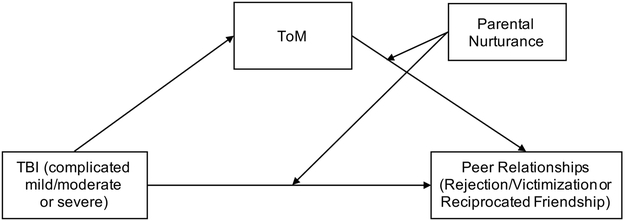
Traumatic brain injury (TBI) sustained in childhood is associated with poor social outcomes. This study investigated the role of theory of mind (ToM) as a mediator of the relation between TBI and peer rejection/victimization and reciprocated friendships, as well as the moderating effect of parental nurturance on those relationships.
Participants were children of 8-13 years old (M = 10.45, SD = 1.47), including 13 with severe TBI, 39 with complicated mild/moderate TBI, and 32 children with orthopedic injuries. Data on peer rejection/victimization and friendship were collected in school classrooms using the Extended Class Play and friendship nominations. Parents rated parental nurturance using the Child-Rearing Practices Report. Finally, ToM was measured based on children's average performance across three tasks measuring different aspects of ToM.
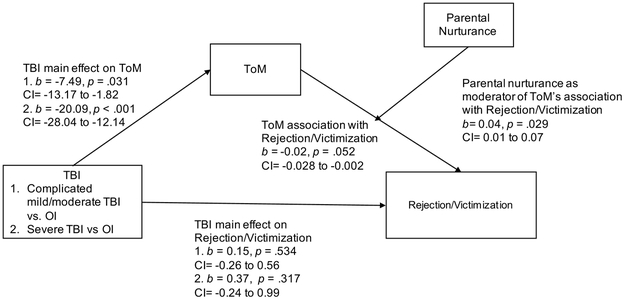
Severe TBI was associated with poorer ToM, greater peer rejection/victimization, and fewer reciprocated friendships. ToM mediated the relation between severe TBI and peer rejection/victimization (i.e., severe TBI predicted poorer ToM, which in turn predicted greater rejection/victimization). Parental nurturance significantly moderated this relation, such that the mediating effect of ToM was significant only at low and average levels of parental nurturance, for both severe and complicated mild/moderate TBI groups. Neither the mediating effect of ToM nor the moderating effect of parental nurturance was significant for reciprocated friendships.
High parental nurturance may mitigate the negative effects of ToM deficits on risk of peer rejection/victimization among children with TBI. Interventions designed to increase parental nurturance or ToM may promote better social outcomes among children with TBI.
儿童时期发生的创伤性脑损伤(TBI)与较差的社交结果有关。本研究调查了心理理论(ToM)作为 TBI 与同伴拒绝/受害和互惠友谊之间关系的中介,以及父母养育对这些关系的调节作用。
参与者为 8-13 岁的儿童(M=10.45,SD=1.47),包括 13 名严重 TBI 患儿、39 名复杂轻度/中度 TBI 患儿和 32 名骨科损伤患儿。在学校教室里使用扩展班级游戏和友谊提名收集同伴拒绝/受害和友谊数据。父母使用育儿实践报告评估父母养育。最后,根据儿童在三个衡量不同方面 ToM 的任务中的平均表现来衡量 ToM。
严重 TBI 与较差的 ToM、更多的同伴拒绝/受害和更少的互惠友谊有关。ToM 介导了严重 TBI 与同伴拒绝/受害之间的关系(即,严重 TBI 预测较差的 ToM,而较差的 ToM 又预测更多的拒绝/受害)。父母养育显著调节了这种关系,因此,只有在低和平均水平的父母养育时,ToM 的中介作用才在严重和复杂轻度/中度 TBI 组中具有统计学意义。无论是 ToM 的中介作用还是父母养育的调节作用,对于互惠友谊都不显著。
高父母养育可能会减轻 TBI 儿童 ToM 缺陷对同伴拒绝/受害风险的负面影响。旨在增加父母养育或 ToM 的干预措施可能会促进 TBI 儿童的更好社交结果。