Department of Molecular Biology and Genetics, Johns Hopkins University School of Medicine, Baltimore, Maryland, United States of America.
Howard Hughes Medical Institute, Johns Hopkins University School of Medicine, Baltimore, Maryland, United States of America.
PLoS One. 2019 Jul 18;14(7):e0219384. doi: 10.1371/journal.pone.0219384. eCollection 2019.
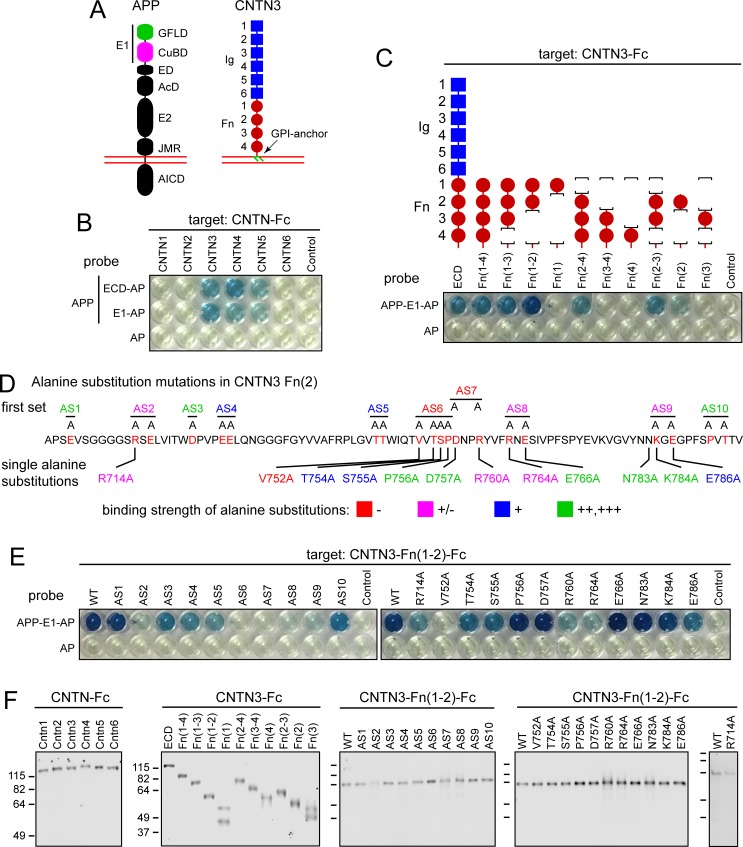
The Amyloid Precursor Protein (APP) and Contactin (CNTN) families of cell-surface proteins have been intensively studied in the context of neural development and neuropsychiatric diseases. Earlier studies demonstrated both genetic and biochemical interactions between the extracellular domains of APP and CNTN3, but their precise binding interfaces were not defined. In the present study, we have used binding assays between APP-alkaline phosphatase (AP) fusion proteins and CNTN-Fc fusion proteins, together with alanine substitution mutagenesis, to show that: (i) the second Fibronectin domain (Fn(2)) in CNTN3 mediates APP binding; (ii) the copper binding domain (CuBD) in APP mediates CNTN3 binding; and (iii) the most important amino acids for APP-CNTN3 binding reside on one face of CNTN3-Fn(2) and on one face of APP-CuBD. These experiments define the regions of direct contact that mediate the binding interaction between APP and CNTN3.
细胞表面蛋白淀粉样前体蛋白 (APP) 和接触蛋白 (CNTN) 家族在神经发育和神经精神疾病的背景下得到了深入研究。早期的研究表明 APP 和 CNTN3 的细胞外结构域之间存在遗传和生化相互作用,但它们的确切结合界面尚未确定。在本研究中,我们使用 APP-碱性磷酸酶 (AP) 融合蛋白和 CNTN-Fc 融合蛋白之间的结合测定,以及丙氨酸取代突变,表明:(i) CNTN3 中的第二个纤连蛋白结构域 (Fn(2)) 介导 APP 结合;(ii) APP 中的铜结合结构域 (CuBD) 介导 CNTN3 结合;(iii) APP-CNTN3 结合的最重要氨基酸位于 CNTN3-Fn(2)的一个面上和 APP-CuBD 的一个面上。这些实验定义了介导 APP 和 CNTN3 之间结合相互作用的直接接触区域。