School of Health Sciences, University of Canterbury-Te Whare Wānanga o Waitaha, Christchurch, New Zealand.
Institute of Public Health, Makerere University, Kampala, Uganda.
PLoS One. 2019 Jul 18;14(7):e0219963. doi: 10.1371/journal.pone.0219963. eCollection 2019.
Research on contraceptive behaviour changes over time in Uganda is scarce, yet it has among the highest fertility and maternal mortality rates of any country in the East African region. Understanding temporal patterns of contraceptive use for both women and men is vital in evaluating the effectiveness of family planning interventions and strategies, and identifying those with the most unmet need. Using repeated nationally representative cross-sectional samples, this study charts the changes in Uganda's population-based contraceptive use over recent years.
Five Demographic and Health Survey datasets for Uganda over 21 years, from 1995 to 2016, were sourced and interrogated. Eligible participants included all women aged 15-49 years and men aged 15-54 years. Responses to questions on modern and any (modern or traditional) contraceptive use were analysed. Stratified by gender, weighted regression analyses were employed to detect change over time. The patterns associated with key demographic variables were also investigated.
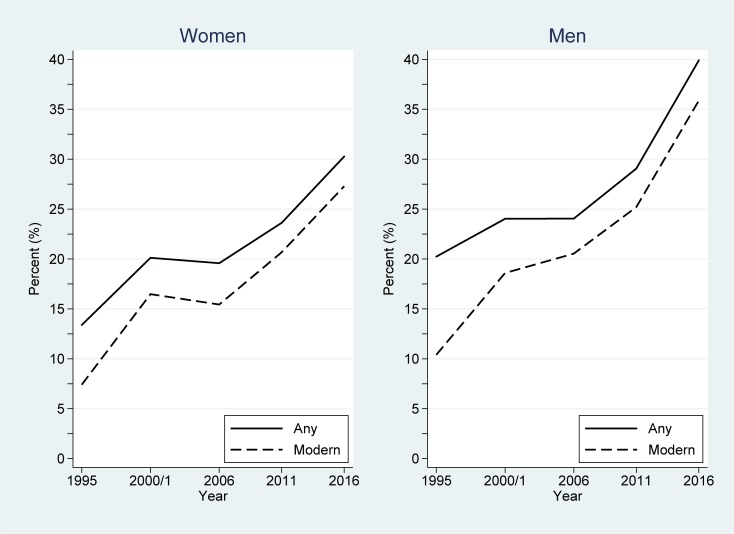
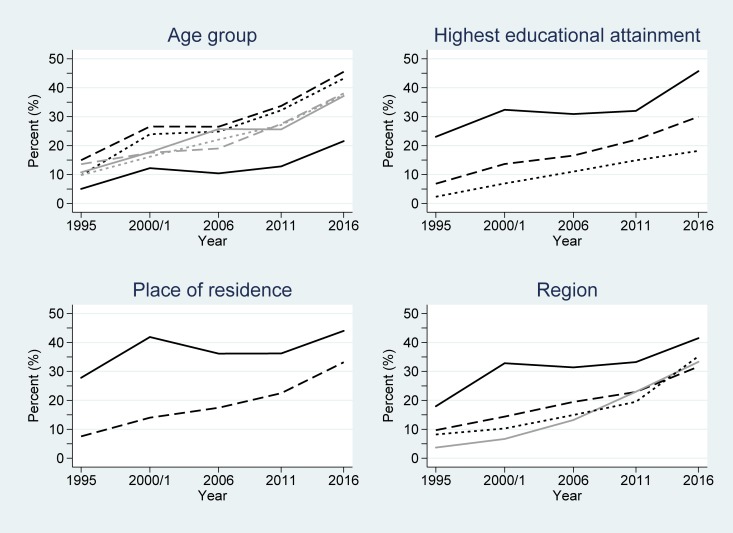
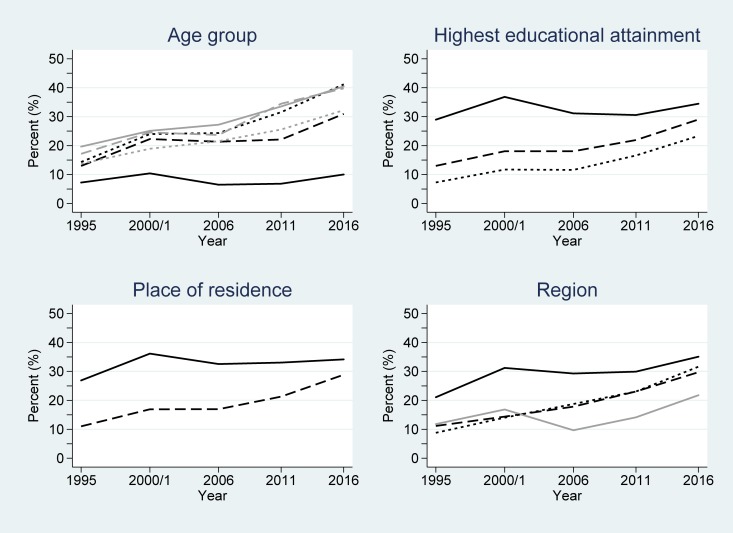
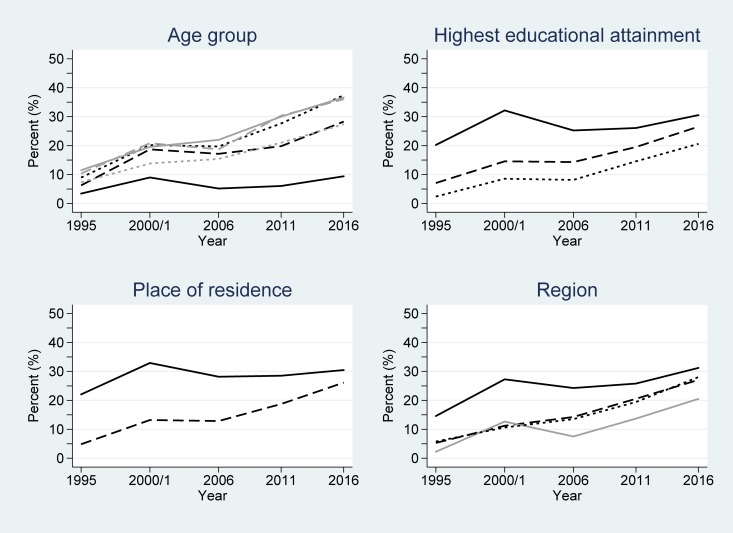
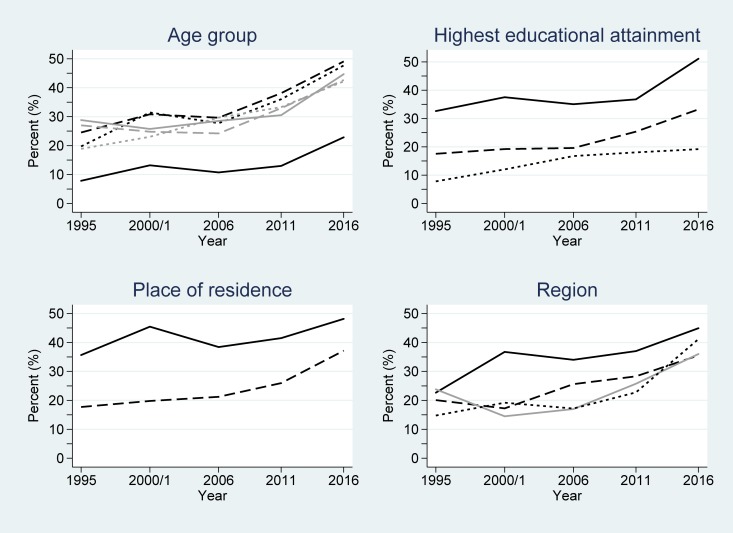
Overall, 50,027 women and 14,092 men were included within the study. In 2016, 30.3% of women and 39.9% of men were using any contraceptive method, a significant non-linear increase from 13.4% of women and 20.3% of men in 1995. Furthermore, 27.3% of women and 35.9% of men were using modern contraceptive methods in 2016, an increase from 7.4% of women and 10.4% of men in 1995. All considered demographic variables were significantly associated with contraceptive use for both women and men (all P<0.001); and for women, all variables differentially changed over time (all P<0.001).
This study showed a significant increase and dynamism across key demographic variables in contraceptive uptake by both women and men. Sustained family planning programs and interventions have successfully resulted in behaviour change across the Ugandan population. However, continued efforts are needed to further reduce Uganda's relatively high fertility and associated maternal mortality rates.
乌干达的避孕行为随着时间的推移而发生变化,这方面的研究很少,但它是东非地区生育率和孕产妇死亡率最高的国家之一。了解男女双方避孕措施的时间模式对于评估计划生育干预措施和策略的有效性以及确定最需要的人群至关重要。本研究利用重复的全国代表性横断面样本,描述了近年来乌干达人口的避孕措施使用情况的变化。
本研究使用了乌干达 1995 年至 2016 年 21 年来的五次人口与健康调查数据集。符合条件的参与者包括所有 15-49 岁的女性和 15-54 岁的男性。对现代避孕措施和任何避孕措施(现代或传统)的使用情况进行了分析。根据性别分层,采用加权回归分析来检测随时间的变化。还调查了与关键人口变量相关的模式。
共有 50027 名女性和 14092 名男性参与了这项研究。2016 年,30.3%的女性和 39.9%的男性使用了任何避孕方法,与 1995 年的 13.4%的女性和 20.3%的男性相比,呈显著的非线性增长。此外,2016 年 27.3%的女性和 35.9%的男性使用现代避孕方法,高于 1995 年 7.4%的女性和 10.4%的男性。所有考虑的人口变量都与女性和男性的避孕措施使用显著相关(均 P<0.001);对于女性,所有变量在不同时间都发生了变化(均 P<0.001)。
本研究表明,女性和男性的避孕措施使用率在主要人口变量方面都有显著增加和变化。持续的计划生育项目和干预措施已经成功地改变了乌干达人口的行为。然而,需要继续努力,进一步降低乌干达相对较高的生育率和相关的孕产妇死亡率。