Li Dan, Zeng Zhenguo
Department of Critical Care Medicine, the First Affiliated Hospital of Nanchang University, Nanchang, Jiangxi 330006, China.
Department of Critical Care Medicine, the First Affiliated Hospital of Nanchang University, Nanchang, Jiangxi 330006, China
Biosci Rep. 2019 Aug 2;39(8). doi: 10.1042/BSR20191815. Print 2019 Aug 30.
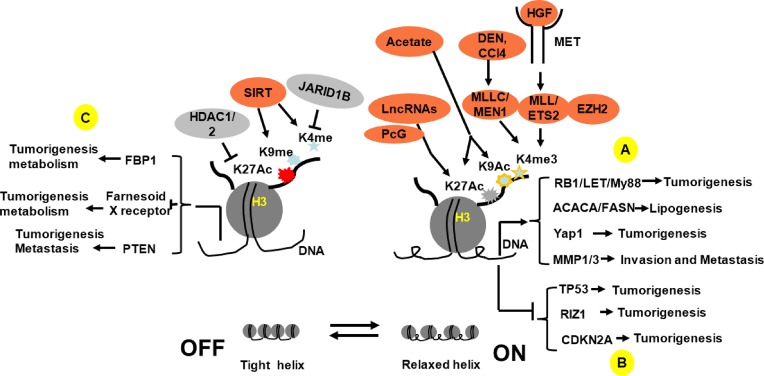
Better understanding of epigenetic regulation of hepatocellular carcinoma (HCC) will help us to cure this most common malignant liver cancer worldwide. The underlying mechanisms of HCC tumorigenesis are genomic aberrations regulated by genetic and epigenetic modifications. Histone H3 lysine modifications regulate histone structure and modulate transcriptional factor binding with target gene promoters. Targetting genes include VASH2, fatty acids synthase, RIZ1, FBP1, MPP1/3, YAP, which affect tumorigenesis, metabolisms, angiogenesis, and metastasis. Signal pathway studies demonstrate that the HGF-MET-MLL axis, phosphatase and tensin homolog (PTEN)-PI3K-Akt axis; WNT-β-catenin signal pathway is involved in histone H3 modification. A variety of factors such as virus infection, reactive oxygen species, food-borne toxins, irradiation, or non-coding RNA cause hepatocellular DNA damage or modification. Dysfunctional DNA repair mechanisms, including those at the epigenetic level are also major causes of HCC tumorigenesis. The development of therapies based on epigenetic regulatory mechanisms has great potential to advance the care of HCC patients in the future.
更好地理解肝细胞癌(HCC)的表观遗传调控将有助于我们治愈这种全球最常见的恶性肝癌。HCC肿瘤发生的潜在机制是由遗传和表观遗传修饰调控的基因组畸变。组蛋白H3赖氨酸修饰调节组蛋白结构并调节转录因子与靶基因启动子的结合。靶向基因包括VASH2、脂肪酸合酶、RIZ1、FBP1、MPP1/3、YAP,它们影响肿瘤发生、代谢、血管生成和转移。信号通路研究表明,HGF-MET-MLL轴、磷酸酶和张力蛋白同源物(PTEN)-PI3K-Akt轴;WNT-β-连环蛋白信号通路参与组蛋白H3修饰。多种因素,如病毒感染、活性氧、食源性毒素、辐射或非编码RNA,可导致肝细胞DNA损伤或修饰。功能失调的DNA修复机制,包括表观遗传水平的机制,也是HCC肿瘤发生的主要原因。基于表观遗传调控机制的治疗方法的开发在未来有很大潜力推进HCC患者的治疗。