Cardiovascular Research Institute, Yokohama City University Graduate School of Medicine, Yokohama, Japan.
Laboratories for Animal Resource Development, RIKEN Center for Biosystems Dynamics Research, Kobe, Japan.
Cell Death Dis. 2019 Jul 18;10(8):549. doi: 10.1038/s41419-019-1787-7.
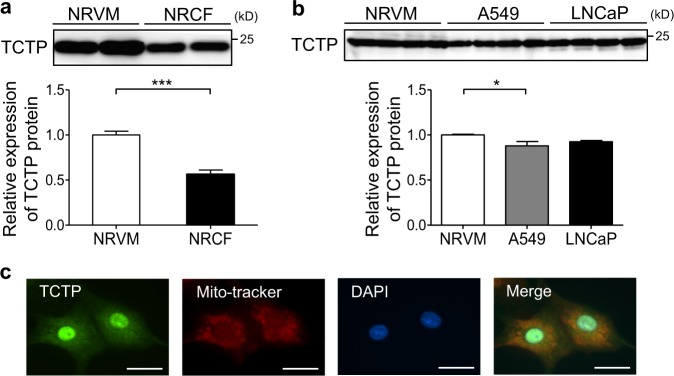
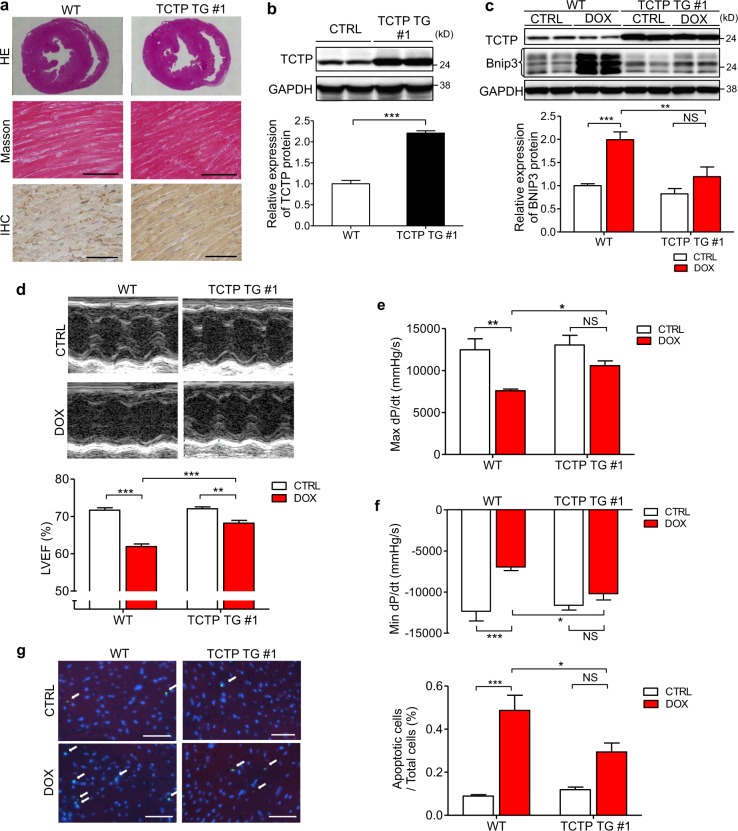
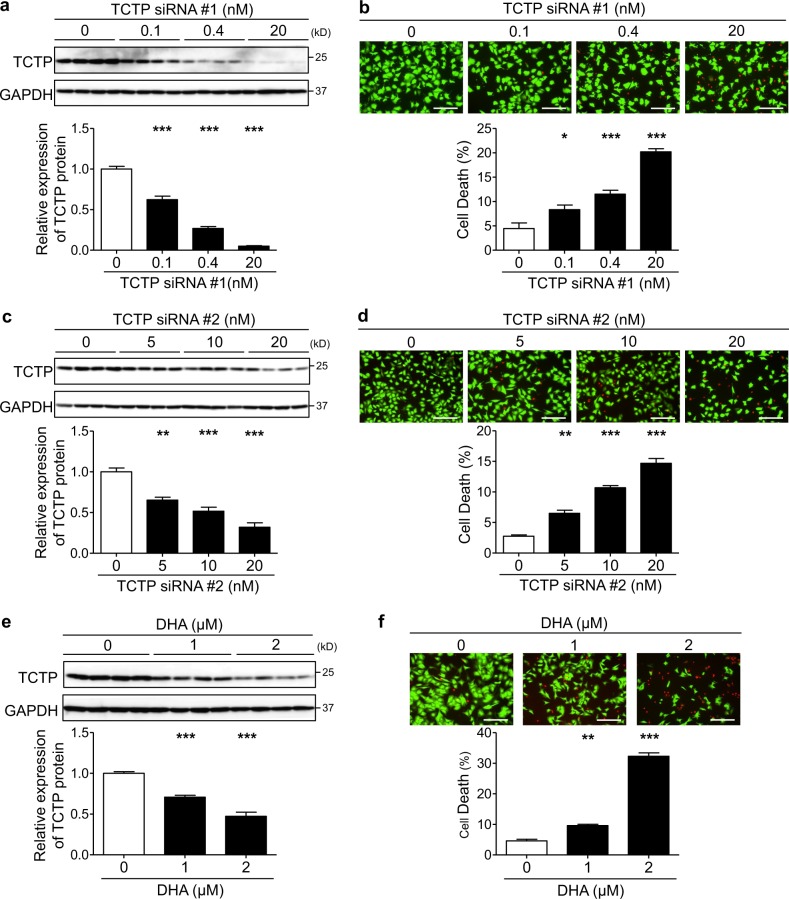
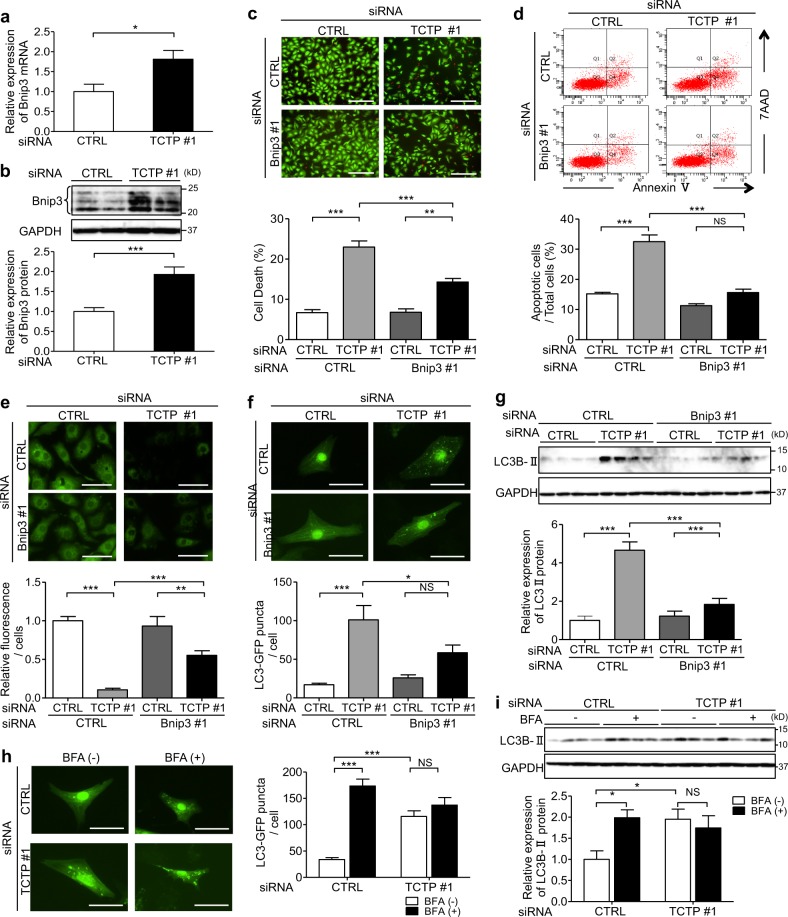
Prevention of cardiomyocyte death is an important therapeutic strategy for heart failure. In this study, we focused on translationally controlled tumor protein (TCTP), a highly conserved protein that is expressed ubiquitously in mammalian tissues, including heart. TCTP plays pivotal roles in survival of certain cell types, but its function in cardiomyocytes has not been examined. We aimed to clarify the role of TCTP in cardiomyocyte survival and the underlying mechanism. Here, we demonstrated that downregulation of TCTP with siRNA induced cell death of cardiomyocytes with apoptotic and autophagic features, accompanied with mitochondrial permeability transition pore (mPTP) opening. TCTP loss did not induce cell death of cardiac fibroblasts. Bcl-2/adenovirus E1B 19-kDa interacting protein 3 (Bnip3) was found to mediate the TCTP-loss-induced cardiomyocyte death. In exploring the clinical significance of the TCTP expression in the heart, we found that DOX treatment markedly downregulated the protein expression of TCTP in cultured cardiomyocytes and in mouse heart tissue. Exogenous rescue of TCTP expression attenuated DOX-induced cardiomyocyte death. In mice, cardiomyocyte-specific overexpression of TCTP resulted in decreased susceptibility to DOX-induced cardiac dysfunction, accompanied with attenuated induction of Bnip3. Dihydroartemisinin, a pharmacological TCTP inhibitor, induced development of heart failure and cardiomyocyte death in control mice, but not in mice with cardiomyocyte-specific TCTP overexpression. Our findings revealed TCTP has a pivotal role in cardiomyocyte survival, at least in part through a Bnip3-dependent mechanism. TCTP could be considered as a candidate therapeutic target to prevent DOX-induced heart failure.
心肌细胞死亡的预防是心力衰竭的重要治疗策略。在这项研究中,我们专注于翻译控制肿瘤蛋白(TCTP),这是一种在哺乳动物组织中广泛表达的高度保守蛋白,包括心脏。TCTP 在某些细胞类型的存活中发挥关键作用,但它在心肌细胞中的功能尚未被研究。我们旨在阐明 TCTP 在心肌细胞存活中的作用及其潜在机制。在这里,我们证明用 siRNA 下调 TCTP 可诱导具有凋亡和自噬特征的心肌细胞死亡,并伴有线粒体通透性转换孔(mPTP)开放。TCTP 缺失不会诱导心肌成纤维细胞死亡。发现 Bcl-2/腺病毒 E1B 19-kDa 相互作用蛋白 3(Bnip3)介导 TCTP 缺失诱导的心肌细胞死亡。在探索 TCTP 在心脏中的表达的临床意义时,我们发现 DOX 处理显著下调了培养的心肌细胞和小鼠心脏组织中 TCTP 的蛋白表达。外源性挽救 TCTP 表达可减轻 DOX 诱导的心肌细胞死亡。在小鼠中,心肌细胞特异性过表达 TCTP 可降低对 DOX 诱导的心脏功能障碍的易感性,同时减轻 Bnip3 的诱导。二氢青蒿素,一种药理学 TCTP 抑制剂,可在对照小鼠中引起心力衰竭和心肌细胞死亡的发展,但在心肌细胞特异性过表达 TCTP 的小鼠中则不会。我们的研究结果表明,TCTP 在心肌细胞存活中具有关键作用,至少部分通过 Bnip3 依赖性机制。TCTP 可以被认为是预防 DOX 诱导的心力衰竭的候选治疗靶点。