Brás Inês Caldeira, König Annekatrin, Outeiro Tiago Fleming
Department of Experimental Neurodegeneration, Center for Biostructural Imaging of Neurodegeneration, University Medical Center Göttingen, Göttingen, Germany.
Max Planck Institute for Experimental Medicine, Göttingen, Germany.
J Huntingtons Dis. 2019;8(3):245-256. doi: 10.3233/JHD-190366.
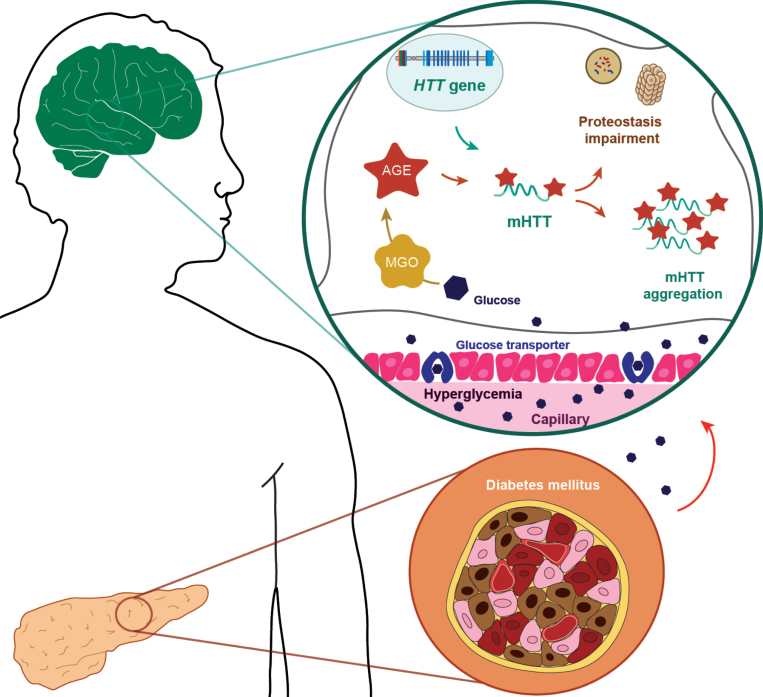
Glycation is the non-enzymatic reaction between reactive dicarbonyls and amino groups, and gives rise to a variety of different reaction products known as advanced glycation end products (AGEs). Accumulation of AGEs on proteins is inevitable, and is associated with the aging process. Importantly, glycation is highly relevant in diabetic patients that experience periods of hyperglycemia. AGEs also play an important role in neurodegenerative diseases including Alzheimer's (AD) and Parkinson's disease (PD). Huntington's disease (HD) is a hereditary neurodegenerative disease caused by an expansion of a CAG repeat in the huntingtin gene. The resulting expanded polyglutamine stretch in the huntingtin (HTT) protein induces its misfolding and aggregation, leading to neuronal dysfunction and death. HD patients exhibit chorea and psychiatric disturbances, along with abnormalities in glucose and energy homeostasis. Interestingly, an increased prevalence of diabetes mellitus has been reported in HD and in other CAG triplet repeat disorders. However, the mechanisms underlying the connection between glycation and HD progression remain unclear. In this review, we explore the possible connection between glycation and proteostasis imbalances in HD, and posit that it may contribute to disease progression, possibly by accelerating protein aggregation and deposition. Finally, we review therapeutic interventions that might be able to alleviate the negative impact of glycation in HD.
糖基化是活性二羰基化合物与氨基之间的非酶促反应,会产生多种不同的反应产物,即所谓的晚期糖基化终末产物(AGEs)。AGEs在蛋白质上的积累不可避免,且与衰老过程相关。重要的是,糖基化在经历高血糖期的糖尿病患者中高度相关。AGEs在包括阿尔茨海默病(AD)和帕金森病(PD)在内的神经退行性疾病中也起重要作用。亨廷顿舞蹈病(HD)是一种遗传性神经退行性疾病,由亨廷顿基因中CAG重复序列的扩增引起。由此产生的亨廷顿蛋白(HTT)中扩展的聚谷氨酰胺片段会导致其错误折叠和聚集,进而导致神经元功能障碍和死亡。HD患者表现出舞蹈症和精神障碍,以及葡萄糖和能量稳态异常。有趣 的是,据报道HD和其他CAG三联体重复序列疾病中糖尿病的患病率增加。然而,糖基化与HD进展之间联系的潜在机制仍不清楚。在本综述中,我们探讨了糖基化与HD中蛋白质稳态失衡之间的可能联系,并假定它可能通过加速蛋白质聚集和沉积而导致疾病进展。最后,我们综述了可能能够减轻糖基化对HD负面影响的治疗干预措施。