Department of Otolaryngology, The Ohio State University, Columbus, OH.
Department of Otolaryngology, The Ohio State University, Columbus, OH.
Neuroscience. 2019 Sep 1;415:77-88. doi: 10.1016/j.neuroscience.2019.07.019. Epub 2019 Jul 17.
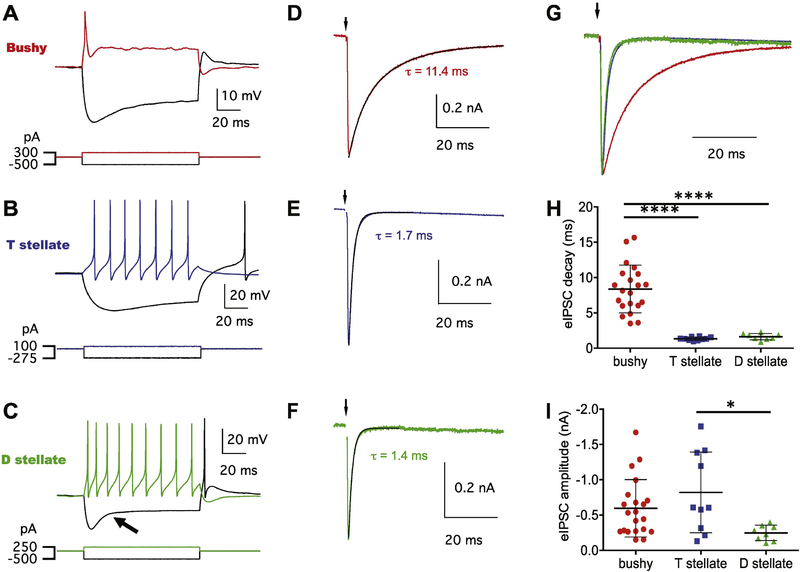
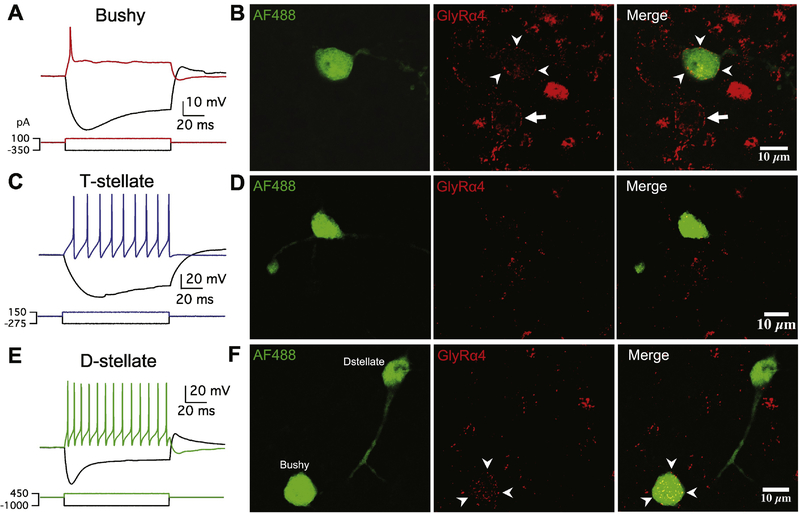
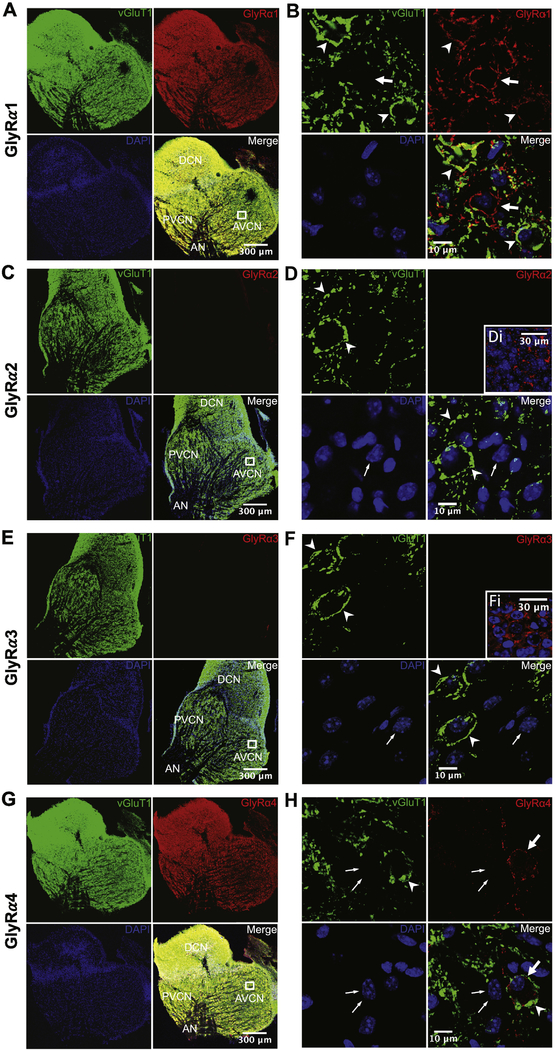
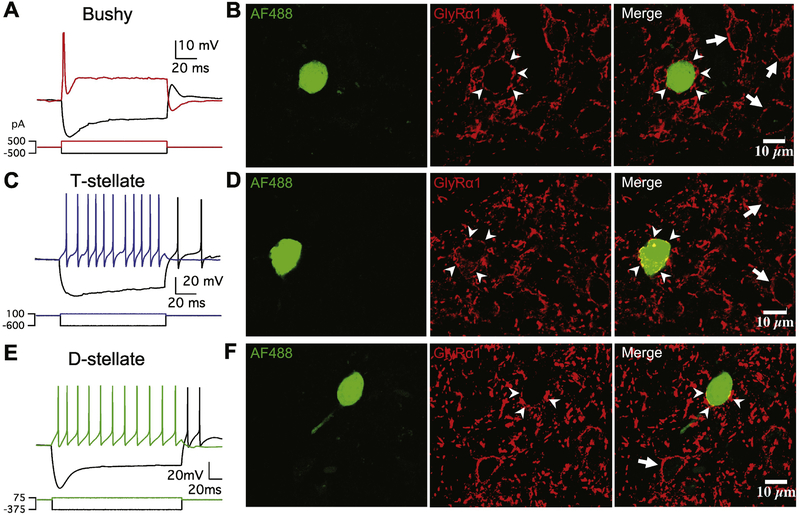
Signal processing in the principal neurons of the anteroventral cochlear nucleus (AVCN) is modulated by glycinergic inhibition. The kinetics of IPSCs are specific to the target neurons. It remains unclear what glycine receptor subunits are involved in generating such target-specific IPSC kinetics in AVCN principal neurons. We investigated the expression patterns of glycine receptor α (GlyRα) subunits in AVCN using immunohistochemical labeling of four isoforms of GlyRα subunits (GlyRα-α), and found that AVCN neurons express GlyRα and GlyRα, but not GlyRα and GlyRα subunits. To further identify the cell type-specific expression patterns of GlyRα subunits, we combined whole-cell patch clamp recording with immunohistochemistry by recording from all three types of AVCN principal neurons, characterizing the synaptic properties of their glycinergic inhibition, dye-filling the neurons, and processing the slice for immunostaining of different GlyRα subunits. We found that AVCN bushy neurons express both GlyRα and GlyRα subunits that underlie their slow IPSC kinetics, whereas both T-stellate and D-stellate neurons express only GlyRα subunit that underlies their fast IPSC kinetics. In conclusion, AVCN principal neurons express cell-type specific GlyRα subunits that underlie their distinct IPSC kinetics, which enables glycinergic inhibition from the same source to exert target cell-specific modulation of activity to support the unique physiological function of these neurons.
前腹侧耳蜗核(AVCN)的主要神经元中的信号处理受甘氨酸能抑制的调节。 IPSC 的动力学是针对目标神经元的特异性的。目前尚不清楚哪种甘氨酸受体亚基参与了 AVCN 主要神经元中产生这种靶特异性 IPSC 动力学的过程。我们使用四种 GlyRα 亚基(GlyRα-α)的免疫组织化学标记来研究 AVCN 中的 GlyRα 亚基表达模式,发现 AVCN 神经元表达 GlyRα 和 GlyRα,但不表达 GlyRα 和 GlyRα 亚基。为了进一步确定 GlyRα 亚基的细胞类型特异性表达模式,我们通过记录所有三种类型的 AVCN 主要神经元,将全细胞膜片钳记录与免疫组织化学相结合,对其甘氨酸能抑制的突触特性进行了表征,对神经元进行了染色,并对切片进行了不同 GlyRα 亚基的免疫染色处理。我们发现,AVCN 毛细胞神经元表达 GlyRα 和 GlyRα 亚基,这构成了它们慢 IPSC 动力学的基础,而 T 形和 D 形神经元仅表达 GlyRα 亚基,这构成了它们快 IPSC 动力学的基础。总之,AVCN 主要神经元表达细胞类型特异性 GlyRα 亚基,这些亚基构成了它们独特的 IPSC 动力学基础,使来自同一来源的甘氨酸能抑制作用能够对靶细胞进行特异性调节,从而支持这些神经元的独特生理功能。