CREA Research Centre for Plant Protection and Certification, Florence, Italy.
Department of Experimental and Clinical Medicine, Careggi University Hospital, Florence, Italy.
PLoS One. 2019 Jul 22;14(7):e0220055. doi: 10.1371/journal.pone.0220055. eCollection 2019.
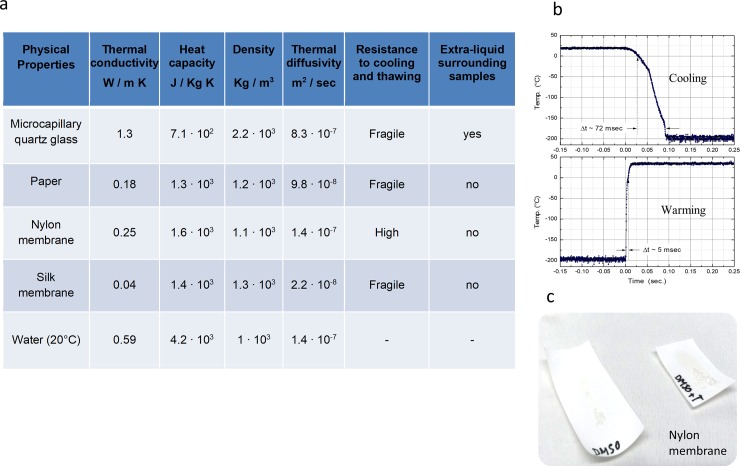
Cryopreservation is the most common method for long-term cell storage. Successful cryopreservation of cells depends on optimal freezing conditions, freezer storage and a proper thawing technique to minimize the cellular damage that can occur during the cryopreservation process. These factors are especially critical for sensitive stem cells with a consequential and significant impact on viability and functionality. Until now, slow-freezing has been the routine method of cryopreservation but, more recently rapid-cooling techniques have also been proposed. In this study, an ultra-rapid cooling technique [1] was performed for the first time on human mesenchymal stem cells and the effectiveness evaluated in comparison with the conventional slow-freezing procedure. A thin nylon-membrane carrier was used combined with different cryoprotective agents: dimethyl sulfoxide, ethylene glycol and/or trehalose. Various aspects of the low cryoprotective doses and the ultra-rapid cooling procedure of the human mesenchymal stem cells were examined including: the physical properties of the nylon-support, cells encumbrance, viability, proliferation and differentiation. The expression of cell surface markers and apoptosis were also investigated. The study used an ultra-rapid cooling/warming method and showed an overall cell integrity preservation (83-99%), with no significant differences between dimethyl sulfoxide or ethylene glycol treatment (83-87%) and a substantial cell viability of 68% and 51%, respectively. We confirmed a discrepancy also observed by other authors in cell viability and integrity, which implies that caution is necessary when assessing and reporting cell viability data.
冷冻保存是长期细胞储存的最常用方法。细胞的成功冷冻保存取决于最佳的冷冻条件、冷冻器储存和适当的解冻技术,以最大程度地减少冷冻保存过程中可能发生的细胞损伤。这些因素对于具有重要影响的敏感干细胞尤为关键,对其活力和功能有重大影响。到目前为止,慢速冻一直是冷冻保存的常规方法,但最近也提出了快速冷却技术。在这项研究中,首次对人骨髓间充质干细胞进行了超快速冷却技术[1],并与常规慢速冻程序进行了比较。使用了一种薄的尼龙膜载体,并结合了不同的细胞保护剂:二甲亚砜、乙二醇和/或海藻糖。研究了人骨髓间充质干细胞在低细胞保护剂剂量和超快速冷却过程中的各个方面,包括:尼龙载体的物理特性、细胞负担、活力、增殖和分化。还研究了细胞表面标志物和细胞凋亡的表达。该研究使用了超快速冷却/加热方法,整体保持了细胞完整性(83-99%),二甲亚砜或乙二醇处理之间没有显著差异(83-87%),细胞活力分别为 68%和 51%。我们证实了其他作者也观察到的细胞活力和完整性的差异,这意味着在评估和报告细胞活力数据时需要谨慎。