School of Chinese Medicine, The University of Hong Kong, 1/F, 10 Sassoon Road, Pokfulam, Hong Kong, S.A.R., China.
Joint Research Center for National and Local Miao Drug, Anshun, Guizhou Province, People's Republic of China.
Cell Commun Signal. 2019 Jul 22;17(1):81. doi: 10.1186/s12964-019-0396-5.
Inflammatory reaction in the dysfunction of retinal endotheliocytes has been considered to play a vital role in diabetic retinopathy (DR). Anti-inflammatory therapy so far gains poor outcome as DR treatment. This study aims to identify a novel therapeutic target of DR from the OMICs studies of a traditional anti-DR botanical products TNTL.
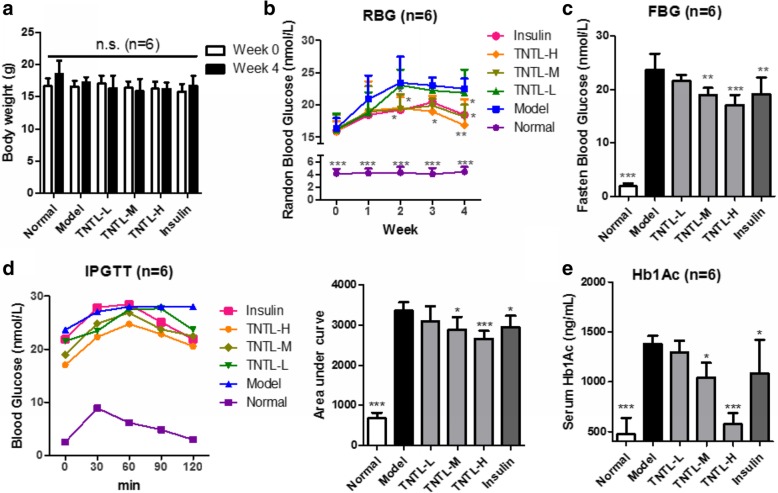
Hyperglycemic mice were treated with TNTL. The anti-hyperglycemic effect of TNTL was validated to confirm the biological consistency of the herbal products from batches. Improvement of DR by TNTL was examined by various assays on the retina. Next-generation transcriptome sequencing and cytokine array was used to identify the therapeutic targets. In vitro study was performed to validate the target.
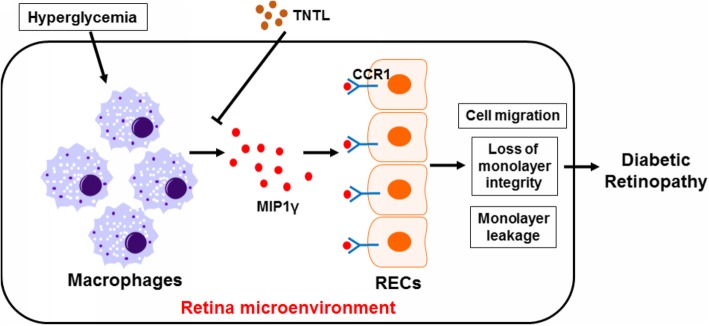
We observed that TNTL at its high doses possessed anti-hyperglycemic effect in murine type I diabetic model, while at its doses without reducing blood glucose, it suppressed DR incidence. TNTL restored the blood-retina barrier integrity, suppressed retinal neovascularization, and attenuated the retinal ganglion cell degeneration. Transcriptomic analysis on the retina tissue of hyperglycemic mice with or without TNTL revealed that the inflammatory retina microenvironment was significantly repressed. TNTL treatment suppressed pro-inflammatory macrophages in the retina, which resulted in the inactivation of endothelial cell migration, restoration of endothelial cell monolayer integrity, and prevention of leakage. Cytokine array analysis suggested that TNTL could significantly inhibit the secretion of MIP1γ from pro-inflammatory macrophages. Prevention of endothelial dysfunction by TNTL may be mediated by the inhibition of MIP1γ/CCR1 axis. More specifically, TNTL suppressed MIP1γ release from pro-inflammatory macrophages, which in turn inhibited the activation of CCR1-associated signaling pathways in endothelial cells.
Our findings demonstrated that TNTL might be an alternative treatment to DR, and the primary source of potential drug candidates against DR targeting MIP1γ/CCR1 axis in the retinal microenvironment.
在视网膜内皮细胞功能障碍的炎症反应被认为在糖尿病视网膜病变(DR)中起关键作用。到目前为止,抗炎治疗作为 DR 的治疗方法效果不佳。本研究旨在从传统抗 DR 植物产品 TNTL 的 OMICS 研究中确定 DR 的新治疗靶点。
用 TNTL 治疗高血糖小鼠。验证 TNTL 的抗高血糖作用,以确认草药产品批次间的生物学一致性。用视网膜上的各种检测方法来检测 TNTL 对 DR 的改善作用。采用下一代转录组测序和细胞因子阵列来鉴定治疗靶点。在体外研究中验证该靶点。
我们观察到 TNTL 在高剂量时具有 I 型糖尿病模型中降血糖作用,而在不降低血糖的剂量时,它可抑制 DR 的发生。TNTL 恢复了血视网膜屏障的完整性,抑制了视网膜新生血管形成,并减轻了视网膜神经节细胞变性。高血糖小鼠的视网膜组织进行转录组分析,结果显示高血糖诱导的炎症视网膜微环境得到了显著抑制。TNTL 治疗抑制了视网膜中的促炎巨噬细胞,导致内皮细胞迁移失活、内皮细胞单层完整性恢复和渗漏预防。细胞因子阵列分析表明,TNTL 可显著抑制促炎巨噬细胞中 MIP1γ 的分泌。TNTL 对内皮功能障碍的预防可能是通过抑制 MIP1γ/CCR1 轴来介导的。更具体地说,TNTL 抑制了促炎巨噬细胞中 MIP1γ 的释放,从而抑制了内皮细胞中 CCR1 相关信号通路的激活。
我们的研究结果表明,TNTL 可能是 DR 的一种替代治疗方法,其主要来源是针对视网膜微环境中 MIP1γ/CCR1 轴的潜在 DR 治疗候选药物。