Park Chan Sun, Kang Dong Yoon, Kang Min Gyu, Kim Sujeong, Ye Young Min, Kim Sae Hoon, Park Hye Kyung, Park Jung Won, Nam Young Hee, Yang Min Suk, Jee Young Koo, Jung Jae Woo, Kim Sang Hyon, Kim Cheol Woo, Kim Mi Yeong, Kim Joo Hee, Lee Jaechun, Lee Jun Gyu, Kim Sang Hyun, La Hyen O, Kim Min Hye, Park Seoung Ju, Koh Young Il, Lee Sang Min, Kwon Yong Eun, Jin Hyun Jung, Kim Hee Kyoo, Kang Hye Ryun, Choi Jeong Hee
Department of Internal Medicine, Inje University Haeundae Paik Hospital, Busan, Korea.
Drug Safety Monitoring Center, Seoul National University Hospital, Seoul, Korea.
Allergy Asthma Immunol Res. 2019 Sep;11(5):709-722. doi: 10.4168/aair.2019.11.5.709.
Severe cutaneous adverse reactions (SCARs), including Stevens-Johnson syndrome (SJS), toxic epidermal necrolysis (TEN), and drug reaction with eosinophilia and systemic symptoms (DRESS) to antiepileptic drug (AED), are rare, but result in significant morbidity and mortality. We investigated the major culprit drugs, clinical characteristics, and clinical course and outcomes of AED-induced SCARs using a nationwide registry in Korea.
A total of 161 patients with AED-induced SCARs from 28 referral hospitals were analyzed. The causative AEDs, clinical characteristics, organ involvements, details of treatment, and outcomes were evaluated. We compared the clinical and laboratory parameters between SJS/TEN and DRESS according to the leading causative drugs. We further determined risk factors for prolonged hospitalization in AED-induced SCARs.
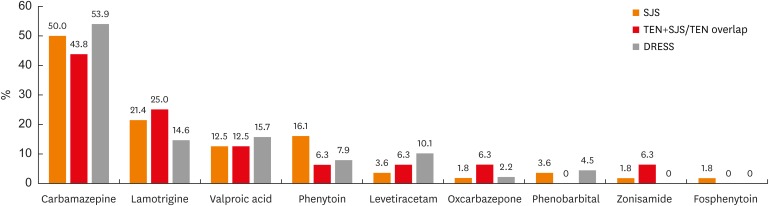
Carbamazepine and lamotrigine were the most common culprit drugs causing SCARs. Valproic acid and levetiracetam also emerged as the major causative agents. The disease duration and hospital stay in carbamazepine-induced SJS/TEN were shorter than those in other AEDs (< 0.05, respectively). In younger patients, lamotrigine caused higher incidences of DRESS than other drugs (= 0.045). Carbamazepine, the most common culprit drug for SCARs, was associated with a favorable outcome related with prolonged hospitalization in SJS (odds ratio, 0.12; 95% confidence interval, 0.02-0.63, = 0.12), and thrombocytopenia was found to be a risk factor for prolonged hospitalization in DRESS.
This was the first large-scale epidemiological study of AED-induced SCARs in Korea. Valproic acid and levetiracetam were the significant emerging AEDs causing SCARs in addition to the well-known offending AEDs such as carbamazepine and lamotrigine. Carbamazepine was associated with reduced hospitalization, but thrombocytopenia was a risk factor for prolonged hospitalization. Our results suggest that the clinical characteristics and clinical courses of AED-induced SCARs might vary according to the individual AEDs.
严重皮肤不良反应(SCARs),包括史蒂文斯-约翰逊综合征(SJS)、中毒性表皮坏死松解症(TEN)以及抗癫痫药物(AED)引起的伴有嗜酸性粒细胞增多和全身症状的药物反应(DRESS),虽较为罕见,但会导致显著的发病率和死亡率。我们利用韩国的一项全国性登记系统,对AED诱发的SCARs的主要致病药物、临床特征、临床病程及转归进行了调查。
对来自28家转诊医院的161例AED诱发SCARs的患者进行了分析。评估了致病的AEDs、临床特征、器官受累情况、治疗细节及转归。我们根据主要致病药物比较了SJS/TEN和DRESS之间的临床及实验室参数。我们进一步确定了AED诱发SCARs患者住院时间延长的危险因素。
卡马西平和拉莫三嗪是导致SCARs最常见的致病药物。丙戊酸和左乙拉西坦也成为主要致病因素。卡马西平诱发的SJS/TEN的病程和住院时间短于其他AEDs(分别<0.05)。在年轻患者中,拉莫三嗪引起的DRESS发生率高于其他药物(P = 0.045)。卡马西平是SCARs最常见的致病药物,在SJS中与住院时间延长相关的良好转归有关(比值比,0.12;95%置信区间,0.02 - 0.63,P = 0.12),并且血小板减少被发现是DRESS患者住院时间延长的一个危险因素。
这是韩国首次关于AED诱发SCARs的大规模流行病学研究。除了卡马西平和拉莫三嗪等知名的致病AEDs外,丙戊酸和左乙拉西坦也是导致SCARs的重要新兴AEDs。卡马西平与住院时间缩短相关,但血小板减少是住院时间延长的一个危险因素。我们的结果表明,AED诱发SCARs的临床特征和临床病程可能因具体的AEDs而异。