William J. von Liebig Center for Transplantation and Clinical Regeneration, Massyo Clinic, Rochester, MN 55905, United States.
Transplant Center, Mayo Clinic, Phoenix, AZ 85259, United States.
World J Gastroenterol. 2019 Jul 7;25(25):3123-3135. doi: 10.3748/wjg.v25.i25.3123.
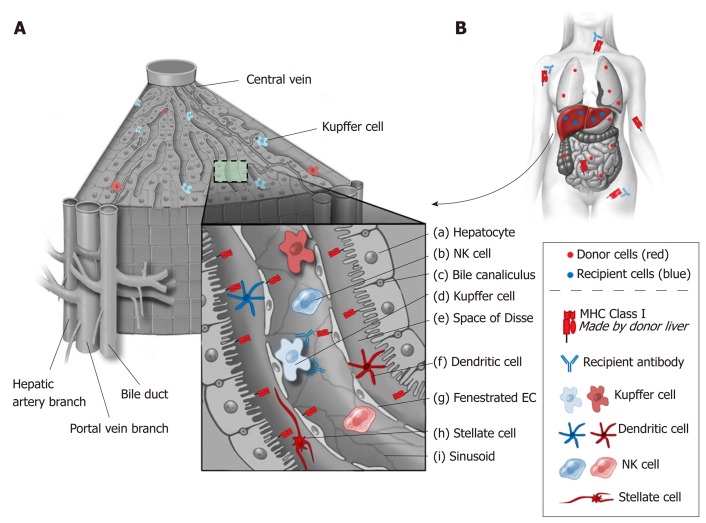
The transplanted liver can modulate the recipient immune system to induce tolerance after transplantation. This phenomenon was observed nearly five decades ago. Subsequently, the liver's role in multivisceral transplantation was recognized, as it has a protective role in preventing rejection of simultaneously transplanted solid organs such as kidney and heart. The liver has a unique architecture and is home to many cells involved in immunity and inflammation. After transplantation, these cells migrate from the liver into the recipient. Early studies identified chimerism as an important mechanism by which the liver modulates the human immune system. Recent studies on human T-cell subtypes, cytokine expression, and gene expression in the allograft have expanded our knowledge on the potential mechanisms underlying immunomodulation. In this article, we discuss the privileged state of liver transplantation compared to other solid organ transplantation, the liver allograft's role in multivisceral transplantation, various cells in the liver involved in immune responses, and the potential mechanisms underlying immunomodulation of host alloresponses.
移植肝脏可以调节受者的免疫系统,在移植后诱导耐受。这种现象在近五十年前就已经观察到了。随后,人们认识到肝脏在多器官移植中的作用,因为它在防止同时移植的肾脏和心脏等实体器官排斥方面具有保护作用。肝脏具有独特的结构,是许多参与免疫和炎症的细胞的家园。移植后,这些细胞从肝脏迁移到受者体内。早期研究发现嵌合现象是肝脏调节人体免疫系统的重要机制。最近对人类 T 细胞亚型、细胞因子表达和同种异体移植物中的基因表达的研究扩展了我们对免疫调节潜在机制的认识。在本文中,我们讨论了与其他实体器官移植相比,肝移植的优势状态、肝移植物在多器官移植中的作用、肝脏中参与免疫反应的各种细胞以及宿主同种异体反应免疫调节的潜在机制。