Ikenaka Kensuke, Suzuki Mari, Mochizuki Hideki, Nagai Yoshitaka
Department of Neurology, Graduate School of Medicine, Osaka University, Osaka, Japan.
Department of Neurotherapeutics, Graduate School of Medicine, Osaka University, Osaka, Japan.
Front Neurosci. 2019 Jul 3;13:693. doi: 10.3389/fnins.2019.00693. eCollection 2019.
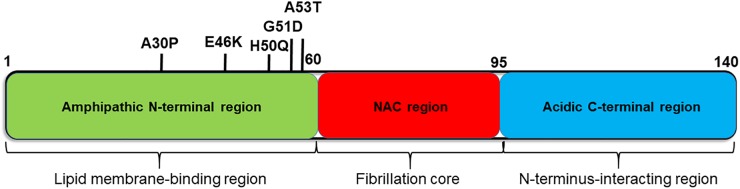
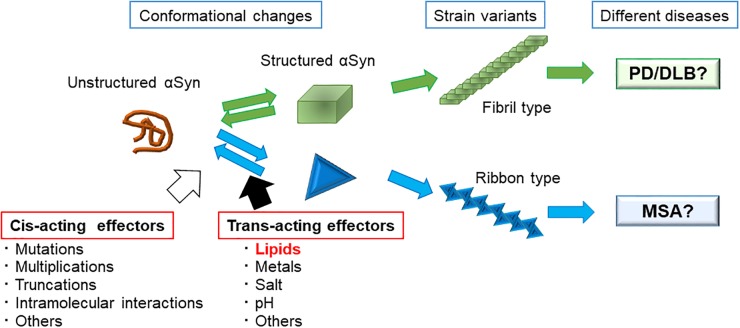
Aggregation of α-synuclein (αSyn) plays a central role in the pathogenesis of Parkinson's disease (PD) and dementia with Lewy bodies (DLB). Lewy bodies (LBs) and Lewy neurites, which consist mainly of aggregated αSyn, are widely observed in the affected regions of patient brains. Except for some familial forms of PD/DLB, most sporadic PD/DLB patients express the wild-type (WT) αSyn protein without any mutations, and the mechanisms as to how WT αSyn gains the propensity to pathologically aggregate still remains unclear. Furthermore, the mechanisms by which the same αSyn protein can cause different synucleinopathies with distinct phenotypes and pathologies, such as PD, DLB, and multiple system atrophy (MSA), still remain largely unknown. Recently, mutations in the gene (encoding glucocerebrosidase), which are responsible for the lysosomal storage disorder Gaucher disease (GD), have been reported to be the strongest risk factor for developing sporadic PD/DLB. We previously demonstrated that glucosylceramide accumulated by deficiency promotes the conversion of αSyn into a proteinase K-resistant conformation. Furthermore, decreased glucocerebrosidase activity has also been reported in the brains of patients with sporadic PD/DLB. Moreover, αSyn pathology has also been shown in the brains of lysosomal storage disorder patients, which show glycosphingolipid accumulation. These observations suggest the possibility that altered lipid metabolism and lipid accumulation play roles in αSyn aggregation and PD/DLB pathogenesis. Indeed, several previous studies have demonstrated that lipid interactions affect the conformation of αSyn and induces its oligomerization and aggregation. In this review, we will give an overview of the association between αSyn aggregation and lipid interactions from the viewpoints of the etiology, pathology, and genetics of PD/DLB. We also discuss the distinct species of αSyn aggregates and their association with specific types of synucleinopathies, and introduce our hypothesis that lipid interactions play a role as -acting effectors in producing distinct strains of αSyn fibrils.
α-突触核蛋白(αSyn)的聚集在帕金森病(PD)和路易体痴呆(DLB)的发病机制中起着核心作用。路易体(LBs)和路易神经突主要由聚集的αSyn组成,在患者大脑的受累区域广泛可见。除了一些家族性形式的PD/DLB外,大多数散发性PD/DLB患者表达野生型(WT)αSyn蛋白且无任何突变,而WT αSyn如何获得病理聚集倾向的机制仍不清楚。此外,相同的αSyn蛋白如何导致具有不同表型和病理的不同突触核蛋白病,如PD、DLB和多系统萎缩(MSA),在很大程度上仍不清楚。最近,据报道,负责溶酶体贮积症戈谢病(GD)的基因(编码葡糖脑苷脂酶)突变是散发性PD/DLB发病的最强风险因素。我们之前证明,因该酶缺乏而积累的葡糖神经酰胺会促进αSyn转化为蛋白酶K抗性构象。此外,散发性PD/DLB患者大脑中也有葡糖脑苷脂酶活性降低的报道。而且,溶酶体贮积症患者大脑中也出现了αSyn病理学改变,这些患者表现出糖鞘脂积累。这些观察结果提示脂质代谢改变和脂质积累可能在αSyn聚集及PD/DLB发病机制中起作用。事实上,先前的几项研究已证明脂质相互作用会影响αSyn的构象并诱导其寡聚化和聚集。在本综述中,我们将从PD/DLB的病因、病理和遗传学角度概述αSyn聚集与脂质相互作用之间的关联。我们还将讨论αSyn聚集体的不同种类及其与特定类型突触核蛋白病的关联,并介绍我们的假说,即脂质相互作用在产生不同菌株的αSyn原纤维中起辅因子作用。