Varricchi Gilda, Pecoraro Antonio, Loffredo Stefania, Poto Remo, Rivellese Felice, Genovese Arturo, Marone Gianni, Spadaro Giuseppe
Department of Translational Medical Sciences, University of Naples Federico II, Naples, Italy.
Center for Basic and Clinical Immunology Research (CISI), University of Naples Federico II, Naples, Italy.
Front Cell Neurosci. 2019 Jul 3;13:299. doi: 10.3389/fncel.2019.00299. eCollection 2019.
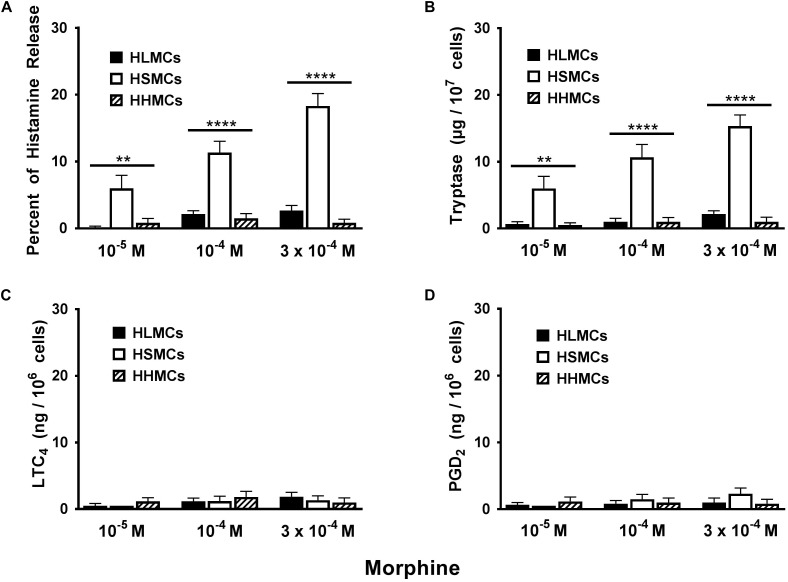
Mast cells and their mediators play a role in the control of homeostasis and in the pathogenesis of several disorders. The concept of rodent mast cell heterogeneity, initially established in the mid-1960s has been extended in humans. Human mast cells isolated and purified from different anatomic sites can be activated aggregation of cell surface high affinity IgE receptors (FcεRI) by antigens, superantigens, anti-IgE, and anti-FcεRI. MAS-related G protein-coupled receptor-X2 (MRGPRX2) is expressed at high level in human skin mast cells (MCs) (HSMCs), synovial MCs (HSyMCs), but not in lung MCs (HLMCs). MRGPX2 can be activated by neuropeptide substance P, several opioids, cationic drugs, and 48/80. Substance P (5 × 10 M - 5 × 10 M) induced histamine and tryptase release from HSMCs and to a lesser extent from HSyMCs, but not from HLMCs and human cardiac MCs (HHMCs). Morphine (10 M - 3 × 10 M) selectively induced histamine and tryptase release from HSMCs, but not from HLMCs and HHMCs. SP and morphine were incomplete secretagogues because they did not induce the synthesis of arachidonic acid metabolites from human mast cells. In the same experiments anti-IgE (3 μg/ml) induced the release of histamine and tryptase and the synthesis of prostaglandin D (PGD) from HLMCs, HHMCs, HSyMCs, and HSMCs. By contrast, anti-IgE induced the production of leukotriene C (LTC) from HLMCs, HHMCs, HSyMCs, but not from HSMCs. These results are compatible with the heterogeneous expression and function of MRGPRX2 receptor on primary human mast cells isolated from different anatomic sites.
肥大细胞及其介质在维持体内稳态以及多种疾病的发病机制中发挥作用。啮齿动物肥大细胞异质性的概念最初于20世纪60年代中期确立,现已扩展至人类。从不同解剖部位分离和纯化的人类肥大细胞可被抗原、超抗原、抗IgE和抗FcεRI激活,导致细胞表面高亲和力IgE受体(FcεRI)聚集。MAS相关G蛋白偶联受体X2(MRGPRX2)在人皮肤肥大细胞(HSMC)、滑膜肥大细胞(HSyMC)中高表达,但在肺肥大细胞(HLMC)中不表达。MRGPX2可被神经肽P物质、多种阿片类药物、阳离子药物和48/80激活。P物质(5×10⁻⁶M - 5×10⁻⁵M)可诱导HSMC释放组胺和类胰蛋白酶,在较小程度上可诱导HSyMC释放,但不能诱导HLMC和人心脏肥大细胞(HHMC)释放。吗啡(10⁻⁶M - 3×10⁻⁵M)选择性地诱导HSMC释放组胺和类胰蛋白酶,但不能诱导HLMC和HHMC释放。P物质和吗啡是不完全促分泌剂,因为它们不能诱导人肥大细胞合成花生四烯酸代谢产物。在相同实验中,抗IgE(3μg/ml)可诱导HLMC、HHMC、HSyMC和HSMC释放组胺和类胰蛋白酶,并合成前列腺素D(PGD)。相比之下,抗IgE可诱导HLMC、HHMC、HSyMC产生白三烯C(LTC),但不能诱导HSMC产生。这些结果与从不同解剖部位分离的原代人肥大细胞上MRGPRX2受体的异质性表达和功能相符。